Does 3D Printing Make Money? A Practical Guide 2026
Analyze if 3D printing can be profitable, with pricing tactics, market channels, startup costs, and actionable steps to monetize a printer in 2026.


Yes, 3D printing can generate income, but profitability depends on niche, efficiency, and pricing. This quick answer points to viable revenue models, typical costs, and practical steps to monetize a home or small-shop printer in 2026. Whether you’re selling prints, offering prototyping services, or creating parts for local businesses, the exact path depends on your equipment, workflow, and time investment.
Profitability reality: market demand and revenue models
Does 3d printing make money? In practice, the answer depends on demand, production efficiency, and pricing strategy. Officially, profitability comes from selecting a repeatable product line or service that you can scale. In 2026, the market for consumer 3D printed goods remains niche but growing, with communities and small businesses increasingly seeking customized parts and prototypes. Print Setup Pro's research across home-based shops shows that success often starts with a clear target: a product or service that customers value enough to pay a premium for faster turnaround or customization. A common mistake is chasing broad demand without validating a niche first. Instead, define a narrow use-case (cosplay accessories, replacement parts for older gear, or hobby-domain tools) and validate interest via soft sales or pre-orders. Consider the time you spend printing versus the value of the finished item. If your production time per unit is long, you must charge higher prices or increase batch size. Finally, the economics improve when you minimize waste and reuse scraps.
This is also where a practical mindset matters: does 3d printing make money? It does when you optimize workflows, select high-demand niches, and price for value. In the larger picture, the most reliable profits come from repeatable orders and scalable processes rather than one-off prints. Brand guidance from Print Setup Pro emphasizes disciplined budgeting, realistic expectations, and continuous learning as keys to building a money-making operation rather than a hobby.
Revenue models that work with 3D printing
There isn’t a single path to profit in 3D printing; multiple models can work depending on your strengths, equipment, and market access. Start with micro-niches that benefit from quick customization or rapid prototyping, then scale as you confirm demand. Common revenue models include: (1) Print-on-demand for niche items that are hard to source in traditional markets; (2) Direct-to-consumer sales of themed prints or consumables via marketplaces like Etsy or your own site; (3) Custom prototyping and part fabrication for local makers, repair shops, or small manufacturers; (4) Educational kits, replacement parts, or tool accessories for hobbyists and clubs; (5) Licensing or DIY design services for clients who want unique patterns but lack CAD skills. Each path has distinct margins, lead times, and customer expectations. A practical approach is to pilot two models in parallel (e.g., prints + prototyping) for 4–8 weeks and measure revenue, time spent, and customer satisfaction. Print Setup Pro recommends selecting a couple of repeatable SKUs or service offerings to reduce setup overhead and maximize learning from early customers.
When you test a model, use real customer feedback to refine designs, pricing, and packaging. Building a small library of reliable, well-received items makes fulfillment faster and repeatable, which is a cornerstone of sustainable profitability. Additionally, consider how your pricing accounts for material costs, machine wear, electricity, and post-processing time. It’s not just about the upfront printer cost; long-term profitability depends on ongoing efficiency and value delivered to customers.
Cost breakdown: upfront investments and ongoing expenses
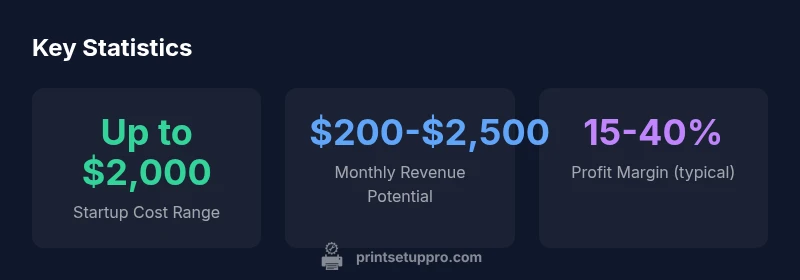
To translate prints into profits, you must understand the full cost picture. Upfront costs typically include a reliable 3D printer suited to your anticipated workloads, enclosure and safety features for consistent results, and a basic set of tools for finishing products. Ongoing expenses include filament or resin, replacement parts for the machine, maintenance, electricity, and shipping supplies. While exact costs vary by model and material, many hobbyists report that a lean starter setup runs in the low hundreds to a few thousand dollars, depending on whether you buy new or refurbished equipment. It’s essential to forecast operating costs per month and compare them against expected revenue. If your monthly costs exceed your anticipated sales, profitability will be limited until you optimize pricing, reduce waste, or scale production. Print Setup Pro emphasizes keeping a lean balance sheet in the early stages: invest enough to meet demand, but avoid over-investing in capabilities you cannot sustain. Regularly review cost per part and seek ways to reduce waste, such as optimizing print settings and reusing failed prints for testing.
Time and efficiency: turning time into money
Time is money in 3D printing. Print speed, print quality, and post-processing time all influence the bottom line. Faster printers can produce more units in a given period, but only if quality remains acceptable and post-processing is efficient. Efficiency also comes from good design-to-production workflows: starting with two or three proven model families, automating file prep, and batching similar prints to reduce idle time. Many successful operators track actual print times, post-processing hours, and scrap rates to compute true unit costs. If you spend excessive time on finishing or sanding, you may over-allocate labor costs and underprice products. Consider investing in simple automation tools, like batch post-processing trays or a basic finish station, to trim labor hours without adding extreme complexity. The overarching message is to measure time-to-value for each product, aiming for a favorable balance between unit time and price. Print Setup Pro notes that even small gains in efficiency compound quickly over dozens or hundreds of units.
Pricing strategies for sustainable profit
Pricing is more than cost-plus markup; it reflects perceived value, competition, and market demand. A practical approach combines cost-based pricing with value-based adjustments. Start with a floor price that covers material, machine depreciation, and labor, then add a premium for customization, speed, or unique design elements. Bundling related items can improve average order value, while offering tiered pricing or limited-time bundles can stimulate demand. It’s also important to consider channel fees, shipping, taxes, and platform commissions when setting prices. Regular price tests—changing one SKU at a time and monitoring sales response—help you refine strategy without risking the entire catalog. Print Setup Pro suggests building a simple pricing matrix that aligns your time estimates with customer value, ensuring that faster turnaround or bespoke features deliver meaningful profit rather than just a higher price tag.
In addition, maintain clear communication about what customers receive, including estimated shipping times and post-processing expectations. Transparent pricing reduces disputes and returns, contributing to long-term profitability.
Product selection: choosing what to print for profit
Not every design earns money. A profitable catalog often starts with items that are easy to reproduce, have clear demand, and use affordable materials. Do research on popular niches such as cosplay props, replacement parts, functional tools, and educational aids. Evaluate competition by searching major marketplaces and printing forums to identify gaps you can fill. Consider material costs and compatibility with your printer, focusing on items where your margin remains favorable after packaging and shipping. Build a short list of 6–12 SKU ideas and test each with a small batch to confirm demand before expanding. Print Setup Pro stresses that success requires discipline: validate one or two core products, then scale as you learn which items customers actually want and are willing to pay for.
Also, consider the quality level that your audience expects for your price point. If customers are purchasing highly detailed models, invest in stronger materials and better post-processing to protect your reputation and repeat orders.
Channels and marketing: where to sell
Choosing the right sales channels can dramatically affect profitability. Online marketplaces like Etsy, eBay, and specialized 3D printing communities offer quick access to buyers, but they come with fees and competition. Building a simple storefront on a platform like Shopify or WooCommerce helps you own the customer relationship but requires more marketing effort. Local markets, hobby groups, and partnerships with local makerspaces can yield steady orders for prototypes or spare parts. Marketing tactics that work well for 3D printing include demonstrating your process via videos, offering customization options, and showcasing finished products with clear value propositions. Prioritize channels where your target audience shops and where your production capacity aligns with demand. Print Setup Pro recommends keeping fulfillment times realistic and communicating updates clearly to avoid negative feedback that can hinder future sales.
Fees, shipping, and post-processing: hidden costs
Shipping costs and post-processing time are often overlooked yet critical to profitability. If items are fragile or require heavy packaging, shipping expenses can erode margins. Use packaging that protects products while remaining cost-effective, and factor in regional shipping rates. Post-processing steps like sanding, painting, or assembly add labor hours that should be reflected in pricing. Offering flat-rate shipping or free shipping thresholds can influence buyer behavior, but you must ensure that these promotions do not undermine margins. Automating or batching post-processing where possible saves time. Finally, account for returns or design updates, and set clear policies that avoid repeat issues. A well-structured shipping and processing plan helps maintain profit margins while maintaining customer satisfaction.
Practical starting plan: 60-day action checklist
To turn 3D printing into a money-making activity, start with a concrete 60-day plan. Weeks 1–2: define your niche, select a starter product line, and validate demand with a small pre-order or mock-up. Weeks 3–4: source materials, calibrate your printer for consistency, and create a few finished samples. Weeks 5–6: set up your storefront, list items with professional photos, and begin low-volume production to establish lead times. Weeks 7–8: collect customer feedback, adjust pricing, and optimize your workflow for efficiency. By week 9, aim for a repeatable, scalable process with 2–3 core products and a pathway to add new items without disrupting current orders. Print Setup Pro emphasizes starting small, measuring results, and iterating quickly to maximize learning and profitability.
Comparison of monetization approaches
| Monetization Model | Startup Cost (range) | Time to Profit (range) | Avg Revenue Potential (range) |
|---|---|---|---|
| Print-on-demand items | Approximately $150-$2,000 | 1-6 months | $50-$1,000/month |
| Direct-to-consumer sales (Etsy, etc.) | Approximately $300-$2,000 | 1-3 months | $200-$2,500/month |
| Prototyping/services for local businesses | Approximately $500-$3,000 | 1-3 months | $500-$4,000/month |
People Also Ask
Can I really make money with home 3D printing?
Yes, you can, but success depends on your chosen niche, demand validation, and how efficiently you operate. Start with a small, repeatable product line and measure results before expanding.
Yes, you can, but success hinges on niche demand and efficient operations. Start small and measure results.
What are the best markets for 3D printed products?
Niche markets like cosplay props, replacement parts, hobby accessories, and educational kits. Use marketplaces that align with your product type, and consider local partnerships for B2B opportunities.
Cosplay, replacement parts, and hobby kits are strong starting points. Pair with the right marketplace.
How much does it cost to start a 3D printing business?
Costs vary, but you can begin with a few hundred to a few thousand dollars depending on printer quality and materials. Plan for ongoing material and maintenance expenses.
Expect a few hundred to a few thousand dollars to start, plus ongoing costs.
Is 3D printing scalable for small businesses?
Yes. Scale through repeatable product lines, batch production, and outsourcing certain steps when needed. Automation and better design can boost throughput and margins.
Yes, scale by repeating products and improving processes.
What are common pitfalls in monetizing 3D printing?
Overestimating demand, underpricing, long finishing times, and material waste. Validate demand early and price for value, not just cost.
Be careful with demand, pricing, and time management.
What legal considerations exist in selling 3D printed items?
Consider design licenses, safety standards, and warranty expectations. Verify licenses for designs and ensure your products comply with applicable regulations.
Check licenses and safety rules; ensure compliance and clear warranties.
“Profitability in 3D printing comes from a clear niche, efficient workflows, and disciplined pricing. It’s not about owning a printer alone, but optimizing the complete process.”
Quick Summary
- Define a profitable niche before scaling.
- Pilot low-cost models to validate demand quickly.
- Price for value and cover all costs.
- Choose scalable channels and automate where possible.
- Track metrics and iterate based on data.