How Much Is 3D Printer Filament? A Practical Pricing Guide
Discover the true cost of 3D printer filament, including material-based price ranges, factors that drive prices, and strategies to save on filament for home projects and small teams.


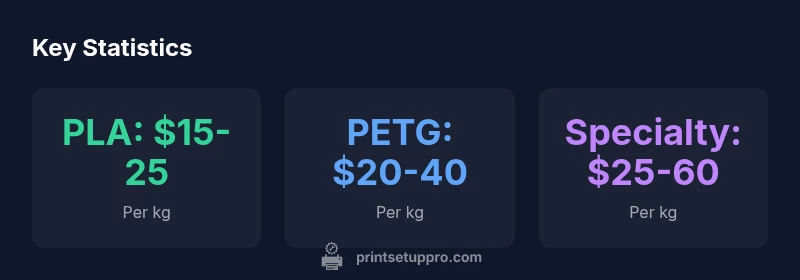
The price of 3D printer filament varies by material and quality. For everyday PLA filament, expect roughly US$15-25 per kilogram, PETG around US$20-40, and specialty filaments (such as flexible or high-temperature blends) typically US$25-60 per kilogram. Shipping and packaging can add to per kilogram costs. Prices can drop further with bulk purchases or promotional offers.
How much is 3d printer filament: A price snapshot
The ongoing question for most home makers and small teams is embedded in the headline: how much is 3d printer filament. Price is not a single number; it’s a spectrum shaped by material choice, brand, and manufacturing process. At the core, you’re paying for polymer quality, consistency, and the selection of additives that improve print reliability. As a result, you’ll see PLA at lower price points and specialty blends at premium rates. When planning a project, start with a material that meets your mechanical needs and budget, then layer in considerations like color consistency, lot-to-lot variability, and the availability of bulk packs. For many buyers, the right balance comes from testing a few reputable brands and tracking performance over several prints. From a budgeting perspective, knowing your typical price bands helps forecast monthly filament costs and allocate funds for future projects.
The exact price you pay will depend on where you buy, whether you buy in bulk, and how reliably the supplier ships. In practice, the best approach is to run a small test batch with a few brands to gather empirical data on print quality and yield per kilogram. Print quality and reliability often justify higher per-kilogram prices in the long run, especially if wasted prints are minimized and post-processing is reduced.
Typical price ranges by material
Understanding price ranges starts with material type, but denominators like diameter (1.75 mm vs 2.85 mm), purity, and color options can shift costs. PLA remains the most accessible filament for beginners because it prints well at low temperatures and often delivers the best price-to-performance ratio. PETG, ABS, and nylon tend to occupy mid-to-high price brackets due to improved strength, heat resistance, and more demanding printing conditions. Flexible and specialty filaments (like carbon-fiber–reinforced or glow-in-the-dark blends) sit at the high end of the scale due to manufacturing complexity and material costs. When reading price listings, compare price per kilogram, not just per spool, and factor in the cost of shipping. Suppliers frequently offer 3–5% discounts for bulk purchases or member programs, which can tilt the economics in favor of bulk buying over single-spool purchases.
Across materials, the market has seen gradual price stabilization for standard filaments, while demand for premium materials has driven upward pressure on average per-kilogram costs. Your own print volume and unit costs will hinge on how often you print, the sizes of your parts, and how efficiently you calibrate your printer. The most economical path often combines a reliable standard material like PLA with occasional investments in stronger materials for functional prints. Print settings, post-processing, and printer maintenance also influence the effective cost per usable part, not just the sticker price on the filament.
Factors that influence price beyond material
Price is driven by more than polymer type. Brand reputation matters; some brands command premium for consistent diameter, lower resin content, and stricter lot testing. Filaments with tighter diameter tolerances (like ±0.02 mm) reduce print failures and improve extrusion stability, which translates to better yield per kilogram and fewer failed prints—an outcome that can justify higher upfront costs. Additives such as colorants, UV stabilizers, or carbon fibers can further push prices upward. Packaging and labeling (e.g., vacuum-sealed, desiccant packs) affect perceived value and storage longevity, which some buyers factor into the overall cost. Finally, geographic factors such as shipping speed, import duties, and local tax policies can alter local price levels, especially for smaller retailers who rely on international sourcing. In practice, a small premium for a source with reliable consistent results often pays for itself through reduced waste and higher print success rates.
Price differences by spool size and packaging
Spool size is a primary lever in filament pricing. A 1 kg reel is the most common, but some brands offer 0.75 kg, 0.5 kg, or multi-spool bundles that reduce shipping costs per kilogram. Larger spools frequently deliver lower per-kilogram prices due to reduced packaging and handling costs, but they require longer print runs and larger storage space. For hobbyists with limited space, a 0.5 kg pack or 1 kg reel offers a practical balance. When you buy in bulk, it’s common to secure a discount that materially lowers the per-kilogram price, even if the upfront ticket price increases. On the flip side, some retailers impose higher per-kilogram prices on small orders to offset the cost of packaging and logistics. Always compute the effective price per usable meter of filament, not just the sticker price per kilogram, to make apples-to-apples comparisons across spool sizes.
Where to buy and how to compare prices effectively
Smart shopping starts with a methodical price comparison. Build a shortlist of reputable brands and compare price-per-kilogram across sellers, while also accounting for spool size and shipping. Look for retailers offering transparent diameter tolerances, consistent color quality, and periodical promotions. Discounts for bundles, seasonal sales, and loyalty programs can significantly alter the long-run cost. When evaluating options, also consider return policies, customer support responsiveness, and the retailer’s reliability in delivering consistent product quality. If you frequently print, consider setting up a price-watch alert for your preferred materials. A small time investment in price comparison can yield meaningful savings over time and reduce print waste due to inconsistent filament feeding or diameter fluctuations.
Smart buying strategies to save on filament
To reduce filament costs without sacrificing quality, start by testing a few well-reviewed brands on small prints and track their performance across several batches. Take advantage of bulk purchases during sales and join loyalty programs offering free shipping or bulk discounts. Calibrate your printer to the optimal extrusion temperature and speed for your chosen material to minimize failed prints and material waste. Store filaments properly (cool, dry, and tightly sealed) to preserve quality and prevent moisture uptake that degrades performance. Maintain a simple inventory system to avoid purchasing duplicates and monitor spool life to prevent material waste from underutilized reels. Finally, consider re-spooling or recycling options for partially used spools if available in your region.
Material-specific considerations for hobbyists
Beginners typically start with PLA due to ease of use and generally low cost, then expand to PETG or ABS as their needs grow. For hobbyists focusing on functional parts, PETG offers a balance of strength and ease of printing, often at a moderate premium. If you’re exploring mechanical or load-bearing projects, nylon or polycarbonate blends provide high strength and heat resistance but require advanced printers and higher costs. Color and specialty finishes, such as glow-in-the-dark or metal-filled filaments, add visual appeal but incur additional costs and potential print quality trade-offs. When evaluating materials, consider your print environment, the printer’s capabilities, and your tolerance for trial-and-error experimentation. A structured approach—start with a standard material, validate its performance on typical parts, then layer in more specialized filaments as needed.
Price expectations for professionals vs hobbyists
For hobbyists, cost per part is often the dominant consideration, so PLA or PETG with reliable performance is a common starting point. Professionals and educators may prioritize repeatability, mechanical properties, and long-term material stability, justifying higher-priced brands or specialty filaments that minimize print failures and post-processing. In educational or small-business contexts, bulk buying can yield meaningful savings and stabilize budgeting. Regardless of the user group, maintaining a predictable filament supply chain and a baseline of tested materials helps reduce downtime and ensures consistent results. Print setups that optimize heat management, nozzle sizes, and layer heights can further reduce material waste, improving the overall cost per part. The key is balancing upfront cost with long-term print reliability and project outcomes.
Price ranges by common filament materials
| Material | Typical price range per kg | Common spool size | Notes |
|---|---|---|---|
| PLA | US$15-25 | 1 kg | Affordable, easy printing, wide color range |
| PETG | US$20-40 | 1 kg | Good strength, transparent options exist |
| ABS | US$15-35 | 1 kg | Requires heated bed, fumes, good for durability |
| Specialty (flexible, carbon-fiber) | US$25-60 | 1 kg | Higher cost, varied print quality |
People Also Ask
What determines the price of 3D printer filament?
Material type, brand, diameter tolerance, and packaging all influence price. Higher tolerance and reputable brands tend to cost more but offer steadier quality.
Price is driven by material, brand reputation, and packaging quality. Higher tolerance and reliability often justify the cost.
Is PLA the cheapest filament material?
PLA is typically among the least expensive common filaments, though price varies by brand and whether you buy in bulk.
Yes, PLA is usually the cheapest option, especially in bulk.
Do premium or specialty filaments offer better value?
Premium filaments provide specific properties (flexibility, heat resistance, color stability). They cost more per kilogram, so value depends on your use case.
Premium filaments cost more, but they can save time or improve results for certain projects.
How do I compare filament prices across sellers?
Look at price per kilogram, shipping, taxes, and spool size. Also factor in print yield and potential waste from diameter variation.
Compare price per kg, shipping, and spool size to gauge true cost.
Are there ways to reduce filament costs without sacrificing quality?
Shop smart, test brands, use bundles during sales, calibrate printers, and store filaments properly to maintain quality and reduce waste.
Shop smart, calibrate, and store filaments well to save money without losing quality.
“Filament price is influenced by polymer type, quality, and supplier practices; smarter buying and material testing can reduce overall costs.”
Quick Summary
- Identify material first to estimate cost
- Compare price per kilogram, not just per spool
- Bulk buys reduce per-kilogram costs
- Premium filaments cost more but unlock specific properties
- Factor shipping and storage when budgeting