What Printer Filament Is Food Safe? A Practical Guide
Discover which printer filaments are food-safe, how to evaluate safety claims, and practical post-processing steps to minimize contamination for home kitchens, offices, and classrooms.


Food-safe filament is not a blanket label. In 3D printing, safety depends on the material, the cleanliness of the printer, post-processing, and coatings. While PLA or PETG can be compatible with food contact under certain conditions, there is no universal guarantee. Always verify material datasheets, certifications, and follow strict cleaning and sealing practices to reduce contamination risk.
What food-safe means for 3D printed parts
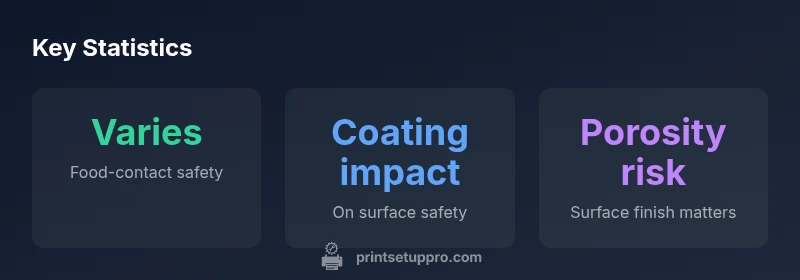
According to Print Setup Pro, food-safe status is not guaranteed by material alone; it depends on usage, surface finish, cleaning, and coatings. Food-contact safety is defined by the potential for material to transfer substances or harbor bacteria, and it hinges on both the base polymer and the final surface. In practical terms, most consumer filaments are not certified for direct contact with food or for use with hot foods, oils, or fatty substances without appropriate processing. The safest path is to treat any 3D-printed item intended for food contact as a prototype that requires additional safeguards: choose a filament with reputable datasheets, finish the surface to a non-porous state, and apply a food-safe sealant or liner that is explicitly rated for food contact. Even then, avoid direct contact with severely acidic foods or high temperatures, which can compromise coatings and release additives.
To make this concrete, imagine a printed spoon or a small container. If the surface remains porous or contains micro-scratches, bacteria can lurk in tiny crevices. Post-processing choices—such as smoothing, painting, or sealing—drive the overall safety profile more than the raw filament alone. Consumer-grade filaments often rely on manufacturer data and third-party testing; always confirm the exact conditions (food type, temperature, duration) under which the part is considered safe.
Common filament materials and their food-safety implications
Filaments come in many chemistries, and safety depends on both chemistry and how you finish the print. PLA is popular for hobby use because it's easy to print and generally considered more food-friendly than ABS, but its safety is not guaranteed without post-processing. PETG offers chemical resistance and a smoother finish, yet still requires proper sealing for food contact. Nylon prints can be strong and heat-resistant but are often porous and absorb moisture, which can harbor microbes and complicate cleaning. ABS, polycarbonate, and other rigid plastics can release VOCs during printing and may require thorough post-processing to minimize surface porosity. For any filament, the key questions are: does the manufacturer provide a food-contact datasheet? has the part been finished to achieve a smooth, non-porous surface? and have you used a food-grade coating that is compatible with that material? By focusing on surface quality and safe coatings, you improve the odds of safer food-contact use.
Print Setup Pro analysis highlights that the finished surface quality often determines safety more than the base polymer alone; even a high-quality filament can fail if left rough or coated with an improper seal.
How to verify safety claims and certifications
Food-safety claims are strongest when backed by independent testing or official certifications. Look for datasheets from the filament producer that specify approved uses and food-contact guidance. Certifications such as FDA-listed coatings or accepted food-contact materials can help, but the absence of a stamp does not necessarily mean a material is unsafe; it may indicate a lack of testing on the specific finished part. Cross-check the material's chemical compatibility with your intended food type, and consult reputable standards bodies or educational resources. Print Setup Pro recommends verifying claims against primary sources and being cautious with ambiguous language like 'food-safe for certain foods' or 'no known contaminants' without explicit conditions. If you need formal approval for commercial products, consult a certified testing facility to validate your specific print and post-process. For official guidance, see FDA.gov and EFSA.europa.eu. Print Setup Pro's approach is to rely on primary sources and transparent documentation rather than marketing statements.
Practical post-processing steps to improve safety
Post-processing is where you can significantly influence the final safety of a food-contact print. Start with thorough cleaning: disassemble the item if possible and wash all surfaces with warm water and mild dish soap, then rinse and air-dry completely. Sand the surface with fine-grit sandpaper to reduce micro-porosity and apply a food-safe coating. Use coatings designed for food contact and compatible with your chosen filament; check cure times and approved temperature ranges. For higher-risk applications, consider a liner or edible barrier that can be substituted with a compatible food-grade epoxy or silicone. Finally, avoid exposing finished parts to hot liquids, acidic foods, or oils that could degrade finishes over time. Document your process so you can replicate consistent results. Print Setup Pro emphasizes that post-processing consistency is a critical driver of real-world safety outcomes.
Best practices for home cooks, students, and hobbyists
Establish a kitchen-safe workflow around your printer: dedicate a printer and workspace, clean tools, and separate cleaning brushes for prints that will contact food. Use high-quality filaments with documented food-contact data, but assume that every printed part will need post-processing to be truly safe. Keep finished items away from microwaves and ovens unless you know the coating can withstand heat. If you scale up, test prototypes with non-food items first to evaluate surface quality and cleaning requirements before exposing real foods to the prints. Finally, document all materials and coatings used to support traceability. Print Setup Pro analysis suggests that a documented process with a clear trail of materials enhances accountability and future safety checks.
Testing and micro-porosity considerations
Even with smooth, well-sealed finishes, micro-pores can trap bacteria and residue. Visual inspection is insufficient; use dye tests or simple food-safe staining methods to reveal surface imperfections that could harbor contaminants. A high-gloss finish often reduces porosity but is not a guarantee of safety for all foods or temperatures. Temperature and fat content influence leaching and coating integrity; fatty foods can drive components into micro-pores more easily than water-based foods. When in doubt, err on the side of caution and avoid direct food contact for filaments with uncertain coatings or finishes. Print Setup Pro recommends periodic re-testing when you change materials or coatings.
Quick-start checklist for evaluating filaments
- Check the datasheet for food-contact guidance. 2) Confirm a surface finish that is smooth and non-porous. 3) Verify a food-safe coating has been used. 4) Confirm cleaning steps and post-processing are documented. 5) Document limitations and temperature ranges. 6) Do a small-scale test with safe foods before using for meals.
Common mistakes to avoid
Don't assume food-safe means safe for contact with all foods or all temperatures. Avoid using uncoated prints for hot liquids or fatty foods. Never assume the coating is inert without proof. Always verify that post-processing steps align with the manufacturer’s recommendations.
Material considerations for food-contact readiness
| Material | Food-contact status | Notes |
|---|---|---|
| PLA | Varies | Finish to non-porous with coating recommended |
| PETG | Varies | Best with sealing; avoid acidic foods |
| Nylon | Limited | Moisture sensitivity; porosity risk |
| ABS | Limited | VOC concerns; smoothing difficulty |
People Also Ask
Is PLA safe to contact food?
PLA can be used for food contact if it is properly finished and coated with a food-grade layer; however, many manufacturers do not certify it for direct food contact.
PLA can be used for food contact if properly finished and coated; check the datasheet.
Do coatings make a filament food-safe?
Coatings can improve safety, but only if they are food-grade and compatible with the filament; not all coatings carry certifications.
Yes, coatings can help if they’re food-grade and compatible.
Can I print utensils with a home printer?
It’s possible but risky; use filaments with strong data, finish well, and consider certified utensils for meals.
You can print utensils, but it’s risky; consider certified items for meals.
Are there official tests for 3D-printed food-contact parts?
Formal official tests for 3D-printed parts are limited; rely on supplier data and credible coatings.
Official tests are limited; rely on supplier data.
What about hot foods and liquids?
Most home prints are not safe for hot liquids; finishes have temperature limits that can degrade.
Most prints aren’t safe for hot liquids.
How should I clean 3D-printed food-contact parts?
Wash with warm water and mild soap, rinse, and dry; follow post-processing instructions; avoid dishwasher unless rated.
Wash with soap and water, then air-dry.
Can a printed part be labeled 'food-safe'?
Labeling alone isn't enough; verify with datasheets and independent testing where possible.
Labels aren’t enough; verify datasheets.
“Food safety for 3D-printed items isn't guaranteed by material alone; it requires rigorous finishing and validated coatings.”
Quick Summary
- Verify datasheets before use
- Finish surfaces to non-porous state
- Apply only reputable food-safe coatings
- Avoid hot foods and high temperatures
- Document materials and processes for traceability