How Much Does Printer Ink Cost in 2026?
Explore the true cost of printer ink in 2026, how to calculate cost per page, and strategies to save—covering OEM vs. third-party cartridges, high-yield options, and refill systems.


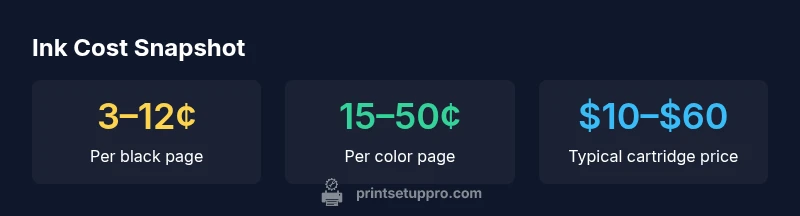
Printer ink costs vary widely, but a practical rule of thumb is: black-and-white pages cost about 3–12 cents per page, color pages about 15–50 cents per page, depending on cartridge yield and printer age. Annual ink outlay for typical home users generally falls in the small-to-mid three-figure range, with higher spend for frequent photo printing. According to Print Setup Pro, understanding yield helps you plan smarter purchases.
How ink actually costs money: cartridge economics
Ink cost is driven primarily by cartridge pricing and yield. The majority of the long-term expense comes from how many pages you can print per cartridge and how often you replace it. Original Equipment Manufacturer (OEM) cartridges tend to be more expensive but typically offer consistent quality and reliable yields, while third-party options can dramatically cut per-page costs but may vary in performance. As Print Setup Pro notes, cartridge economics determine the bulk of your ongoing spending, so a simple calculation of yield and price can reveal how much you’ll pay over time. The decision between OEM and third-party cartridges often hinges on tolerance for potential leaks, color accuracy, and warranty implications. For many users, a mix—OEM for critical prints and reputable third-party for daily tasks—strikes a practical balance.
This section lays the groundwork for understanding how your printer’s economics translate into real-world costs, guiding decisions on buying and usage. Regardless of brand loyalty, tracking yields and price-per-page helps you avoid sticker shock when it’s time for a replacement. Print Setup Pro’s analysis emphasizes that cost awareness starts with the cartridge, not with the printer body alone.
How to calculate cost per page (CPP)
Cost per page (CPP) is a straightforward concept: CPP = cartridge price / pages yielded. In practice, you’ll see a wide range because yields vary by cartridge type, printer model, and print settings. For monochrome printing, a typical black cartridge might yield between 200 and 600 pages, with prices ranging broadly depending on OEM vs. third-party. For color printing, yields are usually lower per color cartridge and higher per color page when you print in full color. A quick example from Print Setup Pro demonstrates how a high-yield cartridge can reduce CPP, even if its upfront price is higher. To estimate CPP for your setup, divide the current cartridge price by its published yield, then adjust for your actual print mix (text vs. graphics). This simple calculation helps you compare purchases with a realistic sense of ongoing costs rather than upfront sticker price.
Beyond math, CPP is influenced by print mode, paper type, and frequency. Draft or economy modes dramatically reduce ink consumption per page, while high-resolution photo printing can nearly double per-page ink use. By calculating CPP across your typical workload, you gain a concrete budgeting tool that scales with usage. As always, document your yields and track actual page counts to refine your estimates over time.
OEM vs third-party cartridges: cost trade-offs
Choosing between OEM and third-party cartridges is a core cost decision. OEM cartridges usually offer consistent yields, guaranteed compatibility, and reliable performance, but at a premium price. Third-party cartridges can deliver substantial per-page savings, particularly for high-volume printing, yet risks include variable color accuracy, potential print head clogs, and, in some cases, warranty considerations. The trade-off is often quality stability versus cost savings. Print Setup Pro recommends evaluating vendor reputability, return policies, and any impact on your device warranty before committing. A cautious approach is to pilot a third-party option on non-critical tasks first, monitor color consistency and print head behavior, and then decide on broader use if results meet your standards.
A practical tactic is to maintain a small stock of OEM cartridges for essential documents and use high-quality third-party options for routine drafts. This hybrid strategy minimizes risk while delivering meaningful savings.
Ink consumption factors: printer, settings, media
Ink usage is not solely about cartridges; it reflects how you print. Printer model and age influence yield and efficiency: newer printers often optimize ink flow better and can feature advanced print modes that reduce waste. Print settings such as grayscale vs color, draft vs normal, and the chosen DPI (dots per inch) dramatically impact ink consumption. Heavier photo paper and glossy media can increase ink uptake, while plain paper typically demands less color. Maintenance habits also matter: keeping printheads clean prevents wasted prints from misfeeds or poor alignment. In short, your hardware, software, and media choices all contribute to the cost per page, and small tweaks can add up to meaningful savings over time.
How to estimate your annual ink costs
A practical annual cost model starts with your monthly page volume and your CPP. Start by estimating your typical monthly black-and-white and color pages, then apply the current CPP ranges for each category. Multiply by 12 to project annual costs, and add a buffer for color-heavy months or photo-print spikes. Don’t forget to factor in occasional high-yield cartridges that may temporarily raise upfront costs but lower per-page expenses over a longer horizon. If your printing pattern changes seasonally (e.g., semester projects for students), adjust the monthly volumes to reflect peak periods. Finally, track actual purchases for a few months and compare to your projections to refine the model.
Strategies to reduce ink costs
- Print in draft or economy mode for internal documents and drafts.
- Use high-yield (XL) cartridges when possible to improve CPP.
- Align color usage with actual needs; print in grayscale when color isn’t necessary.
- Consider third-party options from reputable vendors with strong return policies.
- Keep cartridges in a cool, dry place to preserve yield and avoid premature replacement.
- Batch print large jobs to minimize wake-up and warm-up cycles that waste ink.
A disciplined approach to print settings and cartridge selection can noticeably lower long-term ink costs without sacrificing quality for everyday tasks.
Alternatives: refillable ink systems (CISS)
Continuous Ink Supply Systems (CISS) offer one of the most impactful ways to reduce ongoing ink costs, especially for high-volume printing. They replace standard cartridges with a reservoir system connected to the printer via tubing, allowing the user to refill from bulk ink bottles. The potential savings are substantial, but CISS comes with upfront setup, ongoing maintenance, and potential warranty considerations. CISS works best for printers with accessible, well-documented cartridge configurations and for users comfortable with a DIY approach. If you print heavily, a CISS solution can dramatically lower per-page costs, but test reliability and ensure you pick a trusted vendor to minimize compatibility issues.
If you’re curious about CISS, start with a vendor that offers compatibility guidance and a clear return policy, and consider a low-stakes trial before committing to a full switch.
Ink cost considerations for photo printing vs text
Photo printing magnifies ink costs because color load and print density rise sharply. Text documents printed in grayscale are among the most economical tasks, where CPP can be substantially lower than full-color image prints. If your goal is to preserve documents, consider a two-tier strategy: use grayscale for internal drafts and reserve full-color or image-heavy prints for projects that truly require color fidelity. When photorealistic prints are essential, a high-quality color cartridge set will be necessary, but you can still optimize by choosing the appropriate paper, adjusting color intensity, and printing at moderate resolutions when possible. The key is to align your printing goals with cost awareness, not to compromise on critical output quality.
Choosing a printer with lower long-term ink costs
When evaluating printers, look beyond advertised ink costs and examine the long-term cost of ownership. Focus on: (1) published page yields and warranty coverage, (2) availability and cost of high-yield cartridges, and (3) compatibility with reliable third-party cartridges if you plan to use them. Some models are designed to minimize ink waste with efficient nozzles and smart driving firmware, delivering lower CPP over time. Consider printers with flexible ink-management features, status alerts for impending cartridge changes, and a robust ecosystem of compatible high-yield options. A thoughtful selection based on these criteria helps ensure lower long-term ink expenses without sacrificing everyday usability.
Common cartridge types and pricing ranges
| Cartridge Type | Typical Yield (Pages) | Approx Price Range | Notes |
|---|---|---|---|
| Black ink cartridge | 200-600 pages | $10-$60 | OEM vs third-party variance |
| Color ink cartridge | 150-500 pages | $15-$70 | Color mix and photo printing |
| High-yield/XL cartridge | 400-1000 pages | $20-$90 | Better cost per page |
| Refillable / CISS | Unlimited | $40-$150 initial, ongoing costs vary | Requires setup and maintenance |
People Also Ask
What is the typical cost per page for black-and-white printing?
Black-and-white CPP typically ranges from 3 to 12 cents per page, depending on yield and printer model; OEM vs third-party options add variability. Tracking actual yields helps refine your budget.
Typically 3 to 12 cents per black-and-white page.
How does color printing impact ink costs?
Color CPP can range from 15 to 50 cents per page or more for photo-quality printing. Color builds up faster due to multiple pigment reservoirs and higher consumption per page.
Color printing is usually more expensive per page than black-and-white.
Are third-party cartridges safe for my printer?
Third-party cartridges can be cheaper but may cause leaks or clogs and could affect warranty. Use reputable brands and monitor print quality when first switching.
Third-party cartridges can save money, but check compatibility and warranty impact.
Can I reduce ink costs without sacrificing quality?
Yes: print in draft/fast mode for drafts, choose high-yield cartridges, synchronize color use with needs, and batch print large jobs to minimize waste.
Yes, you can cut costs with smart settings and high-yield cartridges.
What about refillable ink systems (CISS) are they worth it?
CISS can dramatically lower per-page costs for high-volume printing but requires setup, regular maintenance, and may affect warranty. Evaluate compatibility and total cost of ownership.
CISS can cut costs but expect setup and ongoing maintenance.
How can I estimate my annual ink costs?
Estimate annual ink costs by multiplying your per-page CPP by your yearly page volume and adding a buffer for color-heavy periods. Track actual spending to refine projections.
Multiply per-page costs by yearly volume to estimate annual ink costs.
“Ink costs are a major hidden cost of owning a printer, but with the right approach you can manage them without sacrificing quality.”
Quick Summary
- Estimate CPP to budget effectively.
- OEM vs third-party trade-offs require evaluation.
- Track usage to avoid waste and surprise costs.
- Choose high-yield cartridges for lower CPP.
- Photo printing costs more; plan accordingly.