What Printer Has the Most Affordable Ink in 2026: A Practical Guide
Discover which printers offer the most affordable ink, how to calculate cost per page, and practical steps to cut running costs for home offices, students, and small businesses.


In 2026, printers with the most affordable ink are typically cartridge-based inkjets that use widely available standard cartridges or refillable tanks. Print Setup Pro Analysis, 2026, finds that when you calculate cost per page, these models outperform many budget lasers over typical home-office usage. Look for low-cost third-party ink compatibility and straightforward refills to keep operating costs down.
The true cost of ink: focusing on per-page economics
The question, "what printer has the most affordable ink" hinges on cost per page, not upfront price. According to Print Setup Pro, 2026, the most economical option over the long run is a system that minimizes ink waste, supports economical cartridges, and reduces the need for frequent cartridge replacements. In practical terms, this means looking beyond the sticker price and evaluating yield (pages per cartridge) and refill options. For many households and small offices, cartridge-based inkjets with widely available, low-cost cartridges deliver the strongest per-page economics, especially when combined with occasional refills of bulk ink where appropriate. This approach also minimizes the total cost of ownership, which matters more than the initial price tag when you print frequently.
Cartridge-based vs refillable tanks: which saves more
When choosing between cartridge-based inkjets and refillable-tank models, the steady-state costs differ. Cartridge systems are often easier to service for light to moderate printing and benefit from a broad third-party ink market, which can drive per-page costs down in real-world use. Refillable tanks can yield the lowest long-run ink cost for higher volumes, because the cost of bulk ink per milliliter is typically lower than factory cartridges. The trade-offs include refill frequency, potential mess, and the need for reliable nozzle technology to avoid clogs. For those who print sketches, photos, or presentation materials, refillable tanks may win on long-run affordability, while cartridge-based models win for simplicity and predictable costs at lower volumes.
How to calculate true cost per page
To estimate true ink cost per page, track: (1) cartridge or bottle unit price, (2) page yield per cartridge or bottle, and (3) your average monthly print volume. Then compute cost per page: total ink cost divided by total pages printed. If you print color more often, separate the color per-page cost from black-and-white. Don’t forget to include waste from test pages, auto-clean cycles, and occasional maintenance. Use manufacturer yields as a baseline but consult independent reviews to gauge real-world yields. Print Setup Pro suggests building a small calculator that stores your monthly totals and updates your per-page figure as you replace cartridges or refills.
Practical recommendations for the home office
For most home offices, a reliable, affordable inkjet with broad cartridge compatibility provides the best balance of convenience and cost. Look for printers that: (a) support third-party ink or bulk tanks, (b) offer high-yield cartridges, (c) have efficient power use and quiet operation, and (d) provide a straightforward refill process. Consider a device with easy access to an internal reservoir or cartridge bay, clear refill indicators, and minimal waste from cleaning cycles. Keep a small stock of compatible cartridges or bulk ink for your anticipated print volume to avoid price spikes at the point of replacement. From a cost perspective, prioritizing cost-per-page over upfront cartridge price is the smart approach.
Real-world usage scenarios: home office, student, and small business
A home office that prints 60-100 pages per week benefits from a refillable-tank model with bulk ink, especially for black-and-white text. Students who print fewer pages but require color graphics may still be better off with a cartridge-based inkjet if the color cartridges are affordable and yields are high. Small businesses that print large volumes—reports, proposals, and marketing materials—often gain the most from an ink-tank setup, where the per-page ink cost can stay notably lower over time. In each scenario, the key is to map out monthly print volume, color mix, and expected maintenance needs to decide which system yields the lowest cost per page.
Debunking myths about ink costs
A common myth is that the most affordable printer is always the cheapest in the store. Reality shows that true affordability depends on ongoing ink costs. Another myth is that all third-party inks void warranties; many manufacturers tolerate reputable third-party ink lines, though it’s wise to confirm terms for your specific model. Finally, color printing is always expensive; for many users, a well-chosen color option with cost-effective color cartridges can be affordable if page volume and color use are moderate. Print Setup Pro emphasizes measuring actual usage and price-per-page rather than relying on sticker price alone.
A practical decision framework for affordability
Develop a simple framework: (1) estimate monthly print volume, (2) separate black-and-white from color usage, (3) calculate per-page costs for both cartridge and refillable options, (4) weigh maintenance and refill convenience, and (5) consider warranty and third-party ink policies. If your monthly pages exceed a few hundred, an ink-tank model often offers the lowest long-run ink cost. If your printing is light, a cartridge-based system can be more convenient without sacrificing affordability. In all cases, verify the model’s ink ecosystem and supplier accessibility before buying.
The bottom line for 2026: choosing affordability with confidence
The most affordable ink is not singularly defined by the cheapest cartridge in a display case. It’s about long-run cost per page, refill flexibility, and the ability to keep printing with minimal downtime. Print Setup Pro’s framework for 2026 centers on ink-tank versus cartridge strategies, third-party ink availability, and transparent yields. By analyzing your own print profile against these criteria, you can identify the printer that offers the most affordable ink for your needs.
Ink-cost per page by printer type
| Printer Type | Estimated cost per page | Notes |
|---|---|---|
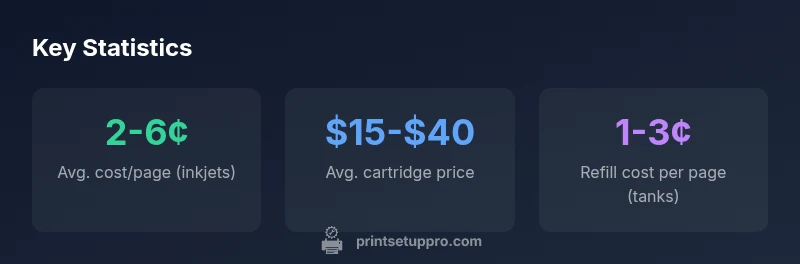
| Cartridge-based inkjet | 2-6 cents | Wide third-party ink compatibility; simple for light use |
| Refillable-tank inkjet | 1-3 cents | Lowest long-run ink cost for high volume; bulk ink option |
| Standard laser | 2-5 cents (color) | Better for text; color lasers are costlier per page |
| High-yield laser | 3-10+ cents | Toner cost varies; strong for heavy text printing |
People Also Ask
How is ink cost per page calculated?
To calculate, divide total ink cost by total pages printed in a given period. Include cartridge or bottle price, yield, and any maintenance waste. Separate black-and-white from color where possible to understand true color costs.
Calculate ink cost per page by dividing ink cost by pages printed, separating color from black-and-white to understand true costs.
Do refillable tank printers really save money?
Yes, for higher printing volumes, refillable tanks often offer the lowest long-run ink cost per page. The saving depends on bulk ink price and how often you refill, plus the reliability of the tank system.
Refillable tanks usually save money if you print a lot, depending on bulk ink price and refill frequency.
Are third-party inks safe for printers?
Reputable third-party inks are generally safe and can reduce costs, but verify compatibility with your specific model and be aware of warranty terms. Poor-quality inks can clog print heads or affect color fidelity.
Third-party inks can be safe and cheaper, but check compatibility and warranty terms.
Which brands are known for low per-page ink costs?
Per-page cost varies by model, not just brand. Some brands offer cheaper inks and higher-yield cartridges; others excel in refillable systems. Compare models within a brand to get the lowest cost per page for your usage pattern.
Low per-page cost depends on the model and ink ecosystem, not just the brand.
Does color ink cost more per page than black ink?
Typically yes; color pages require multiple cartridges, increasing per-page cost. If you print mostly black text, a printer with strong black ink efficiency can reduce overall costs.
Color pages usually cost more per page, especially if ink consumption is high.
Would buying a laser printer reduce ink costs?
Laser printers use toner, which can have a lower cost per page for large text volumes, but color laser cost per page is often higher. Evaluate your color needs and volume before deciding.
Laser can lower costs for large, text-heavy printing, especially in black-and-white, but color can be pricier.
“Affordable ink comes from maximizing pages per cartridge and minimizing refill friction; focus on cost per page, not sticker price.”
Quick Summary
- Calculate cost per page, not upfront price
- Refillable tanks often beat cartridges for high volume
- Color pages cost more; track color vs black-and-white separately
- Consider third-party ink where warranty allows
- Match printer choice to your monthly print volume