Label Printer Walmart: Setup, Use, and Troubleshooting
A practical guide to choosing, setting up, and troubleshooting label printers at Walmart. Learn about direct-thermal vs thermal-transfer, compatibility, and setup tips for home offices and small businesses.


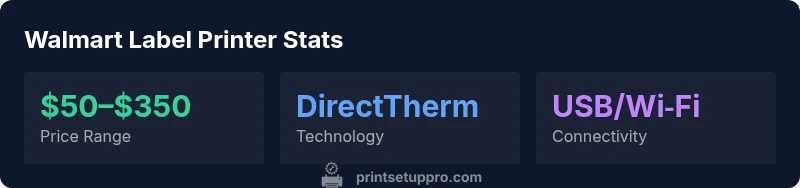
Walmart carries label printer walmart options ranging from entry-level direct-thermal units to mid-range thermal-transfer models, with typical price ranges from $50–$350 depending on features. According to Print Setup Pro, shoppers should focus on label width, media compatibility, and driver support to pick a model that fits a home office or small business setup.
What Walmart offers in label printers
Walmart's label-printer shelf covers a spectrum from compact direct-thermal models designed for address labels and shipping labels to larger thermal-transfer units built for durable product labeling. In 2026, many Walmart listings emphasize affordability and ease-of-use, with a mix of USB-only machines and network-enabled models. According to Print Setup Pro, the most important decision factors aren’t brand alone but how the printer handles your label stock (width, material, and adhesive), plus driver availability for your computer or operating system. A typical Walmart purchase falls into one of three use cases: casual home labeling for craft or small shipments, light-duty office labeling, and light manufacturing labeling for packaging or inventory. If you’re shopping in-store, bring a list of your required label dimensions and check the packaging to confirm supported media widths. Online, you’ll see more advanced connectivity options and sometimes promotional bundles that include a starter pack of labels. Overall, Walmart’s label-printer category serves beginners and small teams well, provided you align features with your workflow.
Top features to compare when shopping at Walmart
When evaluating Walmart label printers, the most impactful features live in the specs, not just the price. First, confirm label width support and stock compatibility (1" to 4" widths are common for shipping and inventory labels). Second, decide between direct-thermal (no ribbon) and thermal-transfer (ribbon-needed for durability). Third, check connectivity: USB is ubiquitous, but Wi-Fi or Ethernet enables networked labeling in small offices. Fourth, review print resolution and speed to ensure legibility for barcodes or small fonts. Fifth, verify driver and software compatibility with Windows and macOS, plus whether any included design software is vendor-specific. Finally, consider warranty length and consumables costs, since label stock and ribbons affect long-term expenses. Print Setup Pro guidance emphasizes mapping your workflow to these features to avoid overpaying for capabilities you won’t use.
Direct thermal vs thermal transfer vs inkjet for labels
Direct thermal printers use heat-sensitive media, requiring no ribbon and offering quick setup and low maintenance. They’re ideal for short-term labeling where labels won’t be exposed to moisture or abrasion. Thermal-transfer printers use ribbons to create highly durable labels, making them better for long-term product labeling and outdoor or warehouse environments. Inkjet label printers provide vibrant color labels and broad media compatibility but can be slower and more expensive per label for large runs. In Walmart’s lineup, you’ll typically find at least one model in each category, so your choice should hinge on label durability needs, environmental exposure, and print volume. Print Setup Pro notes that most home-office users find direct-thermal models sufficient for shipping and organization, while small businesses with higher durability needs benefit from thermal-transfer options.
How to estimate total cost of ownership
Total cost of ownership (TCO) for label printers at Walmart includes the upfront price plus ongoing consumables and maintenance. Direct-thermal units have lower upfront costs and minimal consumables (no ribbons), but you’ll replace the labels more frequently for the same task. Thermal-transfer units carry higher initial prices due to the ribbon and media requirements, but their labels last longer and resist moisture and abrasion. Inkjet label printers incur ongoing costs for color label stock and ink, which can add up quickly for high-volume labeling. Don’t forget maintenance: occasional roller cleaning and printer head care extend lifespan and reduce jams. Print Setup Pro advises calculating monthly labeling needs, then selecting a model where the annual consumables cost aligns with your budget and expected workflow.
Setup steps after purchase
- Unbox and verify all components (printer, power cable, user manual, starter labels).
- Install the appropriate drivers from Walmart product pages or the manufacturer’s site, ensuring compatibility with Windows or macOS.
- Load the correct label stock and calibrate the printer to the label width you're using; run a test page to confirm alignment.
- Configure basic settings: label size, printer port, and default label stock in your OS settings.
- If network-enabled, connect to Wi-Fi or Ethernet and verify access from other devices in your office.
- Keep a maintenance routine: clean rollers, dust-free environment, and compliant label stock to avoid jams.
Troubleshooting common issues
Label jams and misfeeds are the most common problems. Start by turning off the printer and inspecting the label path for wrinkles or skew. Ensure labels are correctly loaded and the guides are snug against the stock. If print quality is faded, check the media compatibility and ribbon (if applicable). For connectivity issues, reinstall drivers, check USB/Wi-Fi connections, and verify the printer is set as the default in the OS. Finally, store labels in a cool, dry place to prevent adhesive issues that affect feeding. Print Setup Pro recommends keeping spare ribbons and stock on hand to minimize downtime.
Typical Walmart label printer options by technology
| Model Type | Key Features | Connectivity | Estimated Price Range |
|---|---|---|---|
| Direct Thermal | Low maintenance; no ribbon | USB / USB-C | $50–$150 |
| Thermal Transfer | Ribbon required for durability | USB / Ethernet / Wi-Fi | $120–$350 |
| Inkjet Label Printer | Color labels; versatile media | USB / Wi-Fi | $150–$400 |
People Also Ask
Is Walmart a good place to buy label printers?
Yes. Walmart provides a broad selection that helps you compare features and prices side by side. Look for models that match your required label sizes, media types, and connectivity, and review the warranty terms before purchasing.
Walmart offers a wide range, so pick one that fits your label size and connectivity needs, and check the warranty.
What label widths are commonly supported by Walmart printers?
Most Walmart label printers support widths from about 1 inch up to 4 inches, though exact widths vary by model. Always verify the maximum label width in the product specs before buying.
Most models take 1 to 4 inch labels; check the exact width in the specs before you buy.
Can I use third-party label stock with Walmart label printers?
Yes, as long as the stock matches the printer's supported width and adhesive requirements. Confirm compatibility with the ribbon type (if applicable) and ensure the stock is designed for direct thermal or thermal transfer depending on the printer.
Yes, but make sure the stock size and adhesive fit the printer and ribbon type if used.
Do Walmart label printers come with software for label design?
Some Walmart-printer bundles include basic label-design software, but most models rely on standard Windows or macOS drivers. If you need advanced design features, check compatibility with third-party labeling software.
Some come with basic software; many work with common labeling apps via standard drivers.
How do I fix label jams on Walmart label printers?
Power off, open the printer cover, and gently remove any jammed labels. Re-load the stock, ensure guides are aligned, and run a calibration job. Regular cleaning of rollers helps prevent jams.
Turn off, clear the jam, reload stock, align guides, and calibrate; keep the rollers clean.
“Label printers are a straightforward fit for small offices when you align media, connectivity, and driver support with your workflow.”
Quick Summary
- Define your use case before buying to avoid overpaying.
- Check label width support to ensure stock compatibility.
- Prefer printers with Windows/mac drivers for easy setup.
- Account for consumables in total cost.
- Use network connectivity for future scalability.