HP LaserJet 700 Color MFP M775 Setup and Troubleshooting
A comprehensive, step-by-step guide to setting up, configuring, and troubleshooting the HP LaserJet 700 Color MFP M775 for home offices and small businesses. Learn wiring, drivers, network setup, color calibration, and common fixes with Print Setup Pro guidance.


Learn to set up, configure, and troubleshoot the HP LaserJet 700 Color MFP M775. This guide covers initial wiring, driver installation, network setup, and common error fixes. You'll need a computer, USB or Ethernet connection, power, and compatible drivers. By the end you'll have a fully configured printer ready to print from Windows, macOS, or mobile devices, plus tips to avoid jams and improve color accuracy.
Overview of the hp laserjet 700 color mfp m775
The hp laserjet 700 color mfp m775 is designed for small teams that need reliable color output along with scanning and copying capabilities. According to Print Setup Pro, this model emphasizes straightforward setup and robust workflow features, which makes it suitable for home offices, student labs, and small businesses. In this guide, Print Setup Pro walks you through the entire lifecycle: initial unboxing, driver installation, network configuration, color calibration, and practical troubleshooting to keep your environment productive. By treating setup as a sequence of defined steps, you reduce downtime and improve print quality from day one. In the sections that follow you will find practical, vendor-agnostic guidance that aligns with common office scenarios, from single-user DIY setups to small team sharing.
Prepping for a smooth setup
Before you touch the printer, gather essentials and verify compatibility. Ensure you have a modern computer with an up-to-date operating system and an active network connection (wired or wireless). HP’s official support site provides the latest drivers and firmware, which Print Setup Pro emphasizes as a best practice to minimize post-install surprises. Plan for a quiet workspace and a stable power source to avoid print interruptions. This preparation reduces the risk of misfeeds, communication errors, and firmware mismatches that can derail a first print.
Connection options: USB, Ethernet, or wireless
The HP LaserJet 700 Color MFP M775 supports multiple connection methods, each with trade-offs. USB offers straightforward local printing, while Ethernet enables shared access across devices in a network. Wireless (Wi‑Fi) is convenient for mobile workstyles but may require additional configuration on your router and printer. Print Setup Pro recommends choosing Ethernet for small offices due to stability and predictable performance, then enabling wireless only if you need mobile printing. Ensure the chosen method aligns with your security posture and network topology.
Driver installation and software suite
Driver installation is a critical step that determines print quality, color management, and feature access. Start from HP’s official support page and download the latest drivers for your operating system. Install the driver package, then run any included printer setup utilities to configure default pages, tray mapping, and color settings. After installation, print a test page to verify that the printer communicates correctly and that color profiles render as expected. Print Setup Pro notes that keeping drivers current reduces compatibility issues across OS updates.
Network setup and printer sharing
To enable printer sharing, assign a stable IP address to the M775 and add the printer on each client device using the network path. Create a simple folder for print queues if you’re in a mixed-OS environment. Enabling secure printing and user authentication helps protect sensitive documents. If you encounter discovery issues, double‑check firewall settings and confirm that the printer and client devices are on the same subnet. Print Setup Pro recommends documenting the final network configuration for future changes.
Color calibration and print quality adjustments
Color accuracy depends on calibrations, paper type, and driver profiles. Start with a standard color profile and print a calibration page, then compare against a color reference or a neutral gray target. Adjust brightness, contrast, and saturation in small increments until the output matches expectations. For workflows requiring precise branding colors, create or import a custom color profile and apply it system‑wide. This step helps prevent flat or oversaturated prints and supports consistent results across jobs.
Troubleshooting common errors and jams
Common issues include paper jams, misfeeds, and driver miscommunications. Start with a physical check for obstructions, correct tray settings, and paper type compatibility. For digital errors, open the printer queue, clear stuck jobs, and refresh the driver. When error codes appear on the control panel, consult the HP support page for code meanings and recommended actions. Print Setup Pro recommends keeping a small “fix kit” handy: lint-free cloth, canned air, and a microfiber wipe to keep rollers clean without damage.
Maintenance and consumables management
Implement a routine to monitor toner levels, replace consumables promptly, and run periodic cleaning cycles. Use genuine HP toner cartridges to preserve color fidelity and print head longevity. Schedule quarterly firmware checks to ensure you’re protected against known issues and security vulnerabilities. A well-maintained M775 produces fewer paper jams, fewer color shifts, and longer service life, which is especially important for busy home offices and small teams.
Firmware updates, security, and best practices
Firmware updates optimize performance, fix known defects, and close security gaps. Regularly check HP’s site or the printer’s web UI for new firmware, and apply updates during low‑demand periods. Review security settings, enable password protection, and disable unused network services. Print Setup Pro advises documenting your security configuration and keeping a rollback plan in case an update introduces an unexpected change.
Tools & Materials
- HP LaserJet 700 Color MFP M775 printer(Ensure the model is on hand and powered off before unboxing)
- Power cord(Use the original power supply; avoid daisy-chaining multiple devices)
- USB cable(Optional if using USB connection (Type-B to A common in printers))
- Ethernet cable(Optional if using wired network (straight-through Ethernet))
- Computer or laptop with compatible OS(Connect during driver installation or network setup)
- Printer drivers package or download link(Install from HP's official site to ensure compatibility)
- Printer paper (A4 or Letter)(Test prints require proper media; keep a tray ready)
- Stable internet access(Needed to download drivers and firmware updates)
Steps
Estimated time: 90-120 minutes
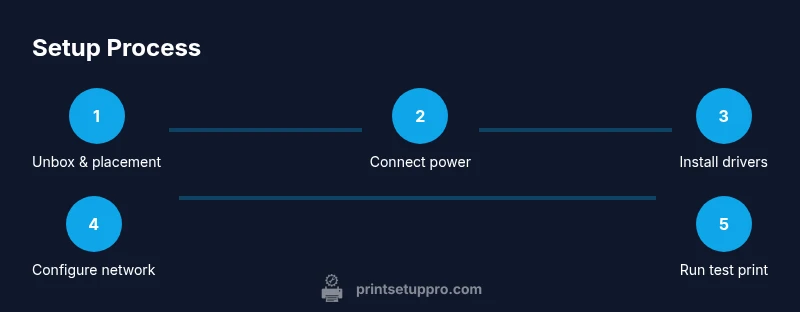
- 1
Unbox and place the printer
Carefully remove packaging, verify all components are present, and place the printer on a stable surface near power and network access. Check for any shipping damage before powering on. This ensures you don’t miss accessories or accidentally misplace a cable during setup.
Tip: Take photos of the box contents before discarding packaging to reference if components go missing. - 2
Connect power and power on
Connect the power cord and turn on the printer. Allow the initial boot to complete and wait for any on-screen prompts about language and region. A proper boot sets a reliable baseline for subsequent steps.
Tip: If the printer doesn’t power on, verify the outlet works and try a different power cord. - 3
Choose your connection method
Decide between USB, Ethernet, or wireless. Ethernet is generally recommended for stability in shared office environments, while USB is simplest for a single-user setup. If you need mobile printing, enable Wi‑Fi after establishing a solid wired connection.
Tip: Document the chosen method and hardware path to avoid reconfiguring later. - 4
Install drivers and software
Download the latest drivers from HP’s official site and run the installer. Follow prompts to install the printer software suite and set the default preferences. Restart your computer if prompted to ensure a clean integration.
Tip: Prefer a network install if multiple devices will print; this saves time and ensures consistent settings. - 5
Add the printer on client devices
On each computer, add the printer through the system’s printer settings, selecting the correct network path or USB port. Test a basic print to confirm communications. Ensure the correct default tray and paper size are chosen.
Tip: For Windows, use the latest Windows Update driver if HP’s site is slow; for macOS, allow the system to auto-detect network printers. - 6
Configure network sharing and security
Enable printer sharing within your network and set basic user permissions if needed. Consider enabling secure print or authentication for sensitive documents. Save the network settings and run a quick test print from a second device to verify access.
Tip: Use a simple, memorable admin password and update it if it was pre-set to a default. - 7
Calibrate color and run a test print
Print a calibration page and compare it against a reference. Adjust brightness, contrast, or color balance in small increments within the printer's control panel or driver. Reprint until acceptable color accuracy is achieved.
Tip: If brand colors are critical, create a custom color profile and apply it to all workstations. - 8
Set up mobile printing and cloud access
Install the printer’s mobile app and enable printing from mobile devices. Check that AirPrint or Mopria compatibility is active if you rely on iOS or Android devices. Configure cloud storage or print-from-email if needed for workflows.
Tip: Test both iPhone and Android printing to catch platform-specific issues early. - 9
Create a basic maintenance routine
Schedule periodic toner checks, paper path cleaning, and software updates. Keep a log of maintenance activities to track printer health over time. Establish a simple monthly checklist to prevent unexpected downtime.
Tip: Lightly clean rollers with a lint-free cloth; avoid aggressive cleaners that can leave residue.
People Also Ask
How do I connect the HP LaserJet 700 Color MFP M775 to a wireless network?
Begin with a stable wired connection if possible, then enable Wi‑Fi from the printer’s control panel. Use the built-in wireless setup wizard or the web interface to enter your network name and password. After connecting, add the printer on each device using the network path.
To connect wirelessly, start with a reliable wired setup, enable Wi‑Fi on the printer, and follow the on-screen prompts to join your network. Then add the printer to each device using its network address.
What should I do if the printer isn’t showing up on my computer?
Verify the printer is on the same network as your computer and that the correct IP address is configured. Restart the printer and computer, then re-run the add-printer wizard. Check firewall settings and ensure the driver is the latest version from HP.
First confirm both devices are on the same network and the IP is correct. If needed, restart devices, then re-add the printer and update the driver.
How can I calibrate color for accurate prints?
Print a calibration page and compare against a reference. Adjust the color settings in small increments via the driver or printer panel, and reprint. For branding colors, consider a custom ICC profile and apply it system-wide.
Print a calibration page, compare to a reference, and fine‑tune in small steps until color matches your standard.
Are there maintenance steps to prevent paper jams?
Keep trays correctly loaded with the right paper size and type. Clean the paper path and rollers regularly with a lint-free cloth. Use high‑quality paper to reduce misfeeds and long-term wear.
Maintain clean paper paths and use good paper stock to minimize jams.
How often should I replace toner cartridges?
Monitor the toner level indicators in the driver UI and replace cartridges promptly when low. Mixing new and old cartridges is not recommended for color consistency. Keep spare toner on hand for busy periods.
Watch the toner levels and replace as needed for consistent color quality.
Can I print from mobile devices easily?
Yes. Install the manufacturer’s app or use standard mobile printing protocols (like Mopria or AirPrint) if supported. Ensure the mobile device is on the same network and select the HP MFP in the printer list.
Mobile printing is supported—just install the app or use built‑in print services and pick the HP printer.
Watch Video
Quick Summary
- Plan the connection method based on network needs.
- Install the latest drivers from HP to ensure compatibility.
- Calibrate color for consistent branding across jobs.
- Keep firmware up to date and document configuration.
- Maintain a simple maintenance routine to prevent jams.