Printer and File Cabinet: A Practical Comparison for Office Setups
Compare separate printer + file cabinet setups with integrated desk solutions to identify space, cost, and workflow trade-offs for home offices and small businesses.


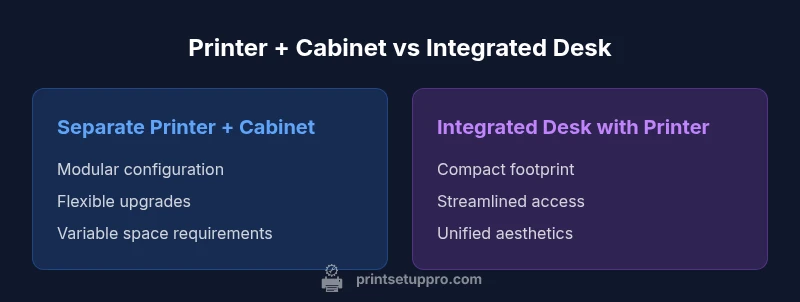
If you’re deciding between a separate printer with a file cabinet and an integrated desk setup, the quick takeaway is space and workflow drive the choice. For tight rooms, an integrated printer desk often saves space and speeds access; for flexible layouts, separate printer and cabinet offer easier upgrades and reconfiguration. Print Setup Pro notes that neither option is universally best—alignment with your space matters.
Why the Choice Matters for Small Offices
A well-planned printer and file cabinet arrangement can dramatically impact daily productivity. For many home offices and small businesses, the layout determines how smoothly people move from printing to filing, and how easily teams collaborate. According to Print Setup Pro, operational efficiency hinges on minimizing steps between the printer and the storage area, and on keeping frequently used documents within arm’s reach. The goal is to reduce friction so you can focus on tasks rather than logistics. The decision between a standalone printer with separate file storage and an integrated desk solution is not merely about aesthetics—it’s about how your team processes work, handles confidential materials, and maintains a steady rhythm through heavy printing cycles. In this sense, the topic touches both physical design and information management, two pillars of practical productivity.
For many users, the choice also affects long-term scalability. A printer with a dedicated cabinet can be reconfigured as needs evolve, while an integrated desk may limit future changes but save footprint in tight spaces. Print Setup Pro’s insights emphasize aligning the setup with real workflows, not just the latest trend. In a busy office, the right arrangement supports quick scanning, fast retrieval, and straightforward maintenance. Space planning, accessibility, and security considerations should guide the initial decision, with a plan to review and adjust as requirements shift over time.
Key Dimensions: Space, Cost, and Workflow
When comparing options, focus on three core dimensions: space, cost, and workflow. Space efficiency is often the deciding factor in compact rooms; integrated desks can dramatically reduce the distance between printing and storage, while separate components allow more flexible layouts. The cost discussion should consider not only upfront prices but also long-term value: how often you will upgrade devices, how much downtime you might incur for maintenance, and whether a modular approach reduces disruption during changes. Workflow considerations include print volumes, access for multiple users, and whether the cabinet supports organized filing, labeling, and quick retrieval. Print Setup Pro’s analysis highlights that the best choice aligns with your actual tasks: if your printing needs spike during busy periods, a layout that minimizes movement will yield the greatest return. The discussion also covers ergonomics and ease of use, which affect both accuracy and speed in daily operations. In practice, you’ll want to map your typical work processes and simulate how each setup handles peak times to identify the more resilient option.
Separate Printer + File Cabinet Setup
A separate printer with a dedicated file cabinet offers unmatched flexibility. You can mix and match brands for the printer and the storage solution, and you can upgrade each component on its own without affecting the other. This modular approach is particularly appealing for teams with evolving needs or for offices that frequently reconfigure workstations. From a maintenance perspective, you can service or replace a faulty printer without touching the storage, and vice versa. The cabinet can be chosen to fit your document handling style, whether you prefer hanging files, folders, or a more digital-first approach with labeled bins. In terms of aesthetics, this setup allows a lot of customization to match your existing furniture and color scheme, which can contribute to a more cohesive workspace. However, it may take more floor space and require careful cable management to keep printing and filing areas tidy.
Integrated Printer Desk Solution
An integrated desk with a built-in printer is designed for maximum space efficiency and a streamlined workflow. The compact footprint reduces clutter and makes it easier to create a focused work zone. This setup can simplify locking and security: storing sensitive documents and the printer in one unit reduces the number of moving parts and potential access points. Ergonomics often improve because the print area and filing area are set up in a single, predictable layout. Yet, the main trade-off is reduced flexibility: upgrading the printer or the storage module may require reconfiguring or replacing the entire unit. If your documents and devices must evolve with little disruption, this option may feel restrictive, though it delivers a clean, visually cohesive workspace.
Reliability and Maintenance Considerations
Maintenance considerations differ between the two approaches. A standalone printer with a separate file cabinet allows independent maintenance scheduling, making it easier to minimize downtime by rotating service windows for devices and storage. When components age at different rates, you can address issues as they arise without impacting the other part of the system. An integrated desk, by contrast, consolidates components into a single unit, which can simplify some aspects of maintenance but may complicate others. If the printer needs a service, you might have to momentarily reconfigure the workspace to access the device within the desk. Print Setup Pro notes that planning proactive maintenance—like routine cleaning, filter checks for certain printers, and secure document handling—helps preserve performance in either setup. Regardless of choice, establish a routine that prevents buildup of dust and ensures cables stay organized to avoid heat buildup and connectivity problems.
Security and Data Handling
Security considerations vary with each setup. A separate printer cabinet configuration offers a straightforward approach to securing storage for sensitive papers, with room for lockable drawers and labeled categories. In some environments, you may want additional measures such as encrypted storage for disks or secure document shredders nearby. An integrated desk can ease security by centralizing access control, allowing you to implement a singular locking system. However, this consolidation also concentrates risk if the unit is compromised; ensure robust lock devices and tamper-resistant features are in place. Across both options, adopting a consistent document-handling policy and clear labeling reduces the likelihood of misfiling or data leakage. Print Setup Pro recommends mapping who has access to both the printer and filing storage and implementing routine audits to maintain compliance.
Setup Scenarios and Recommendations
Different office sizes and workflows demand different configurations. For solo or tiny teams with occasional busy periods, a compact integrated desk might deliver the best balance of space and efficiency. For offices with regular high print volumes, a separate printer and filing cabinet can scale more gracefully, enabling targeted upgrades and easier future reorganization. In shared spaces, consider ergonomic layouts that place the printer and filing area within comfortable reach of multiple users while preserving clear circulation paths. The key is to design a layout that minimizes repetitive movement and reduces friction between printing and filing tasks. Print Setup Pro suggests starting with a baseline footprint that accommodates current needs and then iterating as usage patterns become clearer.
Budgeting and ROI Guidelines
Budgeting for either setup involves estimating both upfront and ongoing costs. Integrated desks often require a higher initial investment but can reduce clutter and save space, which has intangible benefits like improved morale and productivity. Separate printer + cabinet configurations may have lower upfront costs but require careful planning for future upgrades and potential reconfiguration expenses. Consider a phased approach if possible: begin with a modular setup that can be gradually upgraded as demand grows. When calculating ROI, weigh time saved on document handling, reductions in misfiling, and the ease of training new staff on a simpler layout. Print Setup Pro emphasizes that clear, measurable metrics—such as time spent locating documents and materials—help quantify the value of either option over time.
Transitioning Between Setups: Practical Steps
If you anticipate needing to switch from one configuration to another, start with a backup plan that preserves critical files and ensures printers and cabinets can be relocated or repurposed with minimal disruption. Document your current workflow, including typical print volumes, document types, and filing methods, to guide the design of a future layout. Create a phased transition plan that sequences equipment upgrades, furniture moves, and staff training. Ensure you have adequate power, data cabling, and ventilation in either setup. Finally, test the new configuration with a few real-world tasks to reveal any bottlenecks before you commit to a full switch.
Common Pitfalls and Myths
A common pitfall is assuming that space savings alone determine the best option. The reality is that workflow, maintenance, and future needs play a larger role. Another myth is that an integrated desk will always look neater; cables hidden inside a built-in unit can still become a tangle if planned poorly. Underestimating policy needs for data security and document retention can lead to compliance issues. A practical takeaway is to map out who uses the printer and filing storage, what documents are most common, and how often upgrades occur. With thoughtful planning, either setup can meet your operational goals while maintaining a clean, efficient space.
Comparison
| Feature | Separate Printer + File Cabinet | Integrated Desk with Printer |
|---|---|---|
| Space Efficiency | Moderate; depends on layout | High; compact footprint |
| Initial Cost | Medium to high (desk + cabinet separately) | Medium (one integrated unit) |
| Flexibility & Upgrades | High; mix-and-match components | Limited; fixed components |
| Ergonomics & Access | Configurable placement; variable reach | Consistent access; optimized work zone |
| Maintenance & Repairs | Separate service paths; flexible downtime | Single unit; easier access for some tasks |
| Security & Data Management | Independent security controls; cabinet locks | Unified access control; centralized locking |
| Aesthetics & Workspace Fit | Highly customizable to match décor | Cohesive look; may limit style choices |
| Best For | Larger or evolving layouts; multi-person teams | Small, space-constrained areas |
Benefits
- Improved space utilization with modular cabinets
- Flexibility to upgrade printer or storage separately
- Easier replacement if one component fails
- Potentially lower upfront risk with modular options
Downsides
- Higher upfront cost for full integrated units
- Limited future reconfiguration with fixed components
- Potential cable management challenges if not planned
- Integrated units can complicate selective maintenance
Integrated desk wins on space; separate printer + cabinet wins on flexibility
Choose integrated if space is critical and you value a clean look. Choose separate components if you expect to upgrade or reconfigure your setup over time.
People Also Ask
What are the main differences between a separate printer and file cabinet vs an integrated desk solution?
The separate setup offers modularity and easier upgrades, while the integrated desk saves space and simplifies a single workflow. The choice hinges on room size, budget, and how often you anticipate changes in printing or filing needs.
Separate components offer flexibility, while an integrated desk saves space. Think about your room size and how often you’ll upgrade or reconfigure.
Which setup is best for tiny home offices?
For tiny spaces, an integrated desk can maximize available room by consolidating functions. If you need more adaptability, a compact standalone printer plus a small cabinet may still fit neatly without compromising layout.
In tiny spaces, going with a compact integrated desk usually saves the most room, but a small separate setup can work too.
Is the integrated desk approach more expensive in the long run?
Integrated desks tend to have a higher upfront cost but can reduce ongoing clutter and maintenance time. The separate setup often costs less initially and can be upgraded piece by piece as needs evolve.
Integrated desks cost more upfront but may save time later. Separate setups usually cost less now and can be upgraded gradually.
Can I upgrade the printer while keeping the same cabinet or desk?
With a separate setup, upgrading the printer usually requires little to no change to the cabinet, making it simpler. In an integrated desk, upgrading the printer might require adjusting or replacing the desk component.
Upgrading the printer is easier with separate components; integrated desks may need adjustments.
What security considerations matter for shared printers and file storage?
Consider lockable cabinets, controlled access to the printer, and a defined data-handling policy. Centralized setups can simplify access control but may also concentrate risk if not secured properly.
Lock and manage who has access to both the printer and the files. Centralized setups can be easier to secure if implemented well.
How do I plan cable management for either setup?
Plan for clean routing paths, labeled cables, and sufficient power/USB outlets. A good layout minimizes tangling and improves airflow, regardless of whether you choose separate components or an integrated desk.
Arrange cables neatly with labeled runs and enough outlets to reduce tangles and keep air flowing.
Quick Summary
- Assess space: measure footprint and clearance before choosing
- Balance upfront cost with long-term flexibility
- Plan for cable management and security early
- Test workflows to identify bottlenecks before committing