Printer and Price: How to Maximize Value Without Overpaying
Explore how printer price relates to total ownership, compare sticker prices, ink costs, and value to help home offices and students choose smarter printers in 2026.


Printer and price are tightly linked: the sticker price is just part of the story. According to Print Setup Pro, total ownership hinges on ink costs, maintenance, and warranty length. In 2026, buyers should balance upfront cost with long-term value by comparing price-to-per-page, consumables, and potential downtime. Understanding these factors helps home offices, students, and small businesses avoid overpaying.
The price spectrum and what it means for you
Prices for printers range widely, from entry-level inkjets under $100 to full-featured color laser printers approaching $800 or more. But sticker price is only the starting point. Print Setup Pro notes that total ownership depends on consumables, maintenance, and expected usage. For a student or home office, a $100 inkjet might be enticing, but if you replace cartridges frequently, the annual cost can exceed a pricier model with cheaper per-page ink. Consider your typical print volume, photo needs, duplex printing, and whether you’ll need mobile printing or cloud connectivity. If your budget is tight, look for models with efficient ink systems and reputable parts, then compare long-term costs rather than upfront price alone. Also consider energy efficiency, which can reduce operating costs over the printer’s lifetime. Print Setup Pro's analysis highlights the importance of OS compatibility and driver support to prevent hidden upgrade costs.
How sticker price translates into value over time
Choosing a printer based solely on the sticker price is a common mistake. The real question is: what will it cost to own this printer for 2 to 5 years? A low upfront price can be offset by high consumables or frequent repairs. Start by estimating three figures: upfront purchase price, annual consumables (ink or toner), and estimated maintenance or replacement parts. Then adjust for your usage pattern: high-volume print jobs favor models with low per-page costs and larger ink reservoirs; photo-focused work may justify higher ink costs for better media. Finally, evaluate warranty length and included support; a longer warranty can save money on service calls. When you’re comparing models, create a simple side-by-side of upfront price, per-page cost, and projected annual spend to reveal the true value.
Price ranges by printer type
Different printer families sit at different price points, and the right choice depends on usage. Entry-level inkjet printers often start in the low hundreds, while budget inkjets with color capabilities sit around the $150–$300 range. Mid-range printers usually fall between $300 and $600, offering faster speeds, better duty cycles, and more reliable ink systems. Color laser printers tend to require a higher upfront investment, generally from $400 to $800, but they typically deliver lower per-page costs and faster results for high-volume tasks. If you need wide media support or extra features like automatic duplexing, factor those into the price bands. Always compare the total cost of ownership (TCO) rather than sticker price alone to determine which type aligns with your print volume and space constraints.
Hidden costs beyond the sticker price
Sticker price only tells part of the story. Most printers incur ongoing costs that can dwarf the initial investment. Inkjet and color laser printers differ in consumables costs and yield. Before buying, calculate the expected annual ink or toner cost by estimating pages per month, page yield per cartridge, and price per cartridge. Add in paper, maintenance, and possible repair costs. Don’t forget energy usage; some models sip power in idle state, while others conserve energy with sleep modes. If you rely on mobile printing or cloud services, check for subscription fees or required software licenses. Finally, beware of bundled “starter” cartridges that ship with reduced-yield ink; these can inflate early-year costs when you replace them. With a clear view of these ongoing expenses, you can choose a printer that stays affordable in daily use.
Value-focused buying strategies for home offices and students
Small budgets don’t have to mean small outcomes. Start by defining your typical print tasks: document-only text, graphics-heavy reports, or photo printing. Then estimate the monthly page volume to choose a target price band and per-page cost. Look for refurbished or open-box options with a warranty, which can dramatically lower upfront costs while preserving reliability. Compare retailers on return policies and service options; some sellers include free setup or extended support. Take advantage of seasonal sales and educational discounts if you’re a student. Finally, prioritize models with compatibility across devices (Windows, macOS, mobile) and straightforward maintenance routines to minimize downtime and repair expenses.
Shopping channels and warranty considerations
Where you buy matters as much as what you buy. New printers offer the latest features and full warranties, but refurbished models can deliver excellent value when backed by a solid warranty and a reputable seller. Open-box units can also be enticing but require careful inspection of remaining ink, components, and return terms. Compare retailer warranties, shipping policies, and whether on-site support is included. If you anticipate long-term use, choose a model with an extended warranty or optional service plan. Check compatibility with your devices, especially if you print from mobile apps or cloud services. Finally, verify driver availability and OS support; outdated drivers can create headaches during setup and ongoing updates.
Future-proofing your printer purchase
Planning for future needs helps you avoid early obsolescence and repeated upgrading. Consider printers with modular ink systems, firmware update options, and robust driver support for current and upcoming OS versions. Look for models tied to a standard ecosystem of consumables, ensuring you won’t be stranded if a specific cartridge becomes scarce. Evaluate printer after-sales support and the availability of replacement parts. If your use case may expand, pick a model capable of handling higher volumes, better duplexing, and a wider media range. Finally, stay aware of energy efficiency improvements and evolving wireless connectivity options that can extend a printer’s useful life.
Common mistakes to avoid when balancing price and value
Avoid sacrificing reliability for a lower sticker price; in printing, downtime costs can exceed the initial savings. Don’t overlook ink cost per page, which often matters more than the upfront price for high-volume users. Skipping a warranty or service plan can backfire if parts fail. Choosing a model with limited OS compatibility or outdated drivers can cause ongoing friction. Finally, neglecting to compare refills and maintenance cycles across brands often leads to unexpectedly high running costs. By steering clear of these pitfalls and focusing on total cost of ownership, you’ll make a smarter printer purchase that serves your needs for years.
Price and cost overview by printer type
| Printer Type | Typical Price Range | Estimated Annual Consumables | Notes |
|---|---|---|---|
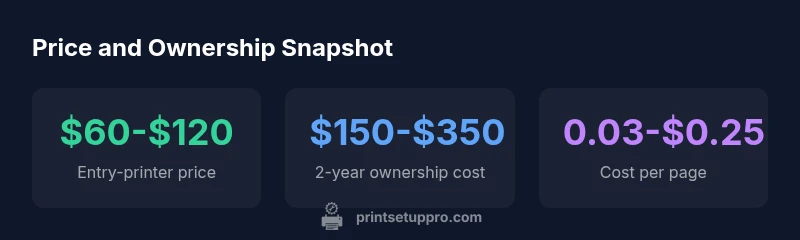
| Inkjet (Entry) | $60-$120 | $60-$120 | Best for casual use and photos |
| Inkjet (Mid) | $150-$300 | $100-$180 | Balanced value |
| Laser (Mono) | $120-$350 | $150-$350 | Lower per-page cost |
| Laser (Color) | $250-$800 | $250-$700 | Higher upfront, lower running costs |
People Also Ask
What is the best printer for price in 2026?
There isn’t a single best printer for price; it depends on your usage. Evaluate total cost of ownership and compare per-page costs across models. Refurbished options can offer great value when backed by a warranty.
There isn’t a single best printer for price; it depends on usage. Look at total cost of ownership and per-page costs, and consider refurbished options with a warranty.
How can I estimate total cost of ownership for a printer?
Start with upfront price, then add estimated annual consumables and maintenance costs. Factor in energy use and potential repair costs. Compare models on a simple TCO worksheet to find real value.
Start with upfront price, then add annual consumables and maintenance costs, plus energy use. Compare models using a TCO worksheet.
Are refurbished printers a good deal?
Refurbished printers can be a great value when backed by a warranty and reputable seller. Always verify return terms, remaining consumables, and driver support before buying.
Refurbished printers can be a great value if they come with a warranty and solid seller support. Check returns and drivers.
Is it cheaper to buy cartridges separately or in multipacks?
Multipacks often reduce per-unit costs and are convenient if you print consistently. Compare yields and unit prices to see which option lowers your long-term spend.
Multipacks usually reduce per-page costs, but always compare yields to see which option lowers your long-term spend.
What features most affect long-term value?
Duplex printing, energy efficiency, reliability, warranty, and driver support all impact long-term value. Prioritize models with low running costs and easy maintenance.
Look for duplex printing, energy efficiency, reliability, and solid warranty to maximize long-term value.
“Price should be evaluated through total cost of ownership, including ink, maintenance, and downtime. Smart buyers prioritize reliable consumables and solid warranties to maximize long-term value.”
Quick Summary
- Compare total cost of ownership, not just sticker price.
- Estimate annual consumables to forecast budget.
- Prioritize printers with low per-page costs for high volume.
- Don't overlook warranties and support when measuring value.