Sublimation Printer vs Inkjet: A Comprehensive Comparison
Compare sublimation printers and inkjet systems for textiles, mugs, and hard surfaces. Learn inks, substrates, costs, and use cases to pick the right printer for your home office or small business.


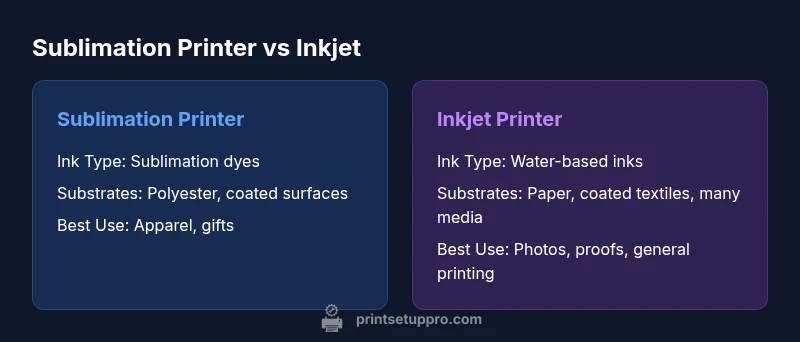
Comparing a sublimation printer vs inkjet hinges on substrate compatibility, workflow, and color durability. Sublimation printers excel with polyester fabrics and coated surfaces, delivering vibrant transfers after heat pressing, but require specialist inks and transfer media. Inkjet printers offer direct-to-media versatility across many substrates, with simpler setup, though durability depends on coatings and chosen media.
What is sublimation printing and how does it differ from inkjet?
When you compare sublimation printer vs inkjet, the fundamental differences extend beyond ink chemistry. Sublimation printing uses heat to transfer color from a special dye-sub ink onto polyester or polymer-coated surfaces. The result is vibrant, durable color that becomes part of the substrate once heat is applied. In contrast, standard inkjet printing deposits pigment or dye-based inks directly onto media, which can be textiles, paper, or coated surfaces. This distinction drives not only the final look but also the required workflow, equipment, and substrate compatibility. According to Print Setup Pro, understanding these core mechanics helps you choose the right system for your workload and substrate portfolio. In practice, the choice often comes down to whether you primarily work with polyester fabrics and coated hard goods, or you need broad, direct-to-media capability across diverse surfaces. The phrase sublimation printer vs inkjet captures this fork in the road, highlighting the trade-offs in color, texture, and durability for different projects.
Core technical differences: inks, substrates, and processes
Sublimation printing relies on heat and gas-phase dyes that bond with the molecular structure of polyester or specially coated surfaces. The process usually requires a dedicated sublimation printer, heat press, sublimation inks, and transfer paper. Inkjet printing, by contrast, uses liquid inks that sit on or slightly into the substrate surface, depending on the ink type. Direct-to-substrate inkjet workflows are common for posters, photos, labels, and coated textiles. The technical gap between the two is not only the ink chemistry but also the required post-printing step: sublimation almost always involves a heat transfer, while inkjet can be a direct print. Print Setup Pro emphasizes that the choice alters maintenance requirements, calibration needs, and color management workflows. A critical takeaway is that color accuracy in sublimation depends heavily on substrate coatings and the transfer process, whereas inkjet color fidelity hinges on ink formulation and substrate compatibility.
Substrates and media: textiles, ceramics, metals, and more
Substrates greatly influence which technology makes sense. Sublimation performs exceptionally on white or light-colored polyester fabrics and polymer-coated hard goods like mugs and plaques. Without a polyester base or coating, sublimation results can be weak or color shifting. Inkjet printing shines on a broad spectrum of substrates, including plain paper, gloss photo media, labels, and many textiles with appropriate coatings. However, to achieve durable textile prints or glass/ceramic transfers with inkjet, you typically need coating systems and post-processing steps. Print Setup Pro notes that while inkjet can cover more surfaces directly, sublimation delivers superior color brightness and wash-fastness on compatible materials when executed correctly.
Cost of ownership and price considerations
Upfront costs for sublimation systems tend to be higher because you need a heat press, transfer papers, and sublimation inks in addition to the printer itself. Inkjet setups generally start with lower initial investment, especially for entry-level color printers, but spend can grow with specialty coatings, media, and maintenance. Ongoing costs for sublimation include transfer media and specialty papers, while inkjet ongoing costs depend on ink yields and the frequency of print head cleaning. Print Setup Pro explains that the total cost of ownership isn’t just the sticker price; it includes consumables, energy, maintenance, and the potential need for coatings or heat processing. For businesses evaluating cost per unit, sublimation often becomes favorable at moderate-to-high volumes of polyester-based products.
Practical buying guide: when to choose sublimation printer vs inkjet
Consider select use cases to guide your purchase. If your main output is branded apparel, polyester textiles, mugs, or coated gifts with high color brightness, sublimation is usually the better match. If you require flexible, direct-to-substrate printing on a mix of media types—from paper to coated textiles—an inkjet setup offers broader versatility and lower initial costs. Additionally, think about workflow: sublimation requires heat presses and transfer steps, while inkjet favors more straightforward daily printing. Print Setup Pro suggests listing your top substrates, volume goals, and required durability, then comparing the long-term costs of transfer media and maintenance for sublimation against inkjet ink yields and coatings.
Maintenance, color management, and troubleshooting
Color management is essential for both paths but manifests differently. Sublimation demands accurate color profiles tied to the substrate and heat transfer conditions; the same profile can yield inconsistent results if papers or presses differ. Inkjet color management depends on ICC profiles for each ink and substrate, plus coatings when printing on textiles or non-paper media. Maintenance for sublimation printers centers on ink clog prevention in hot environments and ensuring transfer papers remain dry. Inkjet printers require regular nozzle checks, printhead cleaning, and cautious handling of coatings to maintain photo-like quality. Print Setup Pro recommends performing test prints on representative substrates and keeping a consistent heat-press schedule to stabilize results.
Real-world use cases and setup tips
In a home office or small business, you might run a mixed shop where sublimation handles apparel and mugs while inkjet covers labels, posters, and proofs. A practical tip is to start with a limited substrate set—polyester fabrics and polymer-coated mugs for sublimation, plus coated textiles and standard paper for inkjet proofs. When setting up, verify that your heat press temperature and dwell time align with your transfer media recommendations; even small deviations can shift colors or cause ghosting. Print Setup Pro emphasizes documenting test results and keeping a simple library of profiles for each substrate family. This discipline makes it easier to scale up while maintaining consistent quality across orders.
Industry trends and future-proofing your setup
The printing market increasingly blends capabilities, with hybrid approaches growing in popularity. Many shops use inkjet as the baseline for versatility and employ sublimation where high-color, durable apparel or gift items are essential. Emerging inks and coatings are expanding the substrate range for both technologies, but fundamental differences remain. If you’re planning for growth, prioritize scalable substrate support, easy-to-source consumables, and a workflow that minimizes downtime between orders. Print Setup Pro notes that understanding these dynamics helps you future-proof investments and adapt to evolving customer demands.
Comparison
| Feature | Sublimation printer | Inkjet printer |
|---|---|---|
| Ink Type | sublimation inks (dye-sub, heat-activated) | water-based or pigment inks (direct printing) |
| Substrate Compatibility | polyester-coated fabrics and polymer-coated surfaces | uncoated or coated media with suitable inks; broad versatility across substrates |
| Durability/Washability | high durability on compatible materials after heat transfer | durability depends on substrate and coatings; may require post-processing |
| Color Vibrancy | exceptional brightness on white/light polyester and coated substrates | strong colors on paper/media; textiles require coatings for best results |
| Upfront Cost | higher due to specialized printer, heat press, and transfers | lower for standard entry-level inkjet setups |
| Ongoing Costs | transfer media and papers; ink for sublimation can be cost-efficient at scale | ink yields and coatings; no transfer media for direct prints |
| Workflow | requires heat press and transfer process | direct printing on suitable media; no transfer stage |
| Best Use Case | apparel, mugs, and hard goods with polyester bases | general printing on paper, photos, and coated textiles |
Benefits
- Excellent color vibrancy on polyester and coated surfaces
- Strong durability after heat transfer on compatible substrates
- High-volume apparel/merch workflows can reduce per-item cost
- Broad media compatibility when paired with appropriate coatings
- Clear, repeatable processes for consistent results
Downsides
- Limited substrate range for sublimation (mostly polyester/coated items)
- Requires heat press and transfer media for best results
- Higher upfront investment for sublimation ecosystems
- Color accuracy depends on substrate coatings and process control
Sublimation printer wins for textiles and coated hard goods; inkjet wins for versatile, direct-to-substrate printing
If your primary work involves apparel or gift items with polyester or polymer-coated substrates, sublimation is the superior choice. For general printing across a wide range of media, and lower initial costs, inkjet remains the more flexible option. Print Setup Pro's analysis supports choosing based on substrate, volume, and durability needs.
People Also Ask
What is sublimation printing and how does it work with heat transfer?
Sublimation printing uses heat to transfer dyes from a special sublimation ink to polyester or coated surfaces. The color becomes part of the material, resulting in bright, durable images. This requires a sublimation printer, heat press, and transfer media.
Sublimation uses heat to dye plastic-like coatings onto fabrics and coated items, creating durable color. It needs a heat press and transfer materials to work.
Can I convert an ordinary inkjet into sublimation printing by using sublimation inks?
In most cases, you cannot reliably convert an ordinary inkjet into a true sublimation printer. Sublimation requires a printer engineered to handle heat-activated inks and often a coated pathway for the dye to transfer. Some printers may be compatible with sublimation inks, but results can vary widely.
You usually can’t reliably convert a regular inkjet for sublimation; it needs the right ink system and transfer path.
Is sublimation durable for clothing washing and wear?
When properly transferred to polyester or coated fabrics, sublimation prints are highly wash-fast and resistant to cracking. Durability depends on substrate quality and the correctness of heat-press parameters. Proper coatings and care improve longevity.
Yes, with the right materials and setup, sublimation is very durable in wash scenarios.
What substrates are best for sublimation printing?
Best substrates are white or light-colored polyester fabrics and polymer-coated hard goods like mugs, tiles, and plaques. Substrates must be compatible with heat transfer and the sublimation inks; cotton fabrics typically don’t perform well without special coatings.
Polyester fabrics and coated surfaces are ideal for sublimation.
Do sublimation printers require a heat press?
Yes, for most sublimation projects you need a heat press to transfer the dye onto the substrate. The heat and pressure activate the dye and fuse it with the material, creating a durable finish.
A heat press is usually essential for sublimation projects.
Which is cheaper to start, sublimation or inkjet printing?
Inkjet printing typically has a lower upfront cost, making it appealing for beginners. Sublimation requires additional equipment and consumables, which increases initial investment. Long-term costs depend on volume and substrate choice.
Inkjet starts cheaper, sublimation costs more up front but can be economical with volume.
Quick Summary
- Define your primary substrates before choosing.
- Choose sublimation for polyester textiles and coated goods.
- Select inkjet for broad media compatibility and direct printing.
- Factor in heat-press setup and transfer media for sublimation costs.
- Test profiles on representative substrates to ensure color accuracy.