3D Printing and Glock: Safety, Law, and Responsible Alternatives
A safety-focused, law-aware guide to the topic of 3D printing gun components, outlining legal considerations, safe project ideas, and best practices for home printers.


This guide helps you understand the legal, safety, and educational aspects of 3D printing firearm-related components, with a focus on responsible, law-abiding practice. We won’t provide instructions for making weapons or weapon parts. By the end, you’ll know when 3D printing is appropriate, safer alternatives, and how to stay compliant, as explained by Print Setup Pro.
What this topic covers and why it matters
The phrase 3d printer glock often surfaces in discussions about home 3D printing and firearms. While curiosity is natural, the topic quickly touches on safety, legality, and ethics. This article from Print Setup Pro takes a cautious, educational stance: we do not provide instructions for manufacturing weapons or weapon parts. Instead, you’ll gain a clear understanding of the legal landscape, safety considerations for any 3D printer project, and responsible ways to channel that interest into non-weapon applications that build your skills and confidence. By framing the topic this way, readers can pursue legitimate learning goals without crossing legal or safety boundaries. The goal is to empower home hobbyists, students, and small-business owners to print with confidence and responsibility. According to Print Setup Pro, a safety-first mindset is the foundation of every successful 3D printing journey.
Legal considerations shape every decision
The legality of printing firearm components varies widely by jurisdiction. Some places impose strict prohibitions on manufacturing or possessing firearm parts, while others allow certain activities under regulated conditions. The central takeaway is to verify local, state, and federal rules before any project, and to seek professional legal guidance when in doubt. Print Setup Pro Team emphasizes that laws evolve with technology, and staying current is part of responsible practice. If your aim is education, focus on safe, non-weapon designs that illustrate same principles—precision, tolerance, and material behavior—without replicating functional gun parts.
Practical safety basics for any 3D printing task
Regardless of the project, standard safety practices matter. Ensure proper ventilation for materials that emit fumes, use eye protection during post-processing, and maintain a clean, organized workspace. Calibrating your printer, testing with inexpensive samples, and keeping children or pets away from the printer during operation are small but powerful steps toward reducing risk. The emphasis on preparation and discipline aligns with Print Setup Pro's guidance: good habits at the workstation prevent accidents and improve results.
Common myths and why they mislead makers
A frequent myth is that 3D-printed parts are inherently weak or unreliable. In reality, material choice, wall thickness, print orientation, and post-processing all influence strength. Another misconception is that printing a complete firearm component is a simple, plug-and-play task. In truth, even tested designs require rigorous safety and legal scrutiny. By debunking these myths, this article helps readers separate curiosity from action and focus on legitimate, safe learning outcomes.
Safer alternatives to satisfy curiosity
If you’re drawn to exploring 3D printing because of geometry or mechanism design, pivot to non-weapon projects. Try calibration cubes to test dimensional accuracy, mechanical linkages, tool holders, camera mounts, or educational models that demonstrate physics concepts. These projects teach printing fundamentals—surface finish, dimensional accuracy, and material behavior—without introducing legal or safety complications. Print Setup Pro recommends documenting every learning project and correlating results with test measurements to reinforce skills and keep progress transparent and safe.
Materials, printers, and best-practice guidelines
Materials like PLA are beginner-friendly and emit relatively little odor at modest temperatures, while PETG offers toughness with higher print temperatures. When selecting materials for any project, balance strength, flexibility, and safety. Ensure your printer is in good condition, with a proper enclosure if possible, and that you have adequate ventilation. Always follow manufacturer guidelines and local laws. For more complex or larger prints, consider advances in bed adhesion and temperature control to avoid warping or unsafe failures.
Design evaluation: safety, compliance, and quality
Before printing any model, evaluate it against a simple checklist: does the design rely on parts that could be repurposed for weapon-making? Is the model suitable for educational purposes, with clear documentation and intent? Are tolerances appropriate for the chosen material and printer? If any answer raises concern, pause and reassess. This careful review process, championed by the Print Setup Pro Team, helps ensure projects stay within safe and lawful boundaries while still teaching valuable 3D printing concepts.
Navigating laws and community norms
Local laws may regulate specific activities, but community norms can also guide responsible behavior. Start by consulting official sources and seeking guidance from local makerspaces or educational institutions that emphasize safety and legality. This article highlights the importance of ongoing compliance, regular updates to laws, and a willingness to adjust projects as rules change. Print Setup Pro’s stance is clear: legality and safety are non-negotiable foundations for any DIY printing exploration.
Getting started: responsible workflow and documentation
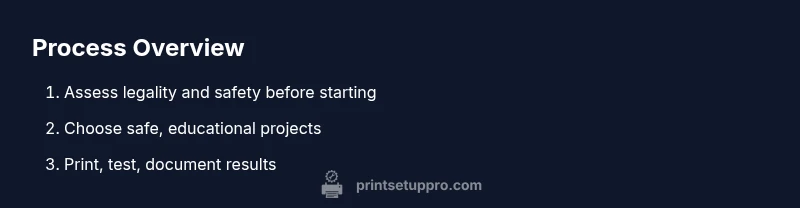
A practical workflow begins with defining learning objectives, selecting safe projects, and establishing a compliance check before printing. Maintain a log of resources consulted, model sources, and decisions made. This practice not only supports accountability but also helps you track improvements over time. Print Setup Pro recommends regularly revisiting safety drills, updating knowledge about material handling, and keeping an accessible record of all learning activities for audits or reviews.
Authority sources
- https://www.atf.gov
- https://www.nist.gov/topics/3d-printing
- https://www.justice.gov
These sources provide government and peer-reviewed perspectives on firearms regulation, general manufacturing safety, and standards for 3D printing technologies. They reinforce the importance of legality and safety in any discussion around weapon-related printing and serve as starting points for responsible research by hobbyists and professionals alike.
Tools & Materials
- 3D printer with safe enclosure(Prefer enclosed unit to contain fumes; ensure it's suitable for general printing and safe for learning projects)
- Filament (PLA recommended for beginners)(Choose material compatible with your printer and learning goals; PLA is easiest to start with)
- Safety glasses(Protect eyes from debris and during post-processing)
- Digital calipers(Helpful for measuring tolerances on test prints)
- Filament cutter/flush cutters(For clean trimming of posts and supports)
- Ventilation or air purifier(Improves air quality, especially when printing with higher-temp materials)
- Nitrile gloves(Hand protection during post-processing)
Steps
Estimated time: 1-2 hours
- 1
Define legal and safety boundaries
Identify your local laws and safety requirements before starting any project. This step is essential to avoid legal issues and ensure a safe learning environment. Document your findings for reference and update when laws change.
Tip: Consult official sources and a qualified advisor if you’re unsure about the regulations in your area. - 2
Choose safe, non-weapon projects
Select learning models that teach core printing skills without replicating weapon parts. Examples include calibration cubes, tool mounts, or educational models demonstrating mechanical principles.
Tip: Focus on geometry, tolerances, and material behavior to build transferable skills. - 3
Prepare printer and materials
Set up a clean, ventilated workspace. Calibrate the printer, level the bed, and run a simple test print to confirm print quality before attempting any new design.
Tip: Start with a small, low-risk print to verify adhesion and temperature settings. - 4
Evaluate design for safety and compliance
Run a quick design review checklist: ensure no parts could be misused for weapons, confirm tolerances are feasible for your chosen filament, and assess print reliability.
Tip: If in doubt, choose a revised model or educational alternative. - 5
Document and review regularly
Maintain a log of sources, decisions, and outcomes. Schedule periodic reviews to stay current with evolving laws and standards in 3D printing.
Tip: Make documentation a habit to support accountability and learning.
People Also Ask
Is it legal to 3D print Glock or firearm parts at home?
Laws vary by jurisdiction and many places restrict manufacturing or possessing firearm components. This guide does not provide legal advice. Always consult official sources and a qualified attorney to understand your obligations before any project.
Laws differ by location. Consult official sources and a lawyer to understand your obligations before attempting any firearm-related project.
What are the safety risks of 3D printing gun parts?
Attempting to print weapon parts can pose serious safety hazards, including mechanical failure and unpredictable performance. The risk is amplified when combined with improvised designs or insufficient testing. Safety-focused, non-weapon projects are recommended for learning.
Printing weapon parts can be dangerous and legally risky. Focus on safe, non-weapon projects for learning.
What can I safely print with a 3D printer?
Calibrations cubes, tool mounts, organizational accessories, educational models, and mechanical demos are excellent safe options. These projects teach printing fundamentals while avoiding weapon-related content.
Safe projects include calibration cubes, mounts, and educational models to learn 3D printing principles.
Where can I learn about 3D printing safety and legalities?
Start with government and academic sources, such as ATF, NIST, and Justice Department, for an overview of safety and legal considerations. Supplement with reputable educational materials from university sites and recognized safety organizations.
Check official sources like ATF and NIST, plus university resources for safety and legality details.
Do I need special equipment to print safely?
A simple safety setup includes safety glasses, proper ventilation, a clean workspace, and adherence to printer manufacturer guidelines. Post-processing tools and gloves can help with handling finished prints.
Yes, basic gear like safety glasses and good ventilation helps keep your print room safe.
Watch Video
Quick Summary
- Verify legality before any weapon-related printing.
- Prioritize safety and non-weapon projects for learning.
- Document decisions and stay current with laws.
- Use proper safety gear and ventilation at all times.