Resin vs Filament: A Comprehensive 3D Printer Comparison
An objective, in-depth comparison of resin (SLA/DLP) vs filament (FDM) 3D printers, covering print quality, speed, materials, post-processing, safety, and use-case guidance.


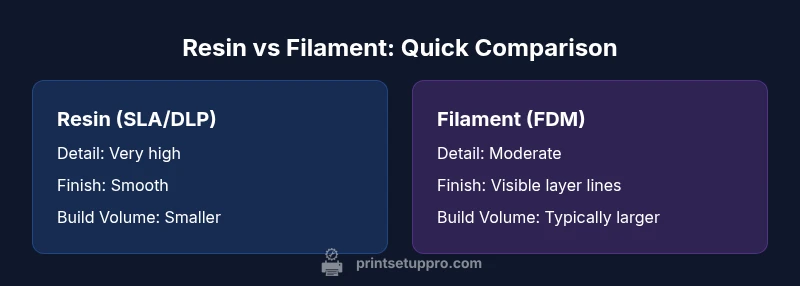
Resin 3d printer vs filament boils down to precision versus throughput. Resin (SLA/DLP) delivers finer detail and smoother surfaces, while filament (FDM) offers lower upfront costs and larger build volumes. According to Print Setup Pro, the best choice depends on your typical projects, workspace, and post-processing tolerance. This quick comparison highlights key differences in print quality, speed, materials, and maintenance to help you decide.
Market Overview and Use Cases
When you consider the resin 3d printer vs filament, the decision hinges on project goals, workspace constraints, and tolerance for post-processing. Resin systems (SLA/DLP) excel at tiny features, incredibly smooth surfaces, and fine tolerances—perfect for miniatures, jewelry masters, dental models, and highly detailed prototypes. Filament systems (FDM) dominate in accessibility, build volume, and material diversity, making them ideal for functional parts, enclosures, and iterative design. Print Setup Pro notes that most home offices and small businesses balance precision needs with throughput and operating costs. In practice, resin shines in micro-detail work; filament shines in rapid iteration and larger-scale parts. By mapping your typical part sizes, required tolerances, and post-processing willingness, you can select the workflow that minimizes time to usable parts while respecting your budget and workspace footprint.
Key Technology Differences
The resin vs filament debate centers on fundamentally different printing paradigms. Resin printers cure photopolymer liquids with UV light (SLA/DLP), producing exceptional resolution and surface smoothness but requiring post-processing steps such as washing and curing. Filament printers extrude melted thermoplastic through a nozzle (FDM/FFF), creating larger parts quickly and at a lower upfront cost, but with more observable layer lines and sometimes lower fine detail. These differences influence maintenance needs, space requirements, and safety considerations. Print Setup Pro emphasizes that the choice is not about which technology is universally better, but which aligns with your job mix, environment, and long-term goals.
Print Quality: Resolution and Finish
Resolution and finish are the most tangible contrasts between resin and filament. Resin prints offer extremely fine XY resolution and smooth surfaces, enabling faithful reproductions of small, intricate features. Filament prints deliver adequate detail for many functional parts and prototypes but may show visible layer lines and reduced curvature smoothness. The resin route often yields higher dimensional accuracy in small parts, while filament can handle larger features with acceptable precision. Both technologies can achieve excellent results with proper printer calibration, software settings, and part orientation. The key is to trade off peak quality against build volume and cycle time for your specific use case.
Surface Finish and Post-processing
Surface finish is a core differentiator. Resin prints typically look almost polished after curing, but they require cleaning with isopropyl alcohol or a similar solvent and a curing step to achieve final hardness. Filament parts usually require minimal post-processing beyond support removal and light sanding or painting, though high-strength or specialty filaments may warrant additional finishing. Post-processing time, waste handling, and solvent use are ongoing considerations with resin workflows. A calm, ventilated workspace helps manage fumes and waste, and having a dedicated post-processing station improves overall efficiency.
Materials: Resin Options and Filament Varieties
Resin formulations range from standard to tough, flexible, and even heat-resistant blends, each with distinct mechanical properties and cure behaviors. Filaments span PLA, PETG, ABS, nylon, and specialty blends with varying stiffness, temperature performance, and printability. Resin chemistry often favors precision and surface quality, while filament chemistry emphasizes strength, impact resistance, and temperature tolerance. Both ecosystems continue to expand, with new materials addressing challenging applications like casting proxies, dental guides, or end-use prototypes. Your selection should consider part function, required stiffness, environmental exposure, and post-processing compatibility.
Build Speed and Throughput Realities
Speed is a nuanced topic in resin vs filament. Resin printers can produce very smooth, fine-detail parts, but curing and washing add time per print, and small batch workflows may benefit from resin’s high precision for rapid, repeatable prototypes. Filament printers typically offer faster part production per print for larger objects, especially when multiple items are printed in a single run. However, overall throughput depends on object complexity, raft/support requirements, and post-processing time. In practice, filament often delivers higher throughput for basic prototypes, while resin supports meticulous fits and tight tolerances for small features.
Build Volume and Part Orientation
Resin printers generally provide smaller build volumes compared to many FDM systems, which means planning the orientation and supports is crucial to maximize part quality. Filament printers often offer larger build areas, enabling bigger prototypes and functional components. An effective strategy for both technologies includes optimizing orientation to minimize support marks, reduce failed prints, and improve surface quality. Consider your workspace constraints, typical part sizes, and how many parts you need to print per job when choosing between the two approaches.
Costs: Upfront and Running
Initial costs for resin and filament printers vary, with resin systems frequently offering strong precision at a lower upfront hardware price but higher ongoing consumable and post-processing costs. Filament printers generally present lower per-part material costs and broad ecosystem options, but may require more frequent nozzle maintenance due to clogging and material feed issues. Budgeting for resin means including resin, alcohol, gloves, and curing supplies; budgeting for filament includes filament spools, nozzles, and occasional hot-end maintenance. Total cost of ownership hinges on print volume, part geometry, and end-use requirements.
Maintenance, Safety, and Environmental Considerations
Resin workflows demand careful handling of liquid resins, proper ventilation, and safe waste disposal. Isopropyl alcohol baths and cured resin waste should be managed according to local regulations, with PPE such as gloves and goggles recommended. Filament printing emphasizes nozzle maintenance, bed adhesion, and appropriate enclosure ventilation if fumes are a concern for certain materials. Both ecosystems benefit from routine calibration, cleaning of optics and extrusion paths, and periodic replacement of consumables. A proactive safety plan and waste management process reduces downtime and protects your workspace.
Software, Workflow, and Ecosystem
Slicer software and workflow choices shape print outcomes for both resin and filament. Filament users commonly rely on Cura or equivalent slicers with straightforward tooling for model orientation and supports. Resin workflows often employ specialist slicers and resin-specific settings to optimize resin cure, exposure, and wash cycles. Workflow considerations include model preparation, support generation, color capabilities (where applicable), and post-processing automation. The right software choice depends on your printer type, material, and project requirements, but a consistent workflow reduces errors and speeds up iteration. Print Setup Pro notes that establishing a reliable process early pays dividends as your library of parts grows.
Practical Decision Framework by Use Case
If your primary need is tiny parts with unprecedented detail for molds, jewelry, or dental-adjacent prototypes, resin is typically the better fit. For larger functional parts, enclosures, fixtures, or rapid iterative prototypes, filament offers more volume, lower material costs, and straightforward handling. A practical approach is to start with one technology based on a dominant use case, then augment with secondary capabilities as your project mix evolves. Consider space, ventilation, post-processing tolerance, and total print-time budget when deciding whether to invest more in resin or in filament tooling.
Common Pitfalls and Myths
A common myth is that resin always outperforms filament in every project. In reality, resin excels at micro-detail and surface finish, but large-scale functional parts may be impractical due to build size, post-processing, and material cost. Another pitfall is assuming resin is always safer or easier; resin handling requires careful safety practices and disposal. Conversely, many hobbyists assume filament prints are always weaker; modern filaments can deliver surprising strength and robustness when paired with proper design and print settings. The reality is context-dependent: match the technology to the job, then optimize through testing.
Authoritative Sources
For deeper context on additive manufacturing and best practices, see authoritative sources such as:
- https://www.nist.gov/topics/additive-manufacturing
- https://www.energy.gov/eere/amo/articles/additive-manufacturing-3d-printing
- https://www.nature.com
These sources provide foundational information on materials, processes, and industry standards relevant to resin and filament printing, helping practitioners make informed decisions.
Comparison
| Feature | resin (SLA/DLP) | filament (FDM) |
|---|---|---|
| Print quality and detail | Very high detail with fine features, smooth surfaces | Moderate detail with visible layer lines (depends on nozzle and layer height) |
| Build volume | Typically smaller build areas | Typically larger build volumes available |
| Material costs per cm3 | Higher material cost per cm3 (liquid resin) | Lower material cost per cm3 (solid filament) |
| Post-processing | Washing and curing required | Minimal post-processing beyond support removal in many cases |
| Print speed (per part) | Slower per-part finishing, especially after curing | Often faster for larger parts, depending on design |
| Maintenance and safety | Ventilation and resin handling precautions | Nozzle maintenance; occasional clogs; fumes considerations for some plastics |
| Best use case | Small, high-precision parts, micro-detail designs | Larger prototypes and functional components, quick iterations |
Benefits
- High-detail, smooth surfaces with resin
- Lower upfront hardware cost for some filament setups
- Wide material choices for both technologies
- Compact resin printers exist for tight spaces
- Strong community and support ecosystems
Downsides
- Resin requires post-processing and ventilation
- Resin materials can be costly and wasteful
- Filament prints can show layer lines without finishing
- Filament workflows may need more routine nozzle maintenance
- Resin handling involves safety precautions
Resin wins for precision and finish; filament wins for cost, speed, and scalability
Choose resin when small, detailed parts matter most. Choose filament when you need larger builds, lower operating costs, and faster throughput for prototypes and functional parts.
People Also Ask
What is the main difference between resin and filament printers?
The core difference is the printing method: resin printers cure liquid resin with light for high detail, while filament printers extrude melted plastic for larger parts. Resin delivers superior surface finish and precision, whereas filament emphasizes build volume and cost efficiency. Your chosen path should align with project needs and workspace limits.
Resin printers give you tiny details and smooth surfaces, while filament printers are better for bigger parts and lower costs. The best choice depends on what you print most often.
Is resin printing better for miniatures?
Yes, resin printing is typically preferred for miniatures due to its high resolution and smooth surface finish. It captures fine features like armor details and facial features more accurately than most filament prints. Consider resin if your numbers are small and detail-critical.
Yes, resin is usually best for miniatures because of the fine detail and smooth finish.
Which is cheaper overall, resin or filament?
Filament generally has lower upfront costs and cheaper material per unit for many standard parts, but resin can be economical for very small, high-detail batches when considering post-processing energy and wear. Total cost depends on print volume, part geometry, and post-processing needs.
Filament usually costs less per piece, but resin can be cost-effective for tiny, detailed batches depending on post-processing.
Can resin printers print large parts?
Resin printers often have smaller build volumes than many filament printers, which makes very large parts impractical on a typical resin setup. For large builds, filament printers are generally the better option, though multiple resin prints or larger-format resin systems can sometimes address this need.
Not typically—the build volume is usually smaller with resin printers, so filament is often better for large parts.
What safety considerations should I know?
Resin printing requires good ventilation, proper PPE, and careful handling of uncured resin and solvents. Post-processing waste and solvents should be disposed of per local regulations. Filament printing mainly requires nozzle and vent maintenance, with fewer chemical-handling concerns.
Ventilate well and wear gloves when handling resin. Dispose of resin waste responsibly; filament printing involves fewer chemical hazards.
Do I always need post-processing for resin prints?
Most resin prints require post-processing, including washing and curing, to achieve final strength and surface finish. Some surfaces may benefit from additional finishing steps, but basic post-processing is standard for resin parts. Filament parts may require finishing too, depending on the material and tolerance needs.
Yes, resin prints usually need washing and curing. Finishing may include sanding or painting as needed.
Quick Summary
- Define your primary need: detail vs size
- Plan for post-processing with resin
- Material choice drives long-term costs more than printer price
- Ensure proper ventilation and waste handling for resin
- Filament offers breadth of materials and larger build volumes
- Adopt a consistent software workflow for reliability