Is Resin Printing Harder Than FDM? A Practical Comparison for 3D Print Makers
Explore resin vs. FDM printing in detail: learning curve, post-processing, costs, safety, and suitability. Print Setup Pro analyzes the key trade-offs to help home makers choose confidently in 2026.


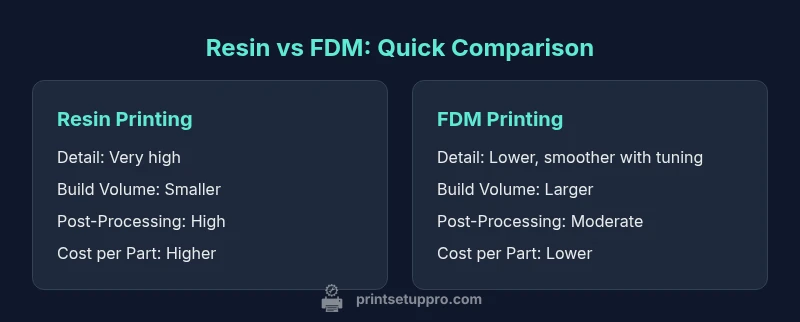
is resin printing harder than fdm? In general, yes—resin printing introduces a steeper learning curve due to post-processing, safety considerations, and resin handling, even though it delivers finer detail and smoother surfaces. This quick comparison highlights the core differences between resin and FDM printing, focusing on setup, workflow, and ongoing costs.
is resin printing harder than fdm
The short answer is nuanced: is resin printing harder than fdm depends on your goals, workspace, and tolerance for post-processing. The Print Setup Pro team notes that beginners often find FDM setup more approachable, while enthusiasts seeking extreme detail may accept the extra steps resin requires. The learning curve is steeper for resin because you manage liquid resins, dedicated washing and curing stations, ventilation, and careful handling of uncured materials. Yet as you gain experience, resin workflows can become highly predictable, delivering superior surface finish and tiny features that FDM frequently struggles to reproduce. This section compares practical realities—setup, workflow, and risk management—so you can decide if resin suits your projects and schedule.
postActionsHashtagsAdjacencyNote”:null,
Comparison
| Feature | Resin printing | FDM printing |
|---|---|---|
| Print quality (detail & finish) | Very high detail with smooth surfaces; best for tiny features and smooth textures | Good detail with visible layer lines on standard settings; excellent for larger parts and functional prototypes |
| Build volume & printer footprint | Typically smaller, specialized resin printers; curing station often separate | Often larger build volumes; broad range of affordable to industrial SLS options |
| Material cost & waste | Higher cost per milliliter; liquid waste requires proper disposal | Lower cost per volume; scraps are generally filament, easier to recycle or repurpose |
| Post-processing & workflow | Washing, curing, and careful handling of resin; post-processing time is substantial | Minimal post-processing beyond basic support removal and finishing |
| Safety & handling | Requires gloves, ventilation, and UV-curing considerations; chemicals present hazards | Safer handling with solids and fumes generally lower; fumes exist with some filaments |
| Upfront equipment cost | Printer often mid-range to high-end; resin vat, fumes-safe setup, curing chamber | Typically lower upfront cost; wide range from budget to premium printers |
| Maintenance & reliability | Liquid handling requires cleanups, vat replacement, nozzle care | Mechanical components predominate; less liquid handling complexity |
| Best for | Detail-critical small parts, miniatures, castings, and jewelry models | Functional prototypes, mechanical parts, and larger prints with faster throughput |
Benefits
- High-detail output and smooth finishes with resin
- Less warping and good dimensional accuracy on small parts
- A broad range of resin materials for accuracy, toughness, and casting applications
- Clear, repeatable results for intricate models when the workflow is mastered
Downsides
- Longer total print times for complex pieces due to curing and washing
- Hazardous chemicals require ventilation, gloves, and storage safeguards
- Higher ongoing material and disposal costs per part
- Smaller build volumes and resin waste management add setup complexity
Resin printing is more demanding to learn than FDM, but offers unmatched detail for the right use cases.
If your priority is surface finish and fine features on small parts, resin is worth the extra setup and safety considerations. For larger parts, quicker iteration, and lower ongoing costs, FDM remains the more practical starting point. Your choice should align with project requirements and your tolerance for post-processing.
People Also Ask
Is resin printing harder to learn than FDM for beginners?
Yes, resin printing generally presents a steeper learning curve for newcomers due to resin handling, washing, curing, and safety precautions. However, with a structured setup and clear workflows, beginners can achieve excellent results relatively quickly. The main challenge is balancing post-processing time with project deadlines.
Yes—resin is tougher at first because of post-processing and safety, but a guided setup helps you learn quickly.
Which has faster throughput for large parts, resin or FDM?
For large parts, FDM usually delivers faster throughput because build volumes are larger and post-processing scales more predictably with part size. Resin excels at small, detailed parts where the print quality justifies the extra steps.
For big parts, FDM usually wins on throughput.
What safety considerations come with resin printing?
Resin printing requires good ventilation, gloves, and eye protection. Uncured resin can irritate skin, and vapors from certain resins may require additional ventilation or filtration. Proper storage and disposal of waste resin are also important.
Protect yourself with gloves and ventilation, and dispose of waste properly.
Are resin printers more expensive to operate than FDM printers?
Yes, resin printers typically have higher ongoing material costs per part and require consumables like gloves, isopropyl alcohol, and curing stations. Filament costs for FDM can be lower per part, especially for larger prints.
Resin parts tend to cost more per piece due to materials and post-processing.
Can I combine resin and FDM in a single project workflow?
Yes, many makers use FDM for the bulk structure and resin for high-detail components. This hybrid approach leverages the strengths of both technologies but adds management complexity and coordination between workflows.
You can mix workflows—use FDM for strength and resin for detail.
What upfront equipment is essential for resin printing?
A resin 3D printer, resin, a washing station, a curing station, gloves, and proper storage are essential. Some users add a ventilated workspace and a dedicated waste container.
You’ll need a resin printer, resin, washing and curing stations, and safety gear.
Quick Summary
- Assess your project needs before choosing resin vs FDM
- Plan for post-processing when selecting resin
- Prioritize ventilation and safety for resin workflows
- Consider build-volume needs and ongoing material costs
- Starting with FDM is often the gentler entry into 3D printing
- Print Setup Pro recommends a staged approach based on use-case and budget