Is Sublimation Printer the Same as DTF? A Comprehensive Comparison
Compare sublimation and DTF printing, covering substrates, inks, workflows, and costs. Is sublimation printer the same as dtf? Get an analytical, home-office friendly overview to decide which method fits your projects.


Is sublimation printer the same as dtf? The short answer is no—the two technologies rely on different inks, films, and curing methods, which leads to distinct results, substrates, and workflows. This comparison aims to clarify these differences for home offices and small businesses. Print Setup Pro provides a practical, evidence-based guide to help you choose the right method for your projects.
Is Sublimation Printing the Same as DTF? Introduction
is sublimation printer the same as dtf. This question pops up frequently among hobbyists and small business operators because both methods promise vibrant prints on textiles. The reality is more nuanced: sublimation relies on heat to convert solid dye into gas that embeds into polyester substrates, while Direct-to-Film (DTF) uses a film that is printed with specialized inks and then transferred to fabric via adhesive. Throughout this guide, we’ll use a structured, analytical lens to compare these processes, their material requirements, costs, and practical workflows. According to Print Setup Pro, understanding the core differences upfront helps prevent costly misapplications and productivity bottlenecks. The goal here is not to declare a winner but to map decision criteria that align with your fabric types, order sizes, and finishing plans.
How Sublimation Printing Works
Sublimation printing uses dye-sublimation inks that are most effective on polymer-coated or natural polyester fabrics. The process begins with an image printed on special transfer paper, using inks that stay solid until heated. In a heat press or heat-roller, typically at 180–210°C for 15–60 seconds, the inks sublimate into a gaseous state and permeate the fabric’s surface. The result is a highly-colored image with excellent colorfastness when applied to suitable substrates. Subtle nuances like gradient detail and edge sharpness can be superior on polyester textiles with proper color management. However, cotton or rayon fabrics generally do not accept sublimation well, and white or light-colored bases are often required to achieve true color accuracy. The workflow emphasizes substrate preparation, transfer timing, and post-press curing to maximize durability.
How DTF Printing Works
DTF (Direct-to-Film) is a more recent transfer method that starts with printing the image onto a clear PET film using water-based inks. After curing, a separate adhesive powder is applied and melted, then the film is placed onto the fabric and pressed to transfer the design. Unlike sublimation, DTF is not strictly limited to poly fabrics and can be used on a wider range of blends, including cotton-rich textiles, provided you select the right adhesive and finishing steps. DTF typically requires a dedicated printer with compatible inks and a separate film workflow, which introduces different maintenance considerations and consumable costs. The result can be highly versatile, with durable prints on a broader fabric set, though color vibrancy and hand feel may differ from high-quality sublimation on polyester.
Media and Substrate Considerations
Substrate choice is the single biggest determinant of how well either method performs. Sublimation excels on polyester and polymer-coated synthetic fibers. The color work appears vibrant, with smooth gradients and excellent washfastness, but only on compatible substrates. For cotton-heavy garments, sublimation usually isn’t practical unless you first apply a coating, which adds cost and complexity. DTF, by contrast, offers more flexibility with fabric types because the film-and-adhesive system can bond to cotton, blends, and some synthetics. However, there are caveats: cotton may require pretreatment, and some dark fabrics can present adhesion challenges. When selecting media, you should balance factors like color vibrancy, texture, and stretch with the intended garment or item.
Inks, Primers, and Consumables
Ink chemistry drives results and long-term costs. Sublimation uses dye-based inks designed for heat transfer into polyester; the color gamut on white or light polyester is typically excellent, with durable prints if the substrate is the right type. Inks for DTF involve white toner (on some systems) or CMYK formulations designed for film printing, plus adhesive powders for transfer. Consumable costs can accumulate quickly with either method, especially if you scale up production. The choice of transfer papers, films, and coatings has a direct impact on finish, stiffness, and hand feel of the printed garment. For small operations, it’s essential to evaluate total cost of ownership, including maintenance, media waste, and turnaround time.
Color control, reproducibility, and longevity
Color management is critical to deliver consistent results across batches. Sublimation often delivers bright, saturated colors on white polyester, with excellent lightfastness when correctly executed. DTF can achieve strong color on diverse fabrics but may require more careful calibration of color profiles and adhesive choices to avoid color shifts on darker backgrounds. Longevity depends on wash cycles, exposure to sunlight, and the substrate’s base color. In practice, both methods can be durable if you adhere to recommended press temperatures, dwell times, and post-processing steps. The key is to test color profiles on representative swatches before committing to large runs.
Workflow and Equipment Costs
Your budget and space influence the decision as much as technical fit. Sublimation requires a sublimation printer or a compatible setup, heat press, coated substrates, and film papers. The upfront investment can be significant, but per-shirt costs may be favorable for high-volume polyester orders. DTF typically requires a dedicated printer with a DTF workflow (film, powder, heat curing), and an adhesive system makes it reasonably versatile for a mixed fabric lineup. Maintenance for both paths includes printer cleaning, nozzle checks, and proper storage of media. If you’re operating from a home office, plan for a dedicated workspace, organization of consumables, and a reliable heat source. The long-term cost of ownership often hinges on how efficiently you can repurpose or retool equipment as demand evolves.
Myths and Misconceptions About Sublimation and DTF
There are several common myths worth debunking. Myth 1: sublimation prints on cotton are as vibrant as on polyester. Reality: cotton often requires coatings or special workflows, and results may still differ. Myth 2: DTF is universally superior for all fabrics. Reality: fabric blend and fiber content matter; some dyes stick differently to cotton than to polyester blends. Myth 3: A single machine can do both sublimation and DTF. Reality: the workflow, inks, and media differ enough that separate configurations are usually required. By separating expectations from reality, you can make better equipment choices and avoid overinvesting in capabilities you won’t need.
Decision Framework: When to Choose Sublimation vs DTF
Consider your fabric base, project types, and scale. If you primarily print on polyester or poly-coated substrates with vibrant color needs and durability, sublimation is often the best fit. If you need flexibility across cotton blends, a broader fabric range, and faster turnaround for mixed orders, DTF offers practical advantages. Consider the total cost of ownership, including consumables, maintenance, and the learning curve. Use a decision matrix that weighs substrate compatibility, color accuracy, finishing requirements, and expected order volume to guide your choice.
Real-World Scenarios and Case Studies
Scenario A: A home-based boutique sells polyester-printed tote bags and t-shirts. The designer prioritizes bright, durable colors and a lean finishing process. Sublimation aligns with the fabric mix and desired colorfastness, provided poly substrates are used. The setup cost is justified by steady demand and the ability to produce in-house without outsourcing. Scenario B: A small screen-printing business expands into cotton apparel and mixed fabrics. DTF offers a more flexible route with a single workflow, enabling quick iterations on cotton-rich items. The business manages higher consumable costs but gains faster turnarounds on diverse orders. In both cases, careful testing, clean workflow, and supplier relationships are essential.
Getting Started: A Practical 8-Week Plan for Beginners
Week 1–2: Define your target fabrics and print goals. Gather a realistic budget, a dedicated workspace, and a maintenance plan for your printer. Week 3–4: Source baseline media (substrates for sublimation and film for DTF) and set up color profiles. Week 5–6: Run test swatches on representative fabrics with both methods to compare vibrancy and feel. Week 7–8: Build a simple product line and a small batch production plan, tracking costs, waste, and quality. Throughout this journey, keep detailed notes and invest in quality consumables to minimize rework.
Comparison
| Feature | Sublimation Printing | DTF Printing |
|---|---|---|
| Substrate compatibility | Polyester/poly-coated fabrics | Cotton blends with adhesive film |
| Ink/film system | Dye-sublimation inks heated to gas and fixed on poly substrates | Film with adhesive and press-then-transfer process |
| White underbase requirement | White substrate or base required for true color | White underbase provided via film/adhesive system |
| Durability on fabrics | Excellent on polyester; fade resistance with proper substrate | Good on cotton blends with proper finishing; durability varies |
| Cost of entry | Moderate to high (printer, coated substrates, press) | Moderate (printer with film, adhesive, powders) |
| Color range | Vibrant on white polyester; limited on non-poly blends | Broad on varied fabrics; color accuracy depends on calibration |
| Production speed | Typically slower per-item for detailed designs | Often faster for mixed fabric runs and quick turnovers |
Benefits
- Clear options for polyester-focused projects with vibrant color
- Versatile on multiple fabrics with DTF when cotton is common
- Strong long-term durability on suitable substrates
- Growing ecosystem of media and support resources
Downsides
- Sublimation limited to polyester or coated substrates
- DTF requires more consumables (film, powder, adhesives)
- Both methods require heat pressing and dedicated workspace
- Color management can be challenging and requires testing
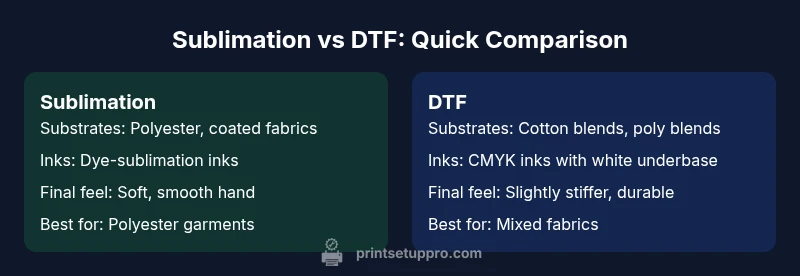
Sublimation wins for polyester-focused, vibrant results; DTF wins for fabric versatility and mixed-material applications
Choose sublimation when your primary fabrics are polyester and you demand vivid colorfast prints. Choose DTF when you need to print across cotton blends and varied fabrics with a streamlined, unified workflow.
People Also Ask
Is sublimation print compatible with cotton fabrics?
Sublimation typically performs best on polyester fibers or polymer-coated fabrics. Cotton fabrics can be printed using sublimation only if they are coated or blended with polyester, which adds cost and may alter hand feel. For pure cotton, DTF or other textile printing methods are usually more practical.
Sublimation works best on polyester. For pure cotton, you’ll usually choose DTF or another method.
Do I need a white substrate for sublimation printing?
Yes, sublimation images require a light or white base to achieve accurate color without the substrate tint affecting the design. Dark-colored fabrics are not ideal for pigment-free sublimation unless you use a coating or alternative finishing. This is one of the key reasons sublimation is associated with white polyester or light-colored bases.
Sublimation needs a light base—usually white polyester—to look right.
Is DTF suitable for beginners?
DTF can be approachable for beginners if you start with a complete starter kit that includes a printer, film, adhesive, and a basic heat press. The learning curve is moderate, mainly around color management and process consistency. Expect ongoing experimentation to optimize quality across different fabrics.
DTF is doable for beginners with a proper starter kit and some practice.
Which method is more cost-effective for small runs?
Costs depend on fabric, volume, and finishing steps. Sublimation tends to have lower per-item costs for large polyester runs but higher upfront substrate costs. DTF can be more economical for mixed fabrics and smaller batches, but consumable costs add up with frequent film and adhesive use.
For small, mixed runs, DTF often offers flexibility with ongoing consumable costs to watch.
Can you switch between sublimation and DTF easily?
Switching between sublimation and DTF is possible but not seamless. Each method uses distinct printers, inks, and media, so a hybrid shop should plan dedicated workflows and spaces for each process to avoid cross-contamination and reduce setup time.
Switching methods means separate workflows and equipment; plan accordingly.
What are the main risks or pitfalls to avoid?
Avoid mis-matching substrate and method, underestimating color management work, and neglecting post-processing steps like heat-set curing. Verify that media, adhesive, and coatings are compatible with your chosen method, and run tests before committing to large orders.
Double-check substrate compatibility and run tests before big orders.
Quick Summary
- Match fabric to method: polyester favors sublimation, cotton blends favor DTF
- Plan your workflow and space before buying equipment
- Test color profiles on representative swatches before large runs
- Budget for consumables as a regular cost, not a one-time expense
- Expect longer setup for sublimation on non-poly fabrics, and accelerated throughput with DTF on mixed fabrics