White toner printer vs dtf: A practical comparison
Analytical guide comparing white toner printers and DTF printing for home offices and small businesses. Learn workflow, costs, substrate compatibility, color quality, and real-world scenarios.


The white toner printer vs dtf decision hinges on your intended volume, substrate, and color needs. White toner printers excel at fast, simple white-on-dark transfers with minimal setup, while DTF delivers broader color fidelity and media versatility for larger runs. For quick turnaround on small batches, choose white toner; for color-rich, scalable transfers, choose DTF.
What the comparison covers: white toner printer vs dtf
This article analyzes two popular approaches to textile and merchandise printing: white toner printer vs dtf. For home offices, small businesses, students, and DIY enthusiasts, understanding how these systems work, their cost implications, and where they shine can prevent costly missteps. According to Print Setup Pro, the decision often hinges on volume, substrate choices, and how important color fidelity is for your designs. In practical terms, a white toner setup prints white pigment first to create on-dark-background capability, then adds color on top—often with a straightforward workflow suitable for small batches. DTF, by contrast, uses a transfer film and a separate powder-cure step to deliver full-color transfers with broader media compatibility. The goal is durable, vibrant reproductions, but the production logic differs in a way that affects speed, waste, and the training you’ll need.
How white toner printing works
White toner printing uses a white pigment toner combined with standard CMY colors to build images on dark or transparent substrates. The process typically starts with your design, then prints the white layer first on the media, followed by color layers. After printing, a heat press or hot-melt transfer secures the image to the garment or surface. Because the white layer creates a background, many designers can skip complicated bleaching or pre-cut masks. A key advantage for beginners is the relatively simple workflow and compact equipment footprint. However, you’ll want to maintain consistent toner quality and calibrate color profiles to ensure repeatable results across batches.
How DTF printing works
DTF (direct-to-film) printing uses a four-step workflow: print CMYK plus white onto a PET transfer film, apply a specialized powder adhesive, cure the powder, and then transfer the image to the garment with a heat press. This approach yields vibrant color, strong whites, and good adhesion on a wide range of fabrics. Because the color is created on the film and then bonded to the substrate, DTF tends to offer robust color reproduction and flexibility for orders with diverse designs. Trade-offs include more consumables to manage (film, powder, and curing time) and a slightly more involved post-processing step.
Key differentiators you should care about
When choosing between white toner printer vs dtf, pay attention to: (1) Setup and space requirements, (2) Color capability and accuracy, (3) Substrate compatibility and texture, (4) Short-term versus long-term cost per unit, and (5) Production speed for your typical order size. A white toner system generally wins on speed and simplicity for small batches on dark fabrics, while DTF shines for rich color, broader substrate options, and scalable runs. Consider your typical design complexity, how often you’ll need to reprofile colors, and whether you value a lean workflow over maximum color versatility.
Print quality and color capabilities: which is stronger
White toner printers perform best when the design relies on bold whites and strong contrasts on dark textiles. Color fidelity depends on the printer’s CMY capability and the quality of color management. DTF, by design, supports full CMYK plus white, enabling smoother gradient transitions and richer imagery across diverse fabrics. In practice, DTF can achieve more nuanced color reproduction, while white toner excels in clean whites and high-contrast images. Your choice should align with whether your priority is reliable white-on-dark results (white toner) or broad, vibrant color across many substrates (DTF).
Substrates and media compatibility
Substrate compatibility is a common differentiator. White toner systems are well-suited to cotton, polyester blends, and garments with dark backgrounds where white chemistry is essential. However, some fabrics may require post-processing or pretreatment for best results. DTF handles a wider range of fabrics, including blends and some synthetics, thanks to the transfer film and powder adhesive. Rigid items, bags, and certain textiles may require testing to confirm adhesion and finish. Consider warp, stretch, and hand feel of the print when evaluating substrates for each method.
Consumables, maintenance, and long-term costs
Consumables are a major factor in total cost. White toner setups use toner cartridges, maintenance kits, and transfer sheets, typically resulting in predictable per-print costs for small runs. DTF requires CMYK inks, white ink, transfer films, and powder adhesive, plus curing components. Over time, the powder, film waste, and frequent film changes can add up. Maintenance-wise, toner systems tend to require regular calibration but fewer moving parts than full inkjet pathways. A careful accounting of ink, film, and powder consumption will illuminate long-term costs for your volume and design complexity.
Setup time, workflow, and production speed
A white toner workflow often translates to straightforward setup: printer, some media, a heat press, and standard color profiles. The overall throughput for light to moderate volumes can be high with minimal downtime. DTF workflows involve more steps (film handling, powder coating, curing), which can slow throughput in the short term but pays off with stronger color on diverse fabrics. If speed with minimal training is a priority, white toner may be more attractive; if you need richer color fidelity and substrate breadth, DTF could be worth the extra steps.
Reliability and longevity in real-world use
Reliability hinges on component quality, maintenance practices, and how well you manage consumables. White toner systems tend to be stable with fewer consumables to track between runs, but toner dust can accumulate if not maintained. DTF equipment requires regular handling of films, powders, and curing steps; mismanagement here can impact adhesion and finish. In real-world settings, both options can be reliable if you commit to regular cleaning, proper calibration, and consistent media testing.
Practical scenarios and best-fit use cases
If your typical orders are small, you print on dark fabrics, and you value speed and simplicity, a white toner setup often fits best. If you routinely produce colorful designs across a mix of fabrics or anticipate scaling to larger orders, DTF provides the color depth and substrate flexibility that many shops demand. No one system is universally “best”; the optimal choice reflects your typical designs, order sizes, and long-term growth plans.
Common myths and pitfalls to avoid
A frequent misconception is that white toner can perfectly replace all DTG or full-color transfers on every substrate. In reality, color gamut and fabric softness matter; testing is essential. Another pitfall is underestimating post-processing needs for both methods, especially for darker fabrics. Finally, assuming lower upfront cost means lower total cost ignores consumables and maintenance that accumulate with volume. Plan a funded trial period to verify performance against your actual designs.
Getting started: a practical decision path
Begin with a needs assessment: list top substrates, typical color complexity, and your monthly output target. Run side-by-side tests with representative designs on a small pilot batch for each method. Compare setup time, color accuracy, hand feel, wash durability, and overall cost per print. Finally, map these findings against your space, budget, and training capacity to decide which path aligns with your business goals.
Step-by-step path to a final decision
- Define your primary use case and fabric types. 2) Run controlled prints on your top substrates with both methods. 3) Measure output quality, consistency, and ease of workflow. 4) Estimate long-term costs including consumables and maintenance. 5) Decide on a starter setup that allows a staged expansion if demand grows.
Comparison
| Feature | White toner printer | DTF printer |
|---|---|---|
| Print method | White pigment + color overprints on dark/background substrates | CMYK + white on transfer film, bonded to fabric |
| Color range | Good white-on-dark capability; color depends on profile | Full color gamut with white attainable on many fabrics |
| Substrate compatibility | Best on dark fabrics and some light fabrics with pretreatment | Broad fabric compatibility including blends and various colors |
| Setup and space | Compact printers; simple workflow; minimal post-processing | Additional film handling and curing area required |
| Production speed | Fast for small batches with quick turnarounds | Slower per unit due to multi-step process, but scalable |
| Consumables | Toner cartridges, transfer sheets, occasional maintenance | Inks (CMYK+White), films, powders, curing equipment |
| Best for | Small runs, quick promos on dark fabrics | Color-rich designs, diverse substrates, larger runs |
Benefits
- Fast setup and simple workflow for small runs
- Strong white-on-dark results with direct-to-substrate printing
- Low initial investment relative to full color systems
- Less post-processing than some multi-step DTG-like workflows
- Convenient for hobbyists and home studios
Downsides
- Narrower color gamut than full-color DTG/DTF transfers
- Color alignment can drift with heat press variations
- Some fabrics require pretreatment or testing for best results
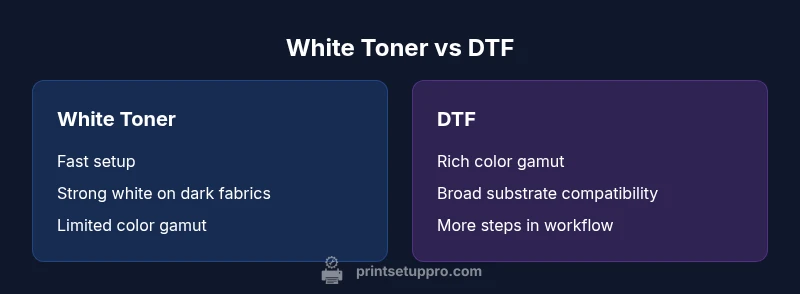
DTF excels in color depth and fabric versatility; white toner wins for fast, simple white-on-dark transfers.
Choose white toner when speed and simplicity on dark fabrics matter most. Opt for DTF if you need vibrant color across a wider range of textiles and larger production scales.
People Also Ask
What is the core difference between white toner printing and DTF?
White toner printing relies on white pigment to create background light areas before applying color, ideal for white-on-dark designs. DTF uses a transfer film with white and color inks, followed by a curing step, enabling rich color on a wider range of fabrics.
White toner builds white backgrounds first for dark fabrics, while DTF uses film and powders to achieve colorful transfers on many fabrics.
Is white toner suitable for dark fabrics without pretreatment?
Yes, white toner is specifically designed for dark backgrounds, often producing strong white areas that show clearly on dark textiles. Some fabrics may still benefit from light pretreatment for best durability.
White toner shines on dark fabrics, with fewer steps needed, but test on your materials to ensure durability.
Does DTF require more equipment than white toner?
DTF typically requires more equipment per workflow step, including transfer film handling and a curing method. White toner generally needs fewer ancillary steps, concentrating on the printer and heat press.
DTF uses more steps and accessories, while white toner focuses on printing and pressing.
Which method is better for high-color, full-spectrum designs?
DTF is usually better for high-color designs due to its broader color gamut and better gradient handling. White toner can approximate color but is more limited in color variety.
For full-color designs, DTF tends to be the stronger option.
What substrates can each method handle best?
White toner works well on cotton and many dark textiles, while DTF can handle a wider mix of fabrics, including blends, with consistent adhesion.
White toner is great for dark fabrics; DTF broadens substrate choices with strong adhesion.
Are there health or safety considerations with DTF powders?
DTF involves powders and curing steps, so good ventilation and PPE are advisable. Follow the manufacturer’s guidelines for handling powders and curing.
Be mindful of powders and curing, use proper ventilation and PPE as advised.
Quick Summary
- Start with a needs assessment to choose the path that fits your substrates
- DTF offers richer color and broader compatibility; white toner offers speed and simplicity
- Test your designs on real garments before committing to a purchase
- Account for consumables and maintenance in long-term cost planning
- Plan a staged purchase to allow growth without over-committing