Inkjet Printer Price Guide for 2026: What You Pay and Why
A data-driven look at inkjet printer price ranges, ink costs, and how to compare models for home offices and students in 2026. Learn budgeting tips and value-driven buying.


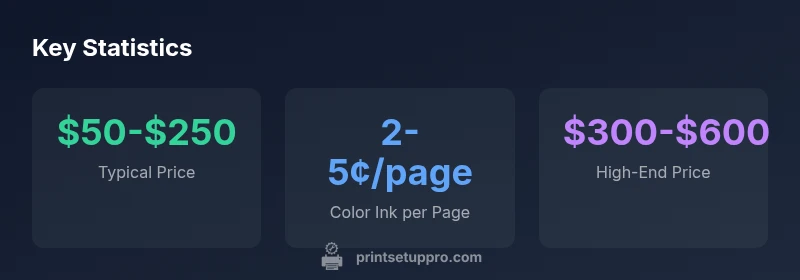
Typical consumer inkjet printer prices range from about $50 to $250, with dedicated photo printers often rising to $400–$600. Entry models cover basic document printing, while mid-range all‑in‑ones add scanning and connectivity. For students and home offices, budgeting for initial purchase plus ink costs over the first year is essential.
Why Inkjet Printer Price Varies Across Brands
Inkjet printers from different brands vary widely in price, even within the same basic category. The price you pay is not just for the print engine; it reflects the overall package: print quality, speed, reliability, included software, and the size of the ink reservoir. Higher-brand models may feature more durable build quality, faster drive motors, better thermal management, and longer warranties. Some brands bundle extra value—manufacturer-approved ink cartridges, extended service plans, or mobile app ecosystems—which raises the upfront price but can reduce long-term costs if ink and maintenance are optimized. Print Setup Pro's analysis shows that the same class of printer can have a wide price spread based on the components used, such as printhead design, ink formulation, and chipset features. When evaluating price, compare what you get for the number of pages you expect to print monthly, and weigh whether features like automatic two-sided printing, dual-band Wi-Fi, or cloud integration are essential rather than optional. In short, the cheapest model is not always the best value over time.
Price Tiers and Use-Case Alignments
Prices cluster into practical tiers that align with real-world use cases. Entry-level models (roughly $50–$100) are adequate for light printing or student needs but may lack duplexing, robust color printing, or wide media support. Mid-range all-in-one units ($100–$250) balance features, reliability, and cost, offering color printing, scanning, and better connectivity for home offices. Premium, photo-centric printers ($250–$600) prioritize color accuracy and print quality for photos or small design projects, often with larger ink reservoirs and advanced software. For small businesses or higher-volume users, office-class devices between $250 and $400+ deliver enhanced paper handling, faster speeds, and network management. Remember that the upfront price is only part of the story; ink costs, page yields, and maintenance frequency significantly affect total ownership.
Total Cost of Ownership: Ink, Maintenance, and Upgrades
Buying decisions should consider long-term costs, not just the sticker price. Ink is a major ongoing expense, especially with color printing; cost-per-page typically ranges beyond a few cents per page and varies by cartridge type and yield. Original manufacturer cartridges are reliable but often pricier per page; compatible or refilled cartridges can reduce per-page costs but may affect warranty or reliability. Maintenance tasks—like printhead cleaning and occasional nozzle checks—vary by model and can influence ink consumption and performance. When evaluating a printer, estimate the annual ink cost based on your expected monthly pages, printer duty cycle, and whether you print more color or grayscale. A model with a slightly higher upfront price may offer better yields and lower maintenance, delivering lower total cost over three to five years.
How to Compare Inkjet Printers in 2026
A systematic approach helps separate price from value. Start with your core tasks: document printing, color photos, or mixed media. Next, compare upfront price but also the cost-per-page for color and black-and-white printing. Check the printer’s duty cycle, paper handling options (including media sizes and weights), and connectivity features (Wi-Fi, Bluetooth, cloud printing). Review warranty length and printer reliability scores from independent reviews. Finally, factor in ink availability and refill options—these influence ongoing costs and convenience. Use a side-by-side comparison to forecast a 3–5 year total cost of ownership, and consider any ongoing subscription services for ink or software that might affect annual spend. Print Setup Pro recommends prioritizing cost-per-page and reliability over sticker price alone.
Budgeting for a Printer Purchase
Create a realistic budget that includes the initial purchase plus at least one year of ink. For a student or casual home user, a $100–$150 upfront model with mid-range ink costs is common. For a home office, plan for a $150–$300 all-in-one with good connectivity and a reliable ink system, then budget $50–$150 per year for replacement cartridges depending on usage. If color printing is frequent, invest a bit more upfront for a higher-yield cartridge kit and consider models with separate color cartridges to maximize efficiency. Print Setup Pro suggests building a simple forecast: (a) monthly pages × color ratio, (b) cost per page, (c) annual maintenance, and (d) potential upgrade paths. This approach helps avoid sticker shock and identifies the best long-term value.
Practical Buying Scenarios for 2026
Consider three common scenarios:
- Home office with moderate color needs: select an all-in-one with reliable wireless printing and a reasonable ink yield. Total cost should balance upfront price with per-page ink costs.
- Student on a budget: a basic monochrome or color printer that supports mobile printing and duplexing can keep costs low while meeting coursework demands.
- Hobbyist or designer: a photo-focused model with high color fidelity and larger ink reservoirs may justify a higher upfront price for long-term savings on ink and reprints.
Pricing and cost-per-page snapshot by model tier
| Model Type | Typical Price Range | Ink Cost per Page | Best For |
|---|---|---|---|
| Entry-Level | $50-$100 | 3-6¢/page | Casual printing for students |
| Mid-Range All-In-One | $100-$250 | 2-5¢/page | Home office with scanning |
| Premium Photo/Pro | $250-$600 | 5-10¢/page | Photo printing and color accuracy |
| Business/Office | $250-$400+ | 1-3¢/page | High-volume workhorse |
People Also Ask
What is a typical price range for consumer inkjet printers?
Most consumer inkjet printers fall in the $50–$250 range, depending on features and brand. Entry models are affordable for light users, while mid-range and premium models add color accuracy, speed, and connectivity. Always factor ink costs and page yields when budgeting.
Most consumer inkjet printers are between fifty and two hundred fifty dollars, with higher-end models offering more features. Don’t forget ink costs when budgeting.
Do ink costs vary a lot between models?
Yes. Color ink costs per page depend on cartridge design, yield, and whether you use original manufacturer cartridges or third-party options. Higher-yield cartridges can lower per-page ink cost, but compatibility and warranty considerations matter.
Ink costs per page vary a lot between models. Higher-yield cartridges can reduce costs, but watch for warranty compatibility.
Are cheaper inkjet printers a poor value for students?
Cheaper models can be a good value if your printing needs are light and primarily black-and-white. For color documents or occasional photos, a mid-range model with predictable ink costs usually provides better long-term value.
Cheaper printers can work for light use, but for color and photos, a mid-range model often saves money over time.
How often should I replace cartridges in an inkjet?
Replacement frequency depends on print volume and color usage. If you print heavily in color, expect more frequent cartridge changes. Monitor page yields and consider high-yield or individual color cartridges to extend intervals between replacements.
Color-heavy printing means more cartridge changes. Track yields and consider high-yield cartridges.
Is there a big price difference between inkjet and laser printers?
Yes. Inkjet printers are typically cheaper upfront and better for color printing, but laser printers often have lower cost per page for monochrome printing and higher duty cycles. For mixed-use, inkjet with efficient ink systems can remain competitive.
Inkjet is usually cheaper upfront and better for color; laser can offer lower pages costs for black-and-white prints.
“Price is only part of value; ink efficiency and reliable performance determine long-term cost.”
Quick Summary
- Budget for ink and upfront price together.
- Always calculate cost per page, not just sticker price.
- Choose a tier that matches your monthly print volume.
- Consider warranty and maintenance when price varies.
- Prioritize long-term value over initial savings.