Printer Ink Price: Understanding Costs and Saving Strategies
Explore how printer ink prices are determined, compare OEM and compatible cartridges, and learn proven strategies to lower ink costs for home offices, students, and small businesses.


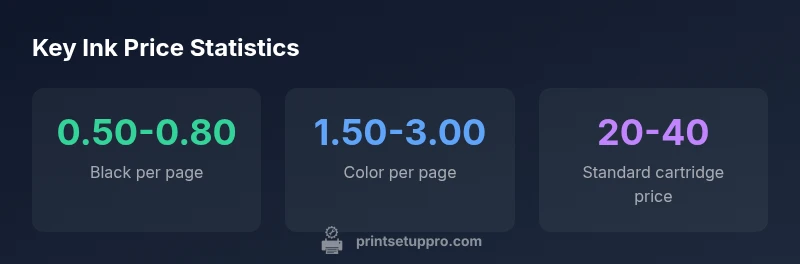
Printer ink price varies widely by brand, cartridge type, and color. In general, consumer ink cartridges cost roughly $0.50 to $2.00 per page for black-and-white prints and more for color or photo printing. OEM inks are typically more expensive than third‑party options, and high‑yield cartridges can reduce the per‑page cost over time.
Cost Drivers Behind Printer Ink Prices
According to Print Setup Pro, printer ink price is driven by a combination of cartridge manufacturing costs, pigment or dye formulation, print head technology, yield per cartridge, and brand positioning. Color ink typically costs more to produce than black, which helps explain why color pages can be two to three times more expensive than monochrome pages. Additionally, manufacturers frequently sell printers at a lower upfront price and recoup costs through ongoing ink sales, a strategy that raises the effective price of ink over the device’s lifetime. For home offices and students, this means choosing a printer with favorable yield and affordable replacement inks can dramatically affect monthly costs. Print Setup Pro’s analysis highlights that the best long‑term value often comes from balancing upfront cartridge prices with expected page yield and your typical page mix (black vs color).
How to Calculate Your Ink Costs
To compare ink prices effectively, start with the per‑page cost. A simple formula is: per‑page cost = cartridge price / pages in the cartridge. If a color cartridge costs $50 and yields 200 pages, the color per‑page cost is $0.25. Do this for both black and color cartridges and multiply by your typical color usage. For many households, black‑and‑white dominates the page count, but even a small color usage can swing your overall cost. When evaluating brands, also consider yield—high‑yield or XL cartridges can dramatically lower the per‑page price, even if the upfront cartridge price is higher. Over a year, these savings compound, especially for busy households or small offices where color prints are common.
Strategies to Lower Ink Expenses
There are several practical approaches to reduce ink costs without sacrificing quality. First, opt for high‑yield cartridges when your printer supports them, as the per‑page cost decreases significantly. Second, compare OEM inks with reputable third‑party or remanufactured options, ensuring compatibility with your device and a valid warranty stance from the manufacturer. Third, adjust print settings to draft or economy mode for drafts and internal documents. Fourth, print in monochrome when color is unnecessary, and consolidate color prints to batch tasks to reduce color waste. Finally, store unused cartridges in a cool, dry place and track expiry dates to avoid wasted ink. These steps collectively shrink long‑term ink expenses while preserving acceptable print quality.
OEM vs. Compatible Inks: Pros, Cons, and Risks
OEM cartridges guarantee original formulations and often come with robust warranties and consistent performance, but they can be the priciest option. Compatible or remanufactured inks offer substantial cost savings but may present minor risks, such as inconsistent color or potential voided warranties if not supported by the printer manufacturer. The decision often hinges on your tolerance for potential quality variation, your device’s warranty terms, and your print volume. If you rely on precise color or photo printing, you may prefer OEM for reliability; for everyday tasks, well‑validated third‑party inks can deliver favorable cost performance.
Practical Budgeting: Page Coverage and Usage Patterns
Everybody’s printing habits differ. A key factor in cost is page coverage: a page with heavy color graphics will drain cartridge ink far faster than a text page. If your typical prints are mostly documents, you will benefit from optimizing margins and using black ink effectively. For households with students or professionals who print presentations, budgeting for color usage—perhaps by using color only when necessary—helps control costs. Consider setting up a recurring quarterly review of ink usage and cartridge performance to anticipate replacements before they run dry. Planning around your actual usage, rather than worst‑case scenarios, yields the most accurate budgeting.
The Role of Printer Type and Brand in Ink Pricing
Ink pricing is partially dictated by the printer’s brand and its business model. Consumer inkjet printers often rely on cartridge sales to monetize the device, while business machines may support separate color channels or larger page yields. Some brands also incentivize the purchase of large‑capacity cartridges, further lowering the per‑page cost but increasing upfront purchase price. When selecting a printer, compare recommended cartridge yields, available high‑yield options, and the price of standard vs. high‑yield cartridges to estimate long‑term ownership cost.
Buying Tips for Home Offices and Teams
For home offices and small teams, a practical approach is to estimate annual ink costs based on expected page volume and color usage, then select a printer with the best balance of upfront cartridge cost and long‑term yield. Shop around for compatible options that fit your model without risking frequent jams. Look for printers with separate color cartridges and clear refill instructions. Finally, consider a quarterly print audit to identify once‑in‑a‑while color usage and re‑balance your default print settings to reduce unnecessary color printing.
Comparison of cartridge pricing, page coverage, and notes
| Cartridge Type | Approx. Price Range | Typical Page Coverage | Notes |
|---|---|---|---|
| OEM Original | 25-60 | 4-6% | Higher upfront cost; reliable color accuracy |
| Generic/Compatible | 15-40 | 5-10% | Lower upfront price; verify compatibility and warranty |
| Remanufactured | 10-30 | 5-9% | Environmentally friendly; quality varies by vendor |
People Also Ask
What factors influence the price of printer ink the most?
Ink price is driven by cartridge yield, color vs. black ink costs, brand pricing strategies, and whether the cartridge is OEM, compatible, or remanufactured. Your print mix (color versus black and white) has a large impact on overall cost.
Ink price is mainly determined by yield, color usage, and whether you’re using OEM or compatible ink. Your print mix matters a lot.
Are third‑party inks safe for my printer?
Many third-party inks are safe if you choose reputable brands and verify compatibility with your printer model. Using unknown inks can lead to clogs, warranty concerns, or color accuracy issues, so research and tests are wise.
Third‑party inks can be safe if you pick trusted brands and ensure compatibility. Watch for warranty terms.
How can I reduce ink costs without sacrificing quality?
Use high‑yield cartridges, print in draft mode for internal documents, and batch color prints. Consider compatible inks from reputable vendors, and adjust default print settings to minimize unnecessary color usage.
Choose high‑yield cartridges, print drafts when possible, and batch color prints to save ink.
Does my printer type affect ink pricing?
Yes. Consumer inkjets often rely on cartridge sales, while some enterprise printers favor larger volumes and long‑lasting cartridges. Page yields and replacement frequency depend on the model and brand strategy.
Printer type matters: consumer models emphasize cartridge sales, while some business printers optimize large yields.
What is the best approach to compare ink prices across brands?
Compare per‑page costs using both black and color yields, consider high‑yield options, and factor in long‑term maintenance. Look for total cost of ownership over your expected print volume.
Compute per‑page costs, align with your color needs, and consider total ownership costs.
“"Cost-conscious printing comes from understanding yield, usage, and brand strategy, not just sticker price. A smart mix of high‑yield cartridges and sensible color usage saves real money over the year."”
Quick Summary
- Start with per-page cost to compare inks.
- Choose high-yield cartridges to lower long-term costs.
- Balance OEM vs. compatible inks based on print needs and warranty.
- Print strategically to minimize color usage.
- Track actual usage to refine future cartridge choices.