How Much Is a Sublimation Printer in 2026? A Practical Guide
Explore the cost range for sublimation printers in 2026, including price drivers, total cost of ownership, and buying tips from Print Setup Pro.


Expect sublimation printer prices to start around two hundred dollars for basic home models and reach about nine hundred dollars for mid-range kits; higher-end models and bundles can push past $1,200. Ongoing costs include ink, transfer paper, and maintenance. Print Setup Pro Analysis, 2026, suggests prioritizing price-to-performance and compatible substrates when choosing a model.
What drives sublimation printer price in 2026
When you ask how much is a sublimation printer, you’re really asking about the trade-offs between price, performance, and total cost of ownership. In 2026, prices still reflect the size of the print area, the allowable substrate types, print head technology, and how much ink the unit can hold before refills. According to Print Setup Pro, price is only part of the equation—assess total cost of ownership, including consumables and maintenance, to avoid sticker-price disappointment. In many markets, entry-level machines designed for small batches offer the lowest upfront cost, while prosumer and professional machines deliver faster speeds and larger formats but at a higher upfront investment. Buyers should also consider bundled features such as built-in Wi‑Fi, color management software, and compatibility with common sublimation inks. Some lower-priced units require external heat presses or conversion kits, which affects the all-in cost. In practice, you’ll trade off features and reliability for a lower sticker price, but the best value often comes from models that balance print area with ink efficiency and maintenance predictability. Print Setup Pro's guidance emphasizes a holistic view: plan for what you print, where you print, and how often.
According to Print Setup Pro, price is a starting point, but the full cost picture matters for sustainable profitability.
Price ranges by use case
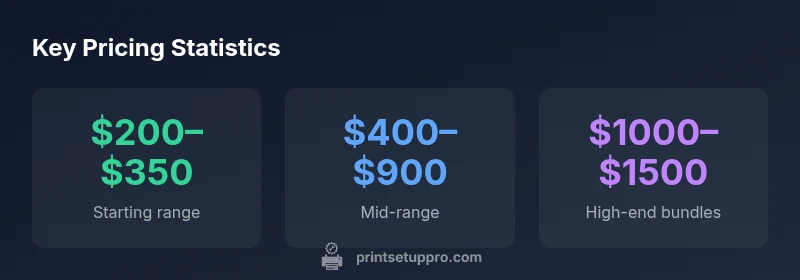
For individuals starting a sublimation hobby or running a tiny home business, price alone is not the only determinant—value matters. In 2026, the typical price ladder starts with basic home models that cover small runs, followed by mid-range systems designed for regular batches, and finally higher-end configurations intended for production workloads. Basic home models often sit in the low hundreds, while mid-range kits generally fall in the four-hundred to nine-hundred dollar range. High-end bundles with larger beds, more durable components, and bundled presses can exceed the thousand-dollar mark. Print Setup Pro notes that a smart buyer compares not just the sticker price but the overall package, including ink costs, maintenance frequency, and substrate compatibility. If you anticipate growth, choose a system that scales through upgrades or compatible accessories rather than a single-purpose device. The right balance often hinges on your typical projects and volume.
Understanding total cost of ownership
The purchase price is only part of what you pay for sublimation capability. Total cost of ownership includes ongoing ink and paper, heat-press compatibility or investment, transfer media, and potential maintenance or parts replacement. In 2026, many users underestimate annual consumables, which can dwarf the initial price difference between models over 12–24 months. Print Setup Pro analyses show that ink costs, especially for high-volume runs, frequently determine profitability and return on investment. To compare models fairly, estimate your monthly or yearly consumable spend and multiply by expected print volume. Also consider substrate variety—some printers support fewer materials, limiting your product range and affecting revenue.
Key features that impact price-to-performance
Price-to-performance hinges on how efficiently a printer converts ink to finished transfers and how flexible it is with substrates. Core features to weigh include print bed size, maximum DPI, color management tools, built-in ICC profiles, and ease of maintenance. Wireless connectivity, USB-C, and robust warranty coverage add value but raise upfront costs. A model with a slightly larger bed and better ink management often saves money over time by reducing waste and downtime. Print Setup Pro emphasizes choosing features that align with your typical projects, not features you won’t use. Also, consider compatibility with commonly available sublimation inks and consumables to avoid vendor lock-in.
For many buyers, a mid-range model hits the sweet spot between capability and total cost of ownership.
Standout budget vs premium models: quick comparison
- Budget models: Pros – low upfront cost, compact footprint. Cons – limited print area, slower speeds, higher per-unit ink use.
- Mid-range models: Pros – balanced price, better speed and area, good ink economy. Cons – still requires careful maintenance and compatible media.
- Premium models: Pros – fastest production, largest formats, strongest software tools. Cons – highest upfront investment and ongoing costs. In most small businesses and hobbyists, a mid-range setup offers the best blend of capability and value. Print Setup Pro notes that the right choice depends on your workflow and substrate diversity, not just the headline price.
Consumables and maintenance: plan for ongoing costs
Even when a sublimation printer is affordable upfront, ongoing costs can add up. Expect recurring ink purchases, transfer paper, specialty substrates, and occasional maintenance. Ink usage efficiency depends on print quality settings and proper color management. The cost of heat transfer sheets or coatings also varies by project type. A thoughtful plan includes setting a monthly budget for consumables, scheduling routine nozzle cleaning, and verifying that ink cartridges and bags are within their shelf life. Print Setup Pro recommends buying a starter bundle that includes a reasonable supply of ink and paper to establish your baseline usage before scaling.
How to evaluate warranties and service options
Warranty length and service coverage are signals of long-term value. In 2026, look for at least one year of hardware warranty, clear terms on print-head coverage, and access to local service or remote support. If you plan to upgrade components or swap in a heat press, confirm compatibility with service terms. Some brands offer extended warranties or service agreements that reduce risk during busy seasons. Print Setup Pro advocates comparing warranty depth with expected print volume and the reliability history of the model.
Practical buying steps for 2026
- Define your print volume, substrate types, and finished product spectrum. 2) Set a realistic budget that includes a cushion for consumables. 3) Shortlist models by bed size, DPI, and ink system. 4) Compare price-to-performance, not just sticker price. 5) Check warranty, service, and community support. 6) If possible, test a sample run with compatible inks and media. 7) Consider refurbished units with warranty if the price-to-performance aligns with your needs. 8) Plan for a heat press or confirm built-in heat module compatibility. 9) Budget for inks and paper and expect that ROI takes months rather than weeks.
Common buying mistakes and how to avoid them
- Focusing only on upfront price: buy with a clear plan for consumables and maintenance.
- Ignoring software and color-management needs: ensure you can produce expected results.
- Skipping warranties or service agreements: longer coverage reduces risk.
- Not verifying substrate compatibility: a printer that cannot handle your materials limits revenue.
- Overlooking heat-press requirements: you often need a heat press for sublimation success.
- Underestimating learning curve: take time to test and calibrate before committing to bulk orders.
Pricing tiers for sublimation printers
| Printer Type | Typical Price Range | Key Pros | Key Cons |
|---|---|---|---|
| Basic home sublimation printer | $200–$350 | Affordable entry, compact | Smaller print area, slower speed |
| Mid-range sublimation printer | $400–$900 | Better speed and larger area | Higher initial cost, ink management needed |
| Professional/large-format sublimation printer | $1000–$1500 | Large format, robust features | Higher maintenance, bulky |
People Also Ask
What factors most influence the price of a sublimation printer?
The main drivers are print area, resolution, ink system, and bundled accessories like heat presses. Seller warranties and support also affect cost.
The main price drivers are print area, resolution, ink system, and bundled accessories. Warranties matter too.
Can I use a standard inkjet printer for sublimation?
Sublimation requires a printer designed for sublimation inks or compatible inks with a compatible printer. Standard inkjets aren't suitable for sublimation transfers.
No—standard inkjets aren't suited for sublimation transfers; you need a sublimation-capable device or compatible inks.
Are refurbished sublimation printers a good deal?
Refurbished units can offer savings if they include a warranty and verified ink compatibility. Check return policy and service options.
Refurbished can be good value if there's a warranty and service options.
What adds ongoing costs beyond the printer price?
Ink, transfer paper, sheets, coatings, and occasional maintenance are recurring costs to factor into profitability.
Ink and media costs add up; plan for replacements and maintenance.
What should I look for in a sublimation printer warranty?
Seek at least one year of coverage, clear service options, and accessible parts. Check whether ink systems and print heads are included.
Get at least a year warranty and clear service options.
Is a heat press necessary for sublimation?
For most projects, a heat press is essential to transfer sublimation inks onto substrates. Some printers include built-in heat modules, but external presses are common.
Yes, a heat press is usually required.
“Price-to-performance remains the best compass when selecting sublimation equipment. Focus on ink costs and substrate compatibility, not just the upfront price.”
Quick Summary
- Define your print size needs before buying.
- Compare price-to-performance, not just sticker price.
- Estimate ongoing consumables costs in your budget.
- Consider refurbished options with warranty to save.
- Pair with a compatible heat press for best results.