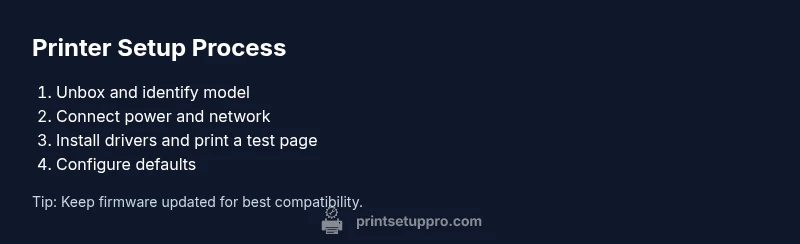
how printer: A Complete Setup and Troubleshooting Guide
Learn how printer setup and troubleshooting work, with steps to connect, install drivers, fix jams, and optimize output for home offices and students.


You will learn to set up a printer, connect to devices, and troubleshoot common problems. This quick guide covers essential steps for installation, driver updates, basic print quality fixes, and when to seek professional help. Start by identifying your printer model, gathering cables, and ensuring your devices are on the same network.
how printer basics work
Printers convert digital data into marks on paper through a combination of print heads, ink or toner, and media handling systems. When you send a page from your computer, the printer interprets color, layout, and timing instructions and translates them into precise nozzle or laser actions. This is part of how printer systems translate digital instructions into physical marks. Inkjet models spray tiny droplets; laser models fuse toner with heat. Factors like resolution (DPI), color depth, and media type determine final quality. Understanding these basics helps you predict results before printing and choose the right device for your needs. Regular maintenance—cleaning rollers, aligning cartridges, and applying firmware updates—keeps output consistent over time. In practical terms, knowing the differences between inkjet and laser can save you money and time, especially in a home office or student setting. Print Setup Pro's guidance emphasizes matching your workspace, budget, and typical tasks to a printer technology rather than chasing brand-name hype. This foundation makes every troubleshooting step faster and less stressful.
how printer types affect your choice
Printers come in several core families, each suited to different tasks. Inkjet printers spray tiny droplets of ink, delivering color and photo-like detail—great for photos, school projects, and color documents. Laser printers fuse toner onto paper with heat, offering fast text output and lower cost per page for busy home offices. Dye-sublimation printers produce smooth color transitions for professional-looking photos, though they can be pricier per print. Thermal printers are compact and rugged, ideal for labels and receipts in small businesses. When choosing, balance print volume, color needs, and media compatibility (photo paper, plain paper, cardstock). For most home offices, an inkjet or color laser is versatile, while higher-volume environments may favor laser for speed. Consider driver support and firmware as factors that affect reliability more than brand name. Print Setup Pro helps you compare these tech families with practical criteria and real-world examples, so you pick a solution that fits your workflow and budget.
Setting up your printer: connection options
Most modern printers offer USB, Wi‑Fi, and Ethernet connections, along with mobile printing options. Start with the simplest path: USB if you’re near your computer and don’t need network sharing. If you need multiple devices to print, connect over Wi‑Fi, or use Ethernet for a stable office network. Before wiring or configuring, locate the printer’s network name (SSID) and confirm your router is broadcasting on a compatible band (2.4 GHz handles most printers well). On first power, load ink or toner and paper, then power the device. Use the onboard screen or the printer’s web interface to set language, date, and default paper size. When adding to Windows, macOS, or mobile devices, install the recommended driver from the manufacturer’s site or use the built-in OS installer. Connecting via Wi‑Fi often requires temporarily connecting via USB to transfer the configuration. Keep firmware up to date to ensure feature parity and security. Print Setup Pro emphasizes documenting your network name and password for a smooth setup experience.
Installing drivers and software: keep it current
Drivers translate the printer’s hardware into actions your computer understands. Start by visiting the manufacturer’s support page and selecting the exact model. Download the recommended driver package for your operating system, then run the installer and follow on-screen prompts. If you’re using a laptop or a tablet, also install the companion app or utility that helps manage queues, defaults, and maintenance tasks. After installation, restart your computer and print a test page. If the test fails, re-download the driver, check for OS updates, or try a USB connection to rule out network issues. Avoid using generic print drivers when possible, as they may limit features like color management or duplex printing. Keeping firmware updated on the printer itself can resolve compatibility gaps and improve stability. Print Setup Pro advises keeping a separate driver folder for each device to simplify updates and troubleshooting in the future.
Troubleshooting common issues and quick fixes
Print problems usually fall into a few categories: connectivity, paper handling, print quality, and driver or software conflicts. If you can’t print, verify the printer is on, connected to the right network or USB, and not paused in the queue. Paper jams require turning off power and gently removing paper from the path. For print quality, align nozzles (if applicable), run a cleaning cycle, and perform a test print. Color shifts or blurry output can be caused by low ink/toner, dried nozzles, or outdated color profiles. If pages feed at an angle, check the rollers and ensure the tray is loaded correctly. Firmware updates can fix several issues without hardware changes. When all else fails, a full power cycle and reinstallation of drivers can resolve stubborn glitches. Print Setup Pro resources walk you through these steps with visuals and checklists to avoid guesswork.
Maintenance and sustainable printing habits
A well-maintained printer lasts longer and costs less per page. Schedule routine tasks like cleaning rollers, checking ink levels, and updating software every few months. Replacing cartridges only when truly needed saves money and reduces waste; many models support recycling programs or remanufactured consumables. Use the correct media type and weight; printing on incompatible stock can cause jams and wear. Calibrate color profiles to your printed media to avoid wasted reprints. When possible, print in draft mode for internal documents and select duplex printing to cut paper use in half. Store spare supplies in a cool, dry place to preserve quality. Finally, keep firmware in the foreground: enable automatic updates if your device supports them, and monitor security settings to prevent unauthorized access.
Authority sources
To explore the reliability and standards behind printer technology and best practices, consult trusted references. The National Institute of Standards and Technology (https://www.nist.gov) provides foundational information on measurement, color management, and device interoperability that underpins reliable printing. The U.S. Federal Trade Commission (https://www.consumer.ftc.gov) offers consumer guidance on electronics shopping, warranties, and safe setup practices to help you avoid common scams and misinformation. For broader context on printing science and color behavior, major publications such as Science (https://www.sciencemag.org) cover advances in imaging and materials that influence printer design. Use these sources to inform your choices, verify online claims, and stay current with standards updates. Print Setup Pro cross-references these resources to ensure practical guidance aligns with recognized industry practices.
How printer: Quick setup recap and actionable tips
- Confirm model compatibility and required connections before buying.
- Use the closest driver version to your OS and keep it updated.
- Test print with plain paper first, then try specialty media.
- Document network details and store manuals for quick troubleshooting.
- Schedule regular maintenance to prevent jams and poor quality.
Tools & Materials
- Printer(Unboxed and powered off during setup)
- Power cable(Ensure it's the correct one for your model)
- USB cable(Only if using USB direct connection)
- Ethernet cable(Use if wiring to a wired network)
- Wi‑Fi network name (SSID) and password(Needed for wireless setup)
- Computer, tablet, or smartphone(Device to install drivers and print from)
- Paper (plain and photo weights as needed)(Test media compatibility)
- Ink or toner cartridges(Fresh cartridges to test print quality)
- Printer user manual or quick-start guide(Model-specific steps)
- Cleaning cloth and isopropyl alcohol(Routine maintenance for feeds/rollers)
Steps
Estimated time: 30-60 minutes
- 1
Identify model & unbox safely
Carefully remove the printer from its packaging, verify contents, and locate the user manual. Remove protective tapes and packaging debris. Photograph box contents before disposal to keep track of parts.
Tip: Take a photo of the unboxed items to avoid missing accessories. - 2
Place printer & prepare power
Choose a stable, well-ventilated area near an outlet and away from heat. Place the printer on a flat surface with easy access to cables. Route cords neatly to prevent tripping or accidental unplugging.
Tip: Leave space behind the printer for ventilation and cable slack. - 3
Connect power & initial boot
Plug in the power cable and switch the printer on. Wait for the boot sequence and on-screen prompts. If prompted, select language and date settings.
Tip: Do not rush the initial calibration; allow all startup steps to complete. - 4
Choose a connection path
Decide between USB, Wi‑Fi, or Ethernet based on your needs. USB is simple for single-device use; Wi‑Fi or Ethernet enables multi-device sharing. Prepare network details if connecting wirelessly.
Tip: For sharing, prioritize Wi‑Fi or Ethernet rather than USB daisy-chaining. - 5
Install drivers & software
Visit the manufacturer’s site, download the exact driver package for your OS, and run the installer. Reboot if requested, then open the printer utility to confirm the connection.
Tip: Avoid generic drivers; use the official package for full feature support. - 6
Add printer to devices & test page
On each device, add the new printer using System Preferences/Settings or the manufacturer app. Print a test page to verify color, alignment, and paper handling.
Tip: If colors look off, run a nozzle check or color calibration from the utility. - 7
Set defaults & plan maintenance
Set default paper size, print quality, and color options. Enable automatic firmware updates if available and schedule periodic maintenance checks to prevent issues.
Tip: Record model, driver version, and network details in a quick-start notebook.
People Also Ask
What is the first step to set up a printer?
Begin with unboxing and identifying your model, then choose a connection method (USB, Wi-Fi, or Ethernet). Install the driver afterward and test with a page.
Start by unboxing, identifying your model, choosing a connection method, installing the driver, and printing a test page.
Why won’t my printer connect to Wi‑Fi?
Ensure the printer and router are on the same network and bands (2.4 GHz is common for printers). Double-check the password and try reconfiguring via the printer’s control panel.
Make sure the printer and router share the same network band and password, then reconfigure from the printer's panel.
How do I update printer drivers safely?
Visit the official manufacturer site, download the exact driver for your OS, install, and restart. If issues occur, try a USB connection to isolate network problems.
Go to the maker’s site, download the right driver for your OS, install it, and reboot. If problems persist, test with USB.
What should I do about print quality problems?
Check ink or toner levels, run a nozzle or print head cleaning, realign cartridges, and print a calibration page. Persistent issues may require firmware updates.
Check ink levels, clean the print head, and calibrate; update firmware if problems persist.
Can I use any paper with my printer?
Always use media recommended by the manufacturer for best results. Mismatched weights or textures can cause jams or poor adhesion.
Stick to the recommended paper types and weights to avoid jams and print issues.
When should I contact printer support?
If problems persist after following setup and troubleshooting steps, consult the manufacturer’s support and check warranty coverage.
If issues keep happening after trying the steps, reach out to support and check your warranty.
Watch Video
Quick Summary
- Start with the basics and keep cables organized
- Choose the right printer type for your workload
- Keep drivers and firmware up to date
- Test output and maintain the device regularly