Portable Thermal Printer: Setup and Troubleshooting Guide
Discover how to choose, set up, and troubleshoot a portable thermal printer for receipts and labels. Includes connections, media handling, battery life, and common errors.


By the end of this guide, you will be able to choose, connect, and troubleshoot a portable thermal printer for receipts, labels, or tickets. It covers model selection, connection methods, media types, and common errors, with practical setup steps. According to Print Setup Pro, the best portable thermal printers balance size, battery life, media options, and reliability for home offices, workshops, and classrooms.
Why a Portable Thermal Printer Matters
In many home offices, small workshops, and classrooms, a portable thermal printer offers a compact, battery-powered solution for quick receipts, labels, shipping slips, or tickets. Unlike bulky desktop printers, these devices aim for mobility and instant ink-free operation, using heat-sensitive media. The result is fast, quiet printing that doesn't require ink cartridges, making them ideal for on-the-go label labeling, inventory tagging, or event check-ins.
The Print Setup Pro team notes that portability is not just about size — it's about reliability in everyday tasks. When you set up a portable thermal printer, you want a device that prints clearly at moderate speeds, holds a charge through a full shift, and handles media without frequent jams. Look for models with a built-in battery or easy charging options, simple pairing with smartphones or laptops, and media compatibility with common thermal papers.
Key use cases include: quick on-site labeling for warehouse layouts; receipts or tickets at pop-up shops; classroom activity tracking; and DIY projects like organizer labels or project timelining. A good portable thermal printer also pays attention to durability and intuitive controls; a rugged outer shell and straightforward menus reduce downtime when you’re working away from a desk.
To avoid buyer’s remorse, clarify your priorities before buying: will you print mainly labels or receipts? Do you need mobile printing via Bluetooth or a wired connection? Are you printing in low-light environments or outdoors? Mapping your needs helps you choose a model that stays reliable in real-world tasks.
How Thermal Printing Works
Thermal printing uses heat to activate a coating on specially treated media. There is no ink cartridge; the printer's head heats specific areas on the media to produce text and images. Direct thermal printers use only the coated paper; thermal transfer printers require a ribbon. For portable devices, many models rely on direct thermal media for simplicity and lower maintenance, though media costs can be higher per print compared to ink. The durability of prints depends on exposure to sunlight and heat; some papers fade over time, especially under sunlight or heat. When selecting media, choose high-quality papers rated for the printer's environment (indoor/outdoor, humidity) and check the printer's supported widths. In addition, ensure the printer’s firmware supports media calibration to ensure correct line height and margins.
In day-to-day use, you'll print barcodes, labels, and receipts with crisp lines. Some devices offer print speeds measured in inches per second, with faster models handling larger media and more repeated prints. The key takeaway is: match media type to your workflow and ensure your device supports the media width you need.
Key Features to Compare
When evaluating portable thermal printers, several features matter most for reliability and cost of ownership. First, check print width and print speed, which determine how much data you can fit on each label or receipt and how quickly you can process orders. Next, assess media compatibility—direct thermal media is common for receipts and labels, but you should confirm the printer supports the media you plan to use (rolls, labels, or tags) and the width you require. Battery life is another critical factor for on-the-go use; devices with longer runtime require fewer recharges during a shift. Connectivity options—Bluetooth, USB, and occasional Wi‑Fi or NFC—determine how easily you can pair with smartphones, tablets, or laptops. App support and driver availability for your operating system reduce friction during setup. Durability and enclosure design affect performance in rugged environments, while warranty length reflects long‑term support. Finally, consider media cost and availability in your region, as ongoing media expenses can outweigh the upfront price of the printer.
A balanced choice combines portability with dependable media handling, easy pairing, and broad media compatibility. The goal is to pick a model you can rely on during busy days without constant tinkering.
Choosing the Right Model for Your Use Case
Your use case drives the best portable thermal printer choice. For home offices that need quick receipt printing for packages or invoices, a compact model with a built‑in battery and straightforward pairing is ideal. For field technicians or event staff, durability, quick media changes, and reliable Bluetooth or USB‑C connectivity become essential. If you plan frequent label printing for inventory or shipping, ensure media width support and a strong ecosystem of compatible media are available in your region. Price is a factor, but consider total cost of ownership: media costs, replacement parts, and customer support quality. If you work primarily with mobile devices, prioritize models with robust mobile apps and simple on‑device controls. Finally, check for firmware updates and a reasonable warranty period to protect against common wear and tear.
Print quality and consistency are not universal; test a few prints from your typical media before committing. This is where Print Setup Pro recommends collecting real-world samples and assessing how the prints hold up under your typical conditions.
Unboxing and First-Time Setup
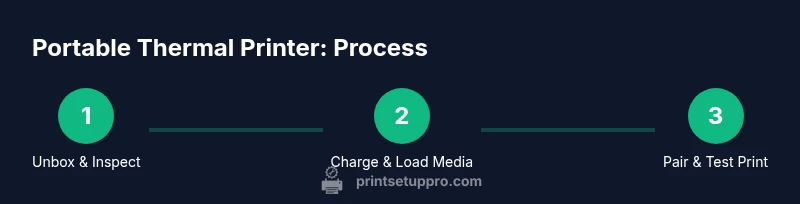
Unbox the printer and verify all components are present, including the device, charging cable, user manual, and sample media. Charge the printer fully before first use to ensure optimal initial performance. Open the media compartment and load the correct thermal media for your device, then thread or feed the media according to the user manual. Calibrate the printer if prompted; calibration ensures proper margins, alignment, and clean text. Pair the printer with your preferred device via Bluetooth or USB, and install any required apps or drivers. Run a test print to confirm alignment, density, and print quality. If the test print looks off, re‑calibrate and re‑load media as needed.
Tip: Keep spare media and a charger in an accessible bag for on‑the‑go printing. This reduces downtime when you’re away from a desk and helps you stay productive.
Connectivity and Mobile Printing
Modern portable thermal printers support multiple connection methods. Bluetooth pairing is common and works well for smartphones and tablets. USB connections provide reliable wired printing from laptops and desktops, while some models offer simple Wi‑Fi or NFC pairing for quick access in larger setups. For mobile printing, install the manufacturer app and ensure it has the necessary permissions for printing and storage. On Windows and macOS, you may need a driver or a universal printing interface; on iOS and Android, native sharing or the vendor app typically handles printing. When using mobile printing, keep your printer and phone within close range to avoid dropped connections, and turn off any power saving features that might interrupt the print job. Regularly check for app updates and firmware updates to maintain compatibility with new devices and OS versions.
A practical tip is to create a dedicated Bluetooth pairing profile for work devices to speed up re‑connections during busy periods.
Media Handling, Battery Life, and Maintenance
Direct thermal media is sensitive to heat and sunlight; store media in a cool, dry place and avoid leaving the printer in direct sun or a hot car. Clean the print head and media sensor periodically with a soft, dry cloth to maintain print quality. When changing media, verify the media type matches the printer’s supported formats and check for any adhesive residue that could affect feeding. Charge cycles impact battery longevity; avoid letting the battery drop to near-empty levels regularly, and use quality charging cables and power sources. If the device begins to print faintly or with inconsistent density, recalibrate, clean the head, or replace the media. Keep spare rolls and chargers in a dedicated pouch so you can quickly swap in when needed.
Routine maintenance reduces downtime and extends the life of the printer, ensuring reliable performance in real-world tasks.
Troubleshooting Common Issues
If nothing prints, verify the device is powered on, paired, and loaded with media the printer supports. Confirm you selected the correct paper size in the app or driver and run a printer test. If prints are faint, increase density in the printer settings or clean the print head. Misalignment can be corrected with a re‑calibration or by updating the firmware. If the media feeds poorly, check the media path for obstructions and re-load the roll. A jam should be handled carefully: power off, gently remove jammed media, and re-load from the correct side. If issues persist, reset the device to factory settings and re‑pair with your computer or phone. Regular firmware updates often resolve compatibility issues with newer OS versions.
Pro Tip: Keep a small toolkit with a soft brush and microfiber cloth to perform quick cleaning and inspection during shifts with heavy printing workloads. Warning: Avoid using solvents on the print head; moisture can damage electronics.
Verdict: Practical Recommendations
The Print Setup Pro team recommends prioritizing models with strong battery life, reliable connectivity, and broad media compatibility, especially if you plan to print away from a desk. For most users, a compact device with direct thermal media support, straightforward pairing, and decent media availability offers the best value. Always test a few prints on your intended media before committing to a model, and confirm there is solid vendor support for firmware updates and spare parts. If you print in outdoor or high‑heat environments, choose a rugged model with protective features and easy media replacement. The Print Setup Pro team’s verdict is to focus on practical use, media availability, and after‑sales support when selecting a portable thermal printer for everyday tasks.
Authority sources and further reading:
- https://www.consumerreports.org
- https://spectrum.ieee.org
- https://www.pcmag.com
Tools & Materials
- Portable thermal printer(Choose a model with built-in battery or reliable charging; direct thermal media support is common)
- Thermal paper rolls / direct thermal media(Ensure media width matches printer specifications)
- Charging cable / power adapter(Use the original or a compatible high-quality charger)
- USB cable (or Bluetooth-enabled device)(Needed for initial setup or wired printing)
- Smartphone or computer(For app-based setup or driver installation)
- Protective case or bag(Optional, for transport and protection)
Steps
Estimated time: 60-90 minutes
- 1
Unbox and inspect
Open the packaging and verify the printer, charging cable, user manual, and sample media are present. Check for any damage before powering on. This step prevents wasted time chasing missing parts later.
Tip: Keep the box and manuals until you confirm full functionality. - 2
Charge the device
Connect the printer to a power source and charge fully before first use. A full charge ensures stable performance during setup and testing. If the printer has a battery indicator, watch it reach full capacity.
Tip: Charge before you start the setup to avoid mid‑process power loss. - 3
Load media
Open the media compartment and insert the thermal media as instructed in the manual. Feed the media to the print head area and ensure there’s no slack. Close the compartment securely before powering on.
Tip: Make sure the media is not creased; creases can cause feed jams. - 4
Power on and calibrate
Power on the printer and run calibration if prompted. Calibration aligns margins and print density for clean text. If prompted for language or region, choose the appropriate setting for your locale.
Tip: Calibration helps prevent misprints and ensures consistent output. - 5
Pair with a device
Enable Bluetooth or connect via USB and pair with your smartphone or computer. Follow the on‑screen prompts or use the manufacturer app to complete pairing. Confirm the printer appears as a selectable device in your print dialog.
Tip: If pairing fails, forget and re‑pair, and ensure your device is not in airplane mode. - 6
Install required apps/drivers
Install any necessary printer app on your mobile device or drivers on your computer. Ensure the software has access to storage and the printer. Run a quick test print from the app or print dialog to verify connectivity.
Tip: Keep apps updated to maintain compatibility with new OS versions. - 7
Print a test page
Load a sample label or receipt and print a test page. Inspect alignment, density, and edge sharpness. If anything looks off, recalibrate or adjust print settings.
Tip: If alignment is off, small adjustments in margins or density can fix it quickly. - 8
Adjust settings for best results
Tweak density, speed, and media type in the printer’s app or driver. Different media may require different settings for optimal quality. Save a profile for common tasks to speed future printing.
Tip: Create at least one profile for labels and one for receipts to stay efficient. - 9
Plan ongoing care
Set a routine for cleaning the print head and the media sensor. Keep spare media and a charger in your bag for on‑the‑go use. Periodic maintenance extends device life and reduces downtime.
Tip: Schedule a monthly check to keep performance consistent.
People Also Ask
What is a portable thermal printer?
A portable thermal printer is a compact device that prints receipts, labels, or tickets using heat-sensitive paper. It requires no ink cartridges and relies on heat to activate the media coating.
A small, inkless printer that uses heat to print on special paper.
Can I print from a smartphone with a portable thermal printer?
Yes. Most portable thermal printers support Bluetooth or Wi‑Fi and offer a companion app or built‑in printing features for mobile devices.
Yes, you can print from your phone using Bluetooth or Wi‑Fi with the right app.
What media does it use?
Direct thermal media is common for receipts and labels. Check media compatibility with your printer to ensure correct size and surface quality.
Direct thermal paper is typical; match media to the printer.
Do I need a driver for a PC?
Some printers require a driver, while others work with built‑in printing interfaces or vendor apps. Always verify driver support for your operating system.
Some use drivers, others rely on vendor apps.
What affects battery life?
Battery life depends on usage, print density, and connectivity. Higher print volumes and faster speeds consume more power.
Usage and print settings affect how long the battery lasts.
Watch Video
Quick Summary
- Choose a model that fits your use case
- Understand connectivity and media compatibility
- Follow proper setup steps to avoid jams
- Maintain the printer for longer lifespan