Printer with Cheapest Ink: A Practical Guide to Save on Ink Costs
Learn how to identify a printer with cheapest ink, compare cost per page, and optimize setup to save on ink. Print Setup Pro guides home offices and students toward lower ink costs.


To identify the printer with cheapest ink, compare cost per page (CPP) across models using cartridge yields and prices. In 2026, CPP varies by ink strategy and maintenance needs; Print Setup Pro recommends prioritizing long-term CPP and total annual ink cost over upfront price when choosing between inkjets and color-lasers.
Why the printer with cheapest ink matters
According to Print Setup Pro, choosing a printer based on ink price alone can be misleading; the true cost is driven by cost per page (CPP) over the device's lifetime. A printer with cheapest ink isn't about the sticker price, but about how many pages you can print per cartridge and how often you need to replace ink. In 2026, the CPP for consumer inks varies widely by cartridge size, color mix, and printing patterns. For home offices, students, and DIY enthusiasts, focusing on CPP helps you avoid "cheap" upfront options that guzzle ink on everyday tasks. Print Setup Pro's team recommends building a simple model: estimate monthly pages, multiply by expected CPP per page, and compare across 3-5 models. This approach reveals which printer truly minimizes long-term ink costs, rather than simply boasting low upfront prices.
How cost per page is calculated and what affects it
CPP = total ink cost per cartridge divided by the number of pages the cartridge yields at typical coverage. The calculation seems straightforward, but real-world outcomes depend on several variables: color vs black-and-white printing, page coverage (percentage of page covered with ink), and printing patterns (draft vs photo mode). The Print Setup Pro analysis notes that cheaper cartridges with lower yield can dramatically raise CPP if you print a lot. Conversely, high-yield cartridges and refill options often reduce CPP, even if the upfront cartridge price is higher. When comparing printers, align CPP with your actual use-case: if you mostly print text, mono ink costs dominate; if you print photos, color ink costs will drive the total. Use official manufacturer yields and unit prices, then validate with real-world tests like a 10-page draft batch and a 1-page photo print to see how the CPP translates in practice.
Ink strategies that reduce CPP: tanks, refills, and compatibility
Ink strategies that reduce CPP revolve around maximizing yield and minimizing waste. Look for printers that offer high-yield color and black cartridges, or modern ink-tank designs with refillable bottles. When evaluating, compare the per-page cost of original versus compatible third-party inks, but factor warranty implications. If you print heavily in color, ink-tank systems can dramatically lower CPP over time, though upfront costs may be higher. For light or moderate users, high-yield cartridges paired with routinely scheduled maintenance may deliver the best balance of upfront price and CPP. The key is to run a small test batch to confirm real-world yields match the advertised figures, then project annual ink expenses based on your typical mix of text and image printing.
Compare printer types for cheapest ink: inkjet vs laser
Inkjet printers dominate in color accuracy and photo printing, but their CPP can be higher for color pages unless you select models with excellent high-yield cartridges. Mono inkjets excel at low CPP for black-and-white text, while color laser printers often offer strong text CPP at higher upfront costs and more expensive color maintenance. If your volume leans heavily toward color photos, inkjets remain competitive when using high-yield inks; for large, text-heavy documents, color lasers may still win on CPP for black-and-white pages but can lose for color pages. The bottom line: map your typical page mix to the printer type that minimizes CPP in the long run.
How to run your own CPP analysis in minutes
Start with a simple worksheet: list 3-5 candidate models, record per-cartridge prices for black and color inks, and note published cartridge yields. Calculate CPP with: CPP = ink cost per cartridge ÷ pages yielded, then scale to your expected monthly pages and annual volume. Add a maintenance allowance for occasional color pages or photo prints. Don’t forget to include remanufactured or refillable options if you consider long-term savings; these can shift the CPP significantly in the right use case. Finally, compare models side-by-side in a single matrix to see which option offers the lowest annual ink cost.
Practical setup tips to minimize ink costs
Small operational choices can curb ink spend. Print in grayscale or draft mode for text documents, avoid unnecessary color prints, and set default page layouts to reduce margins and ink usage. Use software-based color management to avoid over-saturation, and rotate cartridges to equalize wear rather than letting one color degrade faster. If your workflow permits, batch print tasks to reduce warm-ups and waste, and schedule periodic maintenance checks to prevent nozzle clogs that waste ink. By combining CPP awareness with mindful printing habits, you can keep ink costs predictable and manageable over the life of your printer.
Cost-per-page estimates by printer type and cartridge strategy
| Model Type | Estimated CPP per Page | Typical Yield | Notes |
|---|---|---|---|
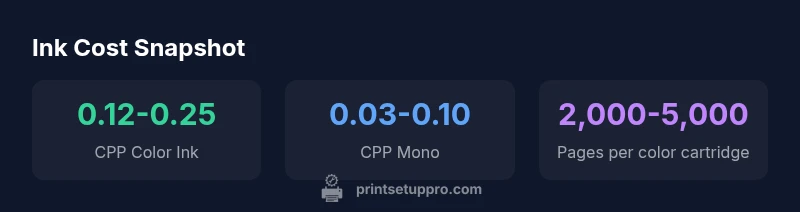
| Inkjet Color | $0.12-$0.25 | 150-400 pages | Common for photos; vary by cartridge |
| Mono Inkjet | $0.03-$0.10 | 400-1,000 pages | Best for text-heavy printing |
| Color Laser | $0.04-$0.15 | 2,000-5,000 pages | Efficient for high-volume text; color costs higher |
| Monochrome Laser | $0.02-$0.08 | 5,000-15,000 pages | Lowest CPP for bulk black-and-white printing |
People Also Ask
What is cost per page (CPP) and why does it matter for ink costs?
CPP is the total ink cost divided by pages printed, giving a practical measure of ongoing expense. It matters because it reveals whether an inexpensive cartridge actually saves money when used over months or years.
CPP tells you how much each page costs to print, which helps you compare long-term costs across models.
Can I save money by choosing refillable ink tanks?
Refillable ink tanks can reduce CPP for high-volume printing, but they require upfront investment and careful maintenance. Verify yields and compatibility before committing.
Ink tanks can lower costs if you print a lot; check yields and compatibility first.
Are third-party inks safe for printers and warranties?
Many manufacturers limit or void warranties with third-party inks, so consider warranty priorities. Always check the terms for your specific model and ink type.
Third-party inks can affect warranty terms; review your warranty before using them.
How do I estimate my annual ink cost?
Estimate based on your expected pages per month and multiply by the CPP, then add an allowance for occasional color prints and maintenance. This produces a practical annual ink budget.
Multiply your pages per month by CPP, then add for color printing and maintenance.
Is color printing more expensive than black-and-white?
Yes, typically color printing costs more due to multiple color cartridges and higher page coverage, though some models optimize color usage well. Compare CPP for your typical mix.
Color prints usually cost more per page, but models vary; check CPP for your needs.
“The true cost of printing is determined by long-term cost per page, not just the upfront price. This is why CPP-driven evaluations guide smart purchases.”
Quick Summary
- Define CPP, not price, as the true cost of ink over time
- Choose high-yield cartridges or ink-tanks to lower CPP
- Match printer type to your page mix (text vs photos)
- Test real yields with a small print batch before buying
- Consider setup habits that reduce color prints and waste