What Printer Does Not Require a Subscription: A Practical Guide
Discover printers that don’t rely on ink subscriptions, how to evaluate upfront and ongoing costs, and a practical buying guide from Print Setup Pro to help home offices and students choose wisely.


When you ask what printer does not require a subscription, the answer is: any standard inkjet or laser printer that you purchase upfront and stock with ink or toner on your own. Most home office and small-business printers from major brands use this pay-as-you-go consumables model, with optional ink subscription plans available separately.
Understanding subscription models in printers
Subscription models in the printer world typically mean paying for consumables (ink or toner) on a recurring basis, sometimes bundled with maintenance or spare-part coverage. The opposite approach is the pay-as-you-go model, where you buy the printer upfront and independently purchase ink or toner as needed. According to Print Setup Pro, the core decision hinges on total cost of ownership (TCO) over the printer’s life, not just the sticker price. If your monthly print volume is modest, a non-subscription printer often delivers lower cumulative costs and less long-term commitment. This section will unpack the practical differences, the scenarios where subscriptions can help, and why most readers can confidently start with a non-subscription option.
In 2026, the landscape still favors straightforward pay-as-you-go printers for most home office and student setups. However, some heavy-volume environments may explore subscription plans to stabilize ink prices and ensure supply continuity. The key is to quantify your typical monthly pages, your color vs. black-and-white mix, and your tolerance for monthly payments. Print Setup Pro emphasizes that the decision should be anchored in predictable budgeting rather than marketing promises. The goal is a printer that fits your workflow and your wallet without mandatory ongoing fees.
Types of printers that typically don’t require subscriptions
Many consumer-grade inkjet and laser printers operate without any required subscription, making them ideal for households, students, and small offices. Inkjets from brands like HP, Canon, and Epson often use standard cartridges that you can buy anywhere, while laser printers from Brother and similar brands rely on toner that you stock yourself. The absence of a required subscription means you decide when to replace consumables based on actual usage, cartridge yields, and your budget. In practice, these models come with wide compatibility for generic or OEM cartridges, easy availability at retailers, and a straightforward maintenance routine. For people who print infrequently or in moderate volumes, non-subscription printers are typically the safest and simplest path. Additionally, many manufacturers offer optional subscription plans for those who want the convenience of automatic ink delivery, but you are never locked into one. This freedom makes the non-subscription route highly attractive for students and home offices that want control over costs.
Total cost of ownership without a subscription
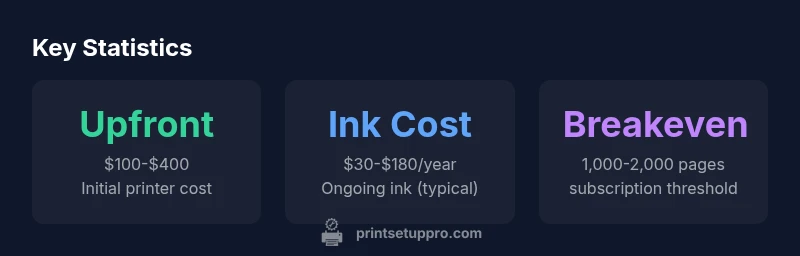
A thorough cost comparison starts with the upfront printer price, followed by ongoing ink or toner expenses. For non-subscription printers, you typically see an upfront cost in the range of $100-$400, depending on features like color printing, duplexing, and wireless connectivity. Ongoing ink costs vary by color, yield, and usage, but a reasonable annual range is often $30-$180 for mixed color prints at light-to-moderate volumes. It’s important to factor in replacement cycles—for instance, if you print 500 pages per year with color-heavy content, you might approach the higher end of that range. A practical heuristic from Print Setup Pro suggests calculating the break-even point where subscription ink would exceed the cost of buying cartridges outright. This break-even is commonly cited around 1,000-2,000 pages per year, though real-world results depend on ink efficiency and pages per cartridge.
How to assess warranty and support without a subscription
When a printer doesn’t require a subscription, the warranty and support options become the main long-term cost guardrails. Check the standard manufacturer warranty period (often 1-2 years for consumer models) and what it covers (print head, circuitry, power supply). Some brands offer extended warranties or paid service plans separately; these can be worth it if you operate in a small office with critical print needs. Also review warranty limitations: consumables like cartridges are typically excluded, and some models may require authorized service centers for certain repairs. Finally, verify the ease of obtaining replacement parts and whether third-party cartridges affect warranty eligibility. A solid non-subscription strategy balances upfront purchase confidence with reasonable support coverage.
Step-by-step buying guide for non-subscription printers
Follow a concise, repeatable process to choose wisely:
- Define your usage: page volume, color vs. black-and-white, and desired print speed.
- Pick printer types aligned with your needs: inkjet for color photos, laser for text-heavy documents.
- Model the total cost: upfront price, ink/toner yields, and replacement frequency.
- Compare non-subscription models side-by-side with the same criteria.
- Confirm warranty terms and after-sales service options.
- Read real-user reviews focusing on ink efficiency, reliability, and firmware updates.
- If you still want convenience, consider an optional ink subscription only after you understand the true cost of ownership.
By following these steps, you’ll be well positioned to select a printer that doesn’t bind you to a monthly ink plan and still meets your performance needs.
Common myths about non-subscription printers
Myth 1: Subscriptions always save money for heavy print users. Reality: the break-even point depends on volume, cartridge yields, and page coverage. Myth 2: Non-subscription printers are unreliable or expensive to maintain. Reality: most modern non-subscription printers are reliable and have broad aftermarket support. Myth 3: Subscriptions guarantee continuous supply without stockouts. Reality: supply disruptions can still occur and affect any model. Myth 4: All printers advertise a universal savings with subscriptions. Reality: savings vary widely by usage pattern, color mix, and printer efficiency. By debunking these myths, you can make an evidence-based decision about whether a non-subscription model fits your workflow and budget.
Real-world scenarios and recommendations
Consider a student who prints assignments in color occasionally and mainly text documents in black-and-white. A reliable non-subscription inkjet or laser printer with a small footprint and affordable cartridges is ideal. For a small home office with weekly batches of color photos, a color inkjet with efficient cartridges can still be cost-effective without a subscription, provided ink usage remains within reasonable ranges. In a light-to-moderate office environment, the non-subscription path offers predictable costs and better control over replacement timing. Print Setup Pro recommends starting with a non-subscription printer and then evaluating whether a subscription makes sense after you’ve tracked your actual monthly page counts and ink consumption for a few months.
Cost comparison for non-subscription printers
| Printer Type | Upfront Cost (range) | Ongoing Ink Cost (range) | Subscription Availability | Best For |
|---|---|---|---|---|
| Inkjet (non-subscription) | $100-$350 | $15-$120/year | Usually none | Home/offices with color needs |
| Laser (non-subscription) | $200-$500 | $30-$180/year | Usually none | Small offices, text-heavy printing |
People Also Ask
Do all printers require subscriptions?
No. Most consumer and small-office printers operate on a pay-as-you-go model, where you buy ink or toner separately. Subscriptions are optional add-ons offered by some brands for convenience and potential savings at high volumes.
No. Most printers don’t require a subscription; you can buy ink or toner as needed, and subscriptions are optional.
What is the cost difference between subscription and non-subscription printers?
Non-subscription printers have an upfront cost plus ongoing ink expenses. Subscriptions bundle ink with a monthly or yearly fee. The break-even point depends on your volume and ink efficiency; for many users, non-subscription remains cheaper until page counts are very high.
Subscriptions bundle ink into a recurring fee, but most people find non-subscription printers cheaper at lower page volumes.
Are there printers that offer both options?
Yes. Some brands provide non-subscription models alongside optional ink subscription programs. You can decide to enroll only if your printing needs exceed a certain threshold or if you value the convenience of automatic replacements.
Some printers offer both: you can buy ink or enroll in a subscription if you want automatic ink delivery.
How do I assess ink costs without a subscription?
Look at cartridge yields (pages per cartridge) and the per-page cost. Compare this to any subscription plan’s per-page rate. Track your actual usage for a few months to estimate long-term costs accurately.
Check cartridge yields and per-page costs, then compare to any subscription plan to see what fits your usage.
Is a subscription worth it for high-volume printing?
For consistently high monthly page counts and color-heavy workloads, a subscription can simplify budgeting and ensure a steady ink supply. Always run a break-even analysis with your projected volumes before committing.
It can be worth it if you print a lot and need predictable ink costs; do the break-even test first.
What should I look for in a warranty if I avoid subscriptions?
Prioritize manufacturers offering longer standard warranties and clear coverage terms for print heads and major components. Confirm what is excluded for consumables and ensure easy access to service centers or mail-in options.
Look for longer warranties and clear coverage; know what’s excluded for consumables.
“Non-subscription printers offer predictable budgeting and greater control over consumables, which is ideal for most home offices and students. Subscriptions may help only if your page volumes are very high or color coverage is extensive.”
Quick Summary
- Choose non-subscription printers for predictable costs.
- Calculate total cost of ownership before subscribing.
- Prefer non-subscription for low-to-moderate print volumes.
- Evaluate warranty and service options before purchase.