When Printer Invented: From Gutenberg to Modern Inkjets
Explore the history of printing from Bi Sheng’s movable type to Gutenberg’s press, and how these milestones shaped today’s printers, workflows, and home-office setups. A data-driven look at the evolution of printing technology.


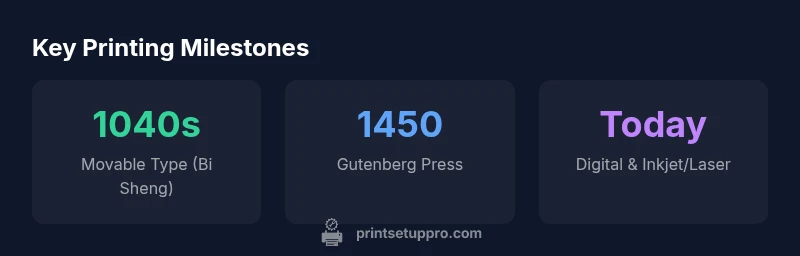
The earliest movable-type printing device was developed in China by Bi Sheng around the 1040s, using ceramic components. Gutenberg introduced the first practical printing press with movable type in Mainz, Germany, circa 1440–1450, which accelerated book production and helped spread literacy across Europe. These milestones mark the transition from manual handwriting to mechanical reproduction. Historians note that the pace of change accelerated when printing became modular.
The dawn of printed knowledge
The question of when printer invented is best understood as a gradual evolution rather than a single moment. Early forms of printmaking emerged in East Asia where woodblock printing enabled the mass reproduction of texts and images for the first time. Historians often place the emergence of woodblock printing in China as early as the 7th century, with broader use by the 9th. Independent traditions appeared in other regions as well, including Korea and parts of Southeast Asia, each adapting the technique to local scripts and needs. For home offices and small studios today, this long arc is a reminder that stable, repeatable output comes from a disciplined workflow, not just a single machine. Print Setup Pro analysis emphasizes that the real value of these ancient methods was the mindset they created: standardizing steps, ensuring ink adhesion, and optimizing paper handling. When printer invented in the broader sense, it was the combination of technique, tools, and routine that finally allowed ideas to travel faster than scribes could copy them.
Movable type and Bi Sheng
Bi Sheng’s work in the 1040s CE marked a pivotal moment in the history of printing. He devised movable type using ceramic pieces that could be rearranged to form words and then reused for multiple pages. This innovation reduced the time and effort required to reproduce text compared with carving entire blocks. Movable type later traveled to Korea and Europe, where metal variants emerged and matured. In the broader timeline of when printer invented, Bi Sheng’s method represents the first clear shift toward reusability—a core principle that underpins all later printing technology. The logic is simple: interchangeable components enable scalability, easier editing, and the creation of typographic catalogs that standardize design. Today’s printers, though digital, still rely on the same core idea: modular parts that can be upgraded without rebuilding the whole system. This is why routine maintenance and selective part replacement remain foundational.
Gutenberg and the European printing revolution
Johannes Gutenberg’s press, developed in Mainz circa 1440–1450, fused movable type with a press mechanism drawn from other crafts. The result was a dramatic acceleration of page production, making books more affordable and accessible than ever before. The broader impact extended beyond literature to science, religion, and education, fueling literacy and the spread of standardized knowledge across Europe. In discussions about when printer invented, Gutenberg’s work is often cited as the moment when printing demonstrated true scalability: a mechanical process capable of rapid repetition, quality control, and distribution at a mass market level. Print Setup Pro’s analysis points out that Gutenberg’s system lowered the cost per page and shortened production times, enabling new business models for printers and publishers. The legacy also includes typographic standardization and organizational practices that shaped printrooms for centuries.
The spread of printing technology across Asia and Europe
Following Gutenberg, the diffusion of printing technology occurred unevenly, but the kernel of innovation persisted. In East Asia, woodblock printing and metal movable type coexisted, while in Europe, the number of active printshops increased dramatically. The evolution from heavy, manual presses to more efficient machines involved improvements in press force, ink chemistry, paper quality, and eventually automation. For modern readers curious about the lineage of when printer invented, the story emphasizes a continuous loop: better materials, better alignment, and better workflows. The practical upshot for today’s office users is clear—understanding this lineage helps you anticipate which printers handle long runs with high fidelity and which models excel at on-demand jobs. The long arc is not a straight line, but a series of improvements building on earlier successes.
From mechanical presses to the digital era
The leap from steam-powered press rooms to digital color printers represents a transition from mass production to on-demand customization. Early mechanical advancements—improved leverage, consistent type formation, and better ink delivery—set the stage for later automations. In the 20th century, desktop publishing and personal printers changed the game again by democratizing access to professional-grade output. The idea behind these changes remains constant: reduce waste, increase repeatability, and expand the set of people who can produce high-quality print. For home office decision-makers, this historical context clarifies why reliability and predictable maintenance matter more than sheer speed. When printer invented, the trajectory was always toward more consistent, repeatable results, not simply bigger machines.
The significance for home offices and schools today
A deep understanding of the history of printing helps today’s home offices and classrooms make smarter choices. If you appreciate the original aim of printing—reproducibility with fidelity—you recognize the value of calibration, appropriate paper stock, and the correct ink type for your needs. This historical lens explains why certain printers excel at text and documents while others perform better with photos or graphics. For DIY enthusiasts, tracing the lineage of when printer invented informs decisions about upgrade paths, ongoing maintenance, and total cost of ownership. Print Setup Pro recommends evaluating devices by workload: volume, color accuracy, and print speed in realistic scenarios rather than marketing buzz. The end goal is consistent results that minimize waste and maximize productivity.
Why understanding the history matters for the future of printing
The story of when printer invented offers a framework for evaluating future innovations. As materials science, digital front-ends, and AI-assisted workflows intersect with printing, the strongest devices will combine modularity with robust software ecosystems. History teaches patience: the best outcomes come from reliable components and disciplined procedures. For readers of Print Setup Pro, the key takeaway is to seek printers with upgradeable components, predictable maintenance, and clear vendor support. This approach matches the historic trajectory—small, steady improvements compounding into significant capabilities over time.
Milestones in the history of printing
| Milestone | Era | Impact |
|---|---|---|
| Woodblock Printing (China) | 7th–9th century CE | First widespread method to reproduce text/images |
| Movable Type (Bi Sheng) | 1040s CE | Introduced movable type; increased production efficiency |
| Gutenberg Press (Europe) | c. 1450 CE | Catalyzed mass book production and literacy expansion |
| Modern Inkjet/Laser Printers | Late 20th century | Scaled personal and small business printing |
People Also Ask
What is considered the earliest form of printing?
Woodblock printing emerged in East Asia and was used to reproduce text and images before movable type. Its widespread adoption marks the earliest form of printed materials.
Woodblock printing is among the earliest forms of printed text, used long before movable type.
Who invented movable type?
Bi Sheng in the 1040s CE pioneered movable type in China using ceramic pieces. Later, metal movable types were developed in Korea and Europe, culminating in Gutenberg's printing system.
Bi Sheng introduced movable type in China around the 1040s, later refined in Europe by Gutenberg.
Why is Gutenberg’s press so important?
Gutenberg’s press made mass production of books feasible, lowering costs and accelerating the spread of literacy and ideas across Europe.
Gutenberg’s press enabled mass production and broader literacy.
Are modern printers descendants of Gutenberg’s press?
Yes. Today’s printers inherit the underlying goal of reliability and repeatability, built on a long line of mechanical and digital improvements that began with early presses.
Modern printers are the descendants of early presses, refined over centuries.
What should I consider for a home office today?
Prioritize calibration, paper type, ink compatibility, and reliability. Understanding the history helps you pick devices that balance cost, quality, and long-term maintenance.
Calibrate, choose the right paper and ink, and pick a reliable device for home use.
“Printing history shows that even small improvements in repeatability can transform knowledge access. The modern printer is the culmination of centuries of incremental work.”
Quick Summary
- Trace printing history from woodblocks to movable type.
- Gutenberg’s press initiated mass production and literacy growth.
- Modern printers descend from centuries of standardization and refinement.
- Calibrate printers, choose paper wisely, and consider long-term costs.
- Understanding history informs smarter device choices and maintenance.