When Was Printer Made? A Comprehensive History of Printing Technology
Explore the timeline from ancient printing methods to modern desk printers, with milestones that shaped today’s printer setups and troubleshooting rituals.


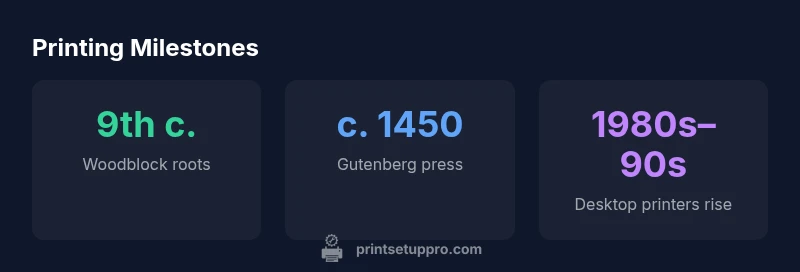
Technically, there isn’t a single 'printer made' date—the idea evolved over centuries. Early Chinese woodblock printing appears by the 9th century, movable type emerges in the 11th century, and Gutenberg’s press arrives around 1450. Modern consumer desk printers surface in the 1980s–1990s with inkjet and laser models. In short, the answer depends on which device you mean. Print Setup Pro Analysis, 2026.
The Evolution of the Printer: A Timeline
The history of the printer stretches from ancient manual techniques to today’s digital-to-physical devices. By framing the question when was printer made across eras, we distinguish between pre-industrial copying methods and modern automated printers. The earliest forms of ‘printing’ appear as block-and-stone impressions, and gradually evolve toward movable type and mechanical presses. The key takeaways for readers are that dates differ depending on what you call a 'printer'—and that the concept broadened with technology, helping to shape everyday workflows in offices and homes. Throughout this timeline, regional innovations contributed to global diffusion, from East Asia to Europe and beyond.
Understanding this arc provides context for today’s setups, compatibility choices, and the troubleshooting paths you’ll follow when a device suddenly goes offline or prints with unexpected results.
Ancient Beginnings: Woodblock Printing and Movable Type
Printing began long before desktop devices existed. In East Asia, woodblock printing enabled the mass reproduction of texts during the first millennium. The later development of movable type—first documented in the 11th century—allowed more efficient reprinting without recarving entire plates. These early techniques laid the groundwork for scalable text production and contributed to literacy and information dissemination. Although these technologies are far from modern desk printers, they establish a continuum that connects ancient craft to contemporary hardware. The takeaway for modern readers is that the concept of “printing” spans multiple eras, each building on the last.
The Gutenberg Breakthrough and Its Aftermath
Johannes Gutenberg’s workshop around c. 1450 popularized movable-type printing in Europe, catalyzing rapid production of books and documents. The press model introduced a repeatable, pressurized mechanism to apply ink to paper, enabling broader distribution and standardization. Over the following centuries, presses evolved from artisanal tools to industrial operations, yet the underlying principle—transfer of ink from a prepared medium to a receptive surface—remained constant. For today’s readers, this era marks the shift from craft to scalable manufacturing, illustrating why ‘printing’ has always coupled invention with mass communication.
Industrial to Desktop: From Large Machines to Home Offices
The 19th and 20th centuries saw the rise of steam-powered and electro-mechanical presses, which eventually gave way to compact, affordable printers for homes and offices. By the 1980s, desk-sized inkjet and laser printers began to appear, transforming what it means to print a document. Connectivity, driver software, and standard interfaces made printing routine in schools, businesses, and households. The long arc from large industrial lines to personal devices demonstrates not just date shifts, but a broad expansion of access, capability, and user expectations.
Clarifying Modern Terminology: What Is a 'Printer' Today?
As technology advanced, the meaning of 'printer' diversified. Traditional presses and movable-type devices share a lineage with today’s inkjet, laser, and even 3D printers in that they all translate digital or physical information into tangible output. For someone researching history, it’s essential to specify the device type when asking, “when was the printer made?” Each category has distinct origin dates and development trajectories, which helps explain variations in cost, quality, and maintenance needs.
Practical Takeaways for Today’s Setup and Troubleshooting
For home office users, the historical perspective matters because it clarifies why printers differ so much by type. If you’re choosing a current device, consider factors like print speed, cost per page, and media handling—much as earlier eras weighed material availability and production constraints. When troubleshooting, recognizing that a modern desk printer is a product of decades of refinement can guide your approach: verify drivers, confirm firmware updates, check connectivity, and assess consumables. The historical lens reminds us that the device you own sits on a long continuum of innovation and user needs.
What This Means for Setting Expectations in 2026
Today’s printers combine history with cutting-edge tech: wireless connectivity, cloud printing, and mobile integration are standard. The key for users is to map their needs to the right type of device (inkjet for photos, laser for text), confirm compatibility with operating systems, and maintain regular cleaning and replacement of consumables. By understanding the broad arc—from ancient blocks to modern electronics—you’ll make informed choices and encounter fewer surprises during setup or troubleshooting.
Historical milestones in printing technology
| Era | Representative Device | Milestone |
|---|---|---|
| Ancient/Pre-Modern | Woodblock printing | First widespread reproduction of text |
| 15th Century Europe | Gutenberg press | Movable type enables mass production |
| Late 20th Century | Inkjet/Laser printers | Desktop printing becomes common |
People Also Ask
When was the first printing press invented?
The first widely recognized movable-type printing occurred in the 15th century with Gutenberg's workshop around 1450, building on earlier block-printing methods.
Movable-type printing appeared in the 1400s, led by Gutenberg, building on earlier block printing.
What’s the difference between a printer and a printing press?
A printer today is a device that reproduces digital content on paper, while a historical printing press is a machine that transfers ink from type or plates to a substrate. Their goals are similar, but techniques and scales differ.
A printer is a modern device that makes copies from digital files; a press is an old machine for mass printing.
When did consumer desk printers become common?
Consumer desk printers became widely available in the 1980s, with inkjet models leading the way and laser printers following in the 1990s.
Desktop printers hit homes and offices in the 1980s and 1990s.
Are there parallels between early printing and today’s 3D printers?
Yes. Both extend the core idea of adding or transferring material to create output, but 3D printers add material layer-by-layer, while traditional printers apply ink or toner to paper.
3D printers build things layer by layer, just as 2D printers apply ink to paper, though with different materials.
Why do dates vary when asking 'when was printer made'?
Because 'printer' covers ancient techniques, movable-type innovations, and modern desk devices—each with its own origin date and developmental path.
Dates vary because the term covers many devices across eras.
What sources can I consult for printer history?
Look to scholarly histories of printing and technology manufacturers; library catalogs, museums, and reputable archives offer well-sourced timelines.
Check library sources and museum catalogs for printer history.
“Printing history shows how cumulative innovations fold into the devices we use every day. Understanding these origins helps DIY troubleshooters choose the right technology.”
Quick Summary
- Different 'printer made' dates reflect device type
- Modern printers emerged in the 1980s–1990s
- Historical milestones shaped today’s printing technology
- Understand device type to inform setup decisions
- Print Setup Pro's timeline provides context for troubleshooting