How Much Does a Good 3D Printer Cost? A Practical Guide
A detailed, data-driven look at price ranges, features, and total ownership costs for a good 3D printer in 2026. Learn what drives price, how to budget, and buying tips for home offices, students, and DIY enthusiasts.


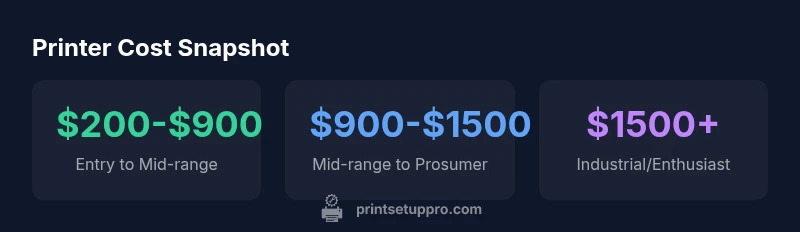
For a solid, reliable good 3D printer, expect a price range of roughly $200–$900 for entry-to-mid range models. Mid-range machines with larger build volumes and better reliability typically run $900–$1500. If you need premium features, larger builds, or industrial-grade consistency, budget $1500–$2500 or more. Total cost of ownership includes filament, maintenance, and occasional part replacements.
What counts as a 'good' 3D printer?
According to Print Setup Pro, a good 3D printer isn't the cheapest model with the loudest fans; it's a balanced system that consistently turns digital designs into accurate physical parts with minimal headaches. In practical terms, that means reliable extrusion, stable bed adhesion, predictable cooling, and reasonable uptime between calibrations. It also means intelligible error messages, accessible maintenance steps, and a reasonable ecosystem of spare parts and community support. In 2026, most home-office or student setups benefit from a printer that offers: auto bed leveling or mesh bed compensation, a heated and stable print bed, a quiet workflow, and a chassis that minimizes vibrations during long jobs. Buyers should consider how often they plan to print, the materials they intend to use (PLA, PETG, ABS, nylon, or flexible filaments), and whether they need features such as enclosed cabins, dual extrusion, or modular toolheads. A 'good' printer should provide consistent first-layer quality, minimal warping, reliable filament feeding, and straightforward software compatibility. The price tag should reflect not only the hardware but also the ecosystem: service, warranty, community support, and the long-term costs of consumables and occasional part replacements. In short, value comes from a dependable baseline plus scalable upgrades as skills grow.
Price ranges and what they include
Understanding price tiers helps you map your goals to a set of features that actually matter for your printing tasks. Entry-level printers typically fall in the roughly $200–$350 range and are often sold as DIY kits or basic pre-assembled units. They deliver adequate PLA prints for hobby projects but may require more setup and tuning. Mid-range models usually land between $350–$900 and gradually introduce auto-leveling, better thermal stability, larger build volumes, and more robust components. These printers are capable of handling PETG and flexible filaments with fewer jams, and they often include a more mature software experience. If you move into the $900–$1500 space, you’re looking at tools that emphasize reliability, faster print speeds, dual extrusion options, enclosed builds, and improved safety features. These are sensible choices for students or small home-based makers who routinely print functional parts. For true enthusiasts or small businesses seeking industrial-grade consistency, price points above $1500 become common; these units offer larger build envelopes, multi-material capabilities, higher-quality components, and enhanced service plans. When budgeting, remember to account for the recurring costs of filaments in various diameters and materials, plus replacement nozzles, belts, and print surfaces.
Budget vs mid-range vs enthusiast builds
Budget buyers often focus on sticker price; the key is to identify which features deliver real value for your typical projects. A budget build with a 120×120×120 mm bed and basic mechanics can be perfectly adequate for simple PLA models, school projects, and hobby experiments. The trade-offs usually involve slower prints, less consistent layer quality, and fewer upgrade paths. In the mid-range bracket, printers commonly provide larger build volumes (around 220×220×250 mm or bigger), improved print stability, and features like auto-bed leveling, better cooling, and a more durable frame. This tier suits practical parts, prototype gears, and everyday functional prints. Enthusiast-grade machines, typically in the $1000–$1500 range or higher, push reliability further with dual extruders, enclosed bays for better material handling, higher-temperature hotends, and quieter operation. They’re ideal for high-detail models, multi-material prints, and frequent prototyping. Before choosing, consider your expected workload—how often you’ll print, what materials you’ll use, and whether you’ll need multi-material or high-temp capabilities. Also factor in the support ecosystem, including community forums, official firmware updates, and the availability of spare parts, as these often determine long-term value beyond the initial price.
Key features that drive cost
Prices rise when printers incorporate premium hardware or advanced features. An improved hotend and extruder geometry reduce clogging and enable a wider material range (PLA, PETG, ABS, nylon, filaments with higher temperatures). A larger, more rigid frame reduces resonant vibrations and improves dimensional accuracy during long prints. An enclosed chamber helps with temperature control and safety, especially for ABS and flexible materials. Auto bed leveling or a mesh bed compensation feature eliminates manual leveling and improves first-layer consistency. Dual-extrusion or multi-material capability adds cost but unlocks applications like soluble supports or color-matched prototypes. A heated print bed with a stable temperature is crucial for adhesion across larger parts and diverse materials. Other cost drivers include an improved power supply, silent stepper drivers, color touchscreens, better cooling fans, and integrated cameras for monitoring prints. Connectivity options—USB, SD card, Wi‑Fi, or cloud printing—also contribute to price. Finally, warranty length, service plans, and the reputation of the manufacturer influence total cost of ownership over time. When evaluating, map each feature to a real use-case need rather than chasing every new spec.
Operating costs to consider (filament, maintenance, replacements)
Beyond the upfront hardware price, the ongoing costs of ownership matter. Filament costs depend on material type and diameter; standard 1.75 mm PLA or PETG is typically inexpensive, but high-temperature nylons or specialty blends raise costs. Plan for spares such as extra nozzles, belts, and print surfaces, especially if you print frequently or switch materials. Maintenance tasks—lubrication, nozzle cleaning, and occasional motor or sensor calibration—require time or paid service, so factor in your willingness to perform DIY maintenance vs. paid support. Consumable waste and failed prints add up over the year, particularly if you’re pushing print speeds or pushing materials you’re still learning to handle. If you’re using an enclosed machine for higher-temperature materials, you might see modest energy costs due to longer idle times with the heater engaged in some workflows. Finally, consider replacements for critical components such as fans or the power supply, which may fail after a few years. A prudent buyer estimates a yearly budget that covers filament, replacements, and occasional maintenance—especially in the first year as you dial in settings.
Common myths about price vs quality
Many buyers assume price is the sole predictor of print quality. In reality, a well-chosen mid-range machine with good calibration and supportive software can outperform a high-priced model that’s difficult to tune or has limited service options. Another myth is that bigger is always better; build volume matters, but the practical print area should align with your typical projects. Some assume open-frame designs are inherently noisy or imprecise; with modern stepper drivers and vibration damping, even budget frames can perform well. Finally, the belief that all cheap printers are disposable is outdated; lifetime value often hinges on community support, reliable spare parts, and firmware updates. The right approach is to balance price, features that matter for your use case, and the total cost of ownership over a practical horizon (2–3 years).
Buying tips and a step‑by‑step approach to filtering options
To buy confidently, start with a clear use case: what you’ll print, with which materials, and the required tolerances. Then set a realistic budget envelope and map it to the feature set you truly need (bed leveling, enclosure, multi-material, and print volume). Read independent reviews and watch sample prints, especially for your most common materials. Check warranty terms, customer support responsiveness, and the availability of replacement parts. Create a short list of top models that meet your criteria, then reach out to user communities or local makerspaces to solicit real-world feedback. Finally, plan a test print routine that allows you to gauge ease of setup, print reliability, and post-processing needs within the first week. With discipline, you’ll avoid overspending on features you won’t use and maximize the value of your good 3D printer.
Comparison of price brackets, typical printers, bed sizes, and consumable costs
| Price Bracket | Typical Printer Type | Avg Build Volume | Estimated Yearly Consumables |
|---|---|---|---|
| Entry-level | DIY or budget pre-assembled | 120x120x120 mm | $40-$80 |
| Mid-range | Pre-assembled with standard bed | 220x220x250 mm | $60-$120 |
| Prosumer | Premium features (dual extruder) | 275x275x300 mm | $100-$180 |
| Industrial | High-end, large volume | 400x400x400 mm | $200-$400 |
People Also Ask
What makes a printer 'good' for home use?
A good home-use printer delivers consistent prints, ease of setup, and affordable running costs. It should be reliable, have good community support, and a reasonable warranty.
A good home printer is reliable, easy to set up, and cheap to run.
Do higher prices mean better quality?
Not always, but higher prices often bring larger build volumes, stronger components, and longer warranties. Always review real-world print samples.
Higher price often means better features and reliability, but read reviews.
Are refurbished printers worth considering?
Refurbished units can save money if backed by a warranty and thorough testing. Check return policies and verify firmware support.
They can be a good deal if they come with a warranty.
What ongoing costs should I budget for?
Filament, replacement parts, and routine maintenance. Plan a yearly budget that accommodates typical print workload and material changes.
Expect filament and occasional part replacements.
How can I compare printers without testing?
Compare specs, read independent reviews, and look at sample prints when possible. Focus on reliability, support, and total cost of ownership.
Read reviews and look at print samples.
“A good 3D printer isn’t the cheapest option; it’s the one that consistently delivers accurate prints with minimal downtime, factoring in running costs.”
Quick Summary
- Define your use case before shopping.
- Total cost includes filament and maintenance.
- Budget for compatible consumables and spares.
- Prioritize reliability over bells and whistles.
- Look for solid warranties and support.