How Much Does a Metal 3D Printer Cost? A Practical Guide
Explore the true cost of metal 3D printers, including upfront prices, ongoing costs, and ROI considerations for home offices, labs, and small manufacturers.


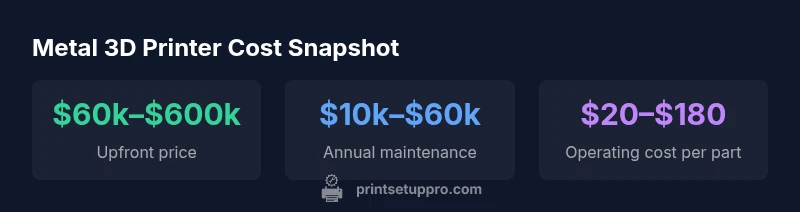
Metal 3D printers typically cost between $60,000 and $600,000 upfront, depending on technology and build volume. When you factor in post-processing, materials, and maintenance, the total investment often climbs well beyond the sticker price for active production use. This guide breaks down price drivers and real-world cost ranges to help buyers budget accurately.
Understanding the price landscape for metal 3D printers
Metal 3D printers sit in a broad price spectrum that reflects technology, build volume, and post-processing needs. For buyers in home offices or small shops, the sticker price can be intimidating, but the total investment includes powders, services, and tools that enable production-grade parts. According to Print Setup Pro, upfront costs are only part of the picture; many buyers underestimate the ongoing requirements. In 2026, the market shows a wide range: entry-level production-capable machines can be tens of thousands, while enterprise-scale systems push well into the six-figure range or more. This disparity makes a clear cost justification essential. When budgeting, consider not only the machine price but also post-processing equipment, safety systems, and the energy footprint of daily operation. A thorough cost assessment helps avoid surprises and aligns the purchase with expected throughput and quality goals.
- Speak to vendors about what is included in the base price (software, licenses, and training).
- Plan for space, electrical, and ventilation needs, which can affect installation costs.
- Factor in post-processing demands, which often drive the majority of life-cycle costs for metal parts.
What drives the upfront cost
Upfront pricing is driven by several core factors. Build volume and chamber size determine how large a part you can print in one job, which directly affects throughput and equipment utilization. Laser power, scan speed, and powder handling capabilities (blowing, sieving, and recycling) add to the price because they influence reliability and part quality. The choice between closed-loop optics, inert gas environments, and automated material handling systems can push the price higher. Software ecosystems—onboard slicers, preparation tools, and simulation modules—also factor in. Finally, installation, training, and initial service contracts add non-negligible costs. The result is a price ladder where small, hobbyist-adjacent systems sit at the low end, while fully integrated production lines with robust post-processing workflows sit at the high end.
Technology options and their price ranges
There are several metal printing technologies to consider, each with its own cost profile. Direct Metal Laser Sintering (DMLS) and Selective Laser Melting (SLM) typically occupy the higher end of the spectrum due to chamber pressure, laser power, and material handling requirements. Binder jetting for metals can offer different economics, often with higher upfront capital but potentially lower per-part costs, depending on materials and post-processing. Directed Energy Deposition (DED) approaches can be attractive for repair and existing-part scaling but may require specialized tooling. In general, you can expect upfront ranges from roughly $60,000 to $600,000 for production-capable desktop-to-mid-size systems, and well beyond for larger, enterprise-grade setups. It’s essential to map your intended output to a technology profile rather than chasing the loudest marketing claims.
Beyond the machine: Total cost of ownership
The machine price is only part of the equation. Material costs for metal powders vary by alloy and supplier, and many users must budget for powder loss, recycling, and storage. Post-processing—machining, heat treatment, surface finishing, and inspection—often accounts for a large share of ongoing costs and may require dedicated equipment such as tumblers, CNC mills, or grinding stations. Facility requirements matter too: ventilation, filtration, and periodic safety checks add recurring expenses. Power consumption and maintenance contracts contribute annually, and software subscriptions may escalate with feature-rich packages. A holistic view of reliability, uptime, and throughput is critical to avoid underestimating the total cost of ownership.
Budgeting and ROI considerations
ROI is driven by how many high-value parts you print and the value those parts deliver. To estimate payback, forecast annual production volume, expected part price, and the cost of labor saved or profits gained from faster lead times. Don’t forget intangible benefits: design freedom, streamlined workflows, and reduced outsourcing. Create a simple TCO model that includes the machine price, maintenance, powders, post-processing, energy, and labor. Compare scenarios with different utilization rates (low, mid, high) to determine a credible payback window. Print Setup Pro’s budgeting framework emphasizes conservative projections and a test run with pilot batches to validate assumptions before scaling.
How to buy smart: financing, resellers, and alternatives
For many buyers, cash flow makes financing or leasing appealing. Vendors often offer structured payment plans, while third-party financiers may provide competitive rates with favorable terms. Exploring refurbished or used machines through certified channels can reduce upfront costs, but requires due diligence on wear, known issues, and remaining warranties. Outsourcing some production to a service bureau can be a cost-effective alternative for infrequent or high-mix runs, allowing you to validate designs before committing to a full machine. Finally, negotiate inclusions like maintenance windows, powder services, and training to maximize value from any deal.
Practical buyer checklist
- Define your production goals: volume, lead times, and required tolerances.
- Map total costs: machine price, powders, post-processing, maintenance, energy, software, and labor.
- Compare technologies by your use case (DMLS vs binder jetting vs DED).
- Include space, ventilation, and safety requirements in your due diligence.
- Request a detailed ROI model and a pilot print plan before committing.
- Check post-install service, training, and upgrade paths.
Price and cost factors by metal 3D printing technology
| Technology | Typical Upfront Price | Annual Maintenance | Operating Cost per Part |
|---|---|---|---|
| DMLS (Direct Metal Laser Sintering) | $60,000–$400,000 | $15,000–$50,000 | $20–$150 |
| Binder Jetting (metals) | $200,000–$600,000 | $20,000–$60,000 | $25–$120 |
| Selective Laser Melting (SLM) | $250,000–$800,000 | $25,000–$70,000 | $30–$180 |
People Also Ask
What is the typical upfront cost range for a metal 3D printer?
Most new metal 3D printers start around $60,000 and can exceed $400,000, depending on capability and scale. Higher-end systems for production environments may push beyond this range. Always couple the machine price with expected post-processing and material costs.
Most metal 3D printers start around sixty thousand dollars and can go well above four hundred thousand, depending on features and capacity.
What additional costs should I expect beyond the machine price?
Expect powder materials, post-processing equipment (machining, heat treatment, finishing), software licenses, safety systems, maintenance, and energy. Consider potential service contracts and training as part of the initial budget.
Beyond the machine, you’ll pay for powders, post-processing, software, maintenance, and energy.
Is financing or leasing common for these machines?
Yes. Vendors offer financing plans and leases to spread upfront costs. Evaluate total cost of ownership, insurance, and maintenance terms to determine the best financing mix for cash flow and ROI.
Financing and leasing are common; compare total costs and terms to find the best option.
How long does it take to recoup the investment?
Payback depends on part volume, material value, and post-processing costs. In some production scenarios, payback can be 1–3 years with steady throughput and high-value parts.
Payback depends on usage; many users see 1 to 3 years with consistent production.
Are there cheaper alternatives to metal 3D printing?
Yes. Outsourcing to service bureaus, using non-metal additive processes for prototyping, or purchasing a lower-capacity system for limited runs can reduce upfront risk while validating designs.
Outsource to a service bureau or use non-metal prototyping first to reduce upfront risk.
“Price is only one dimension of value. The real decision comes from total cost of ownership, including post-processing, materials, and uptime.”
Quick Summary
- Estimate total cost, not just upfront price
- Match technology to production goals
- Plan for post-processing and materials early
- Explore financing or used machines if appropriate
- Ask for a detailed ROI and pilot plan