Ink Tank Printer vs Inkjet: A Comprehensive Comparison
Compare ink tank printers and inkjets across cost, maintenance, print quality, and reliability. Learn which option fits home offices, students, and small businesses, with practical guidance and setup tips.


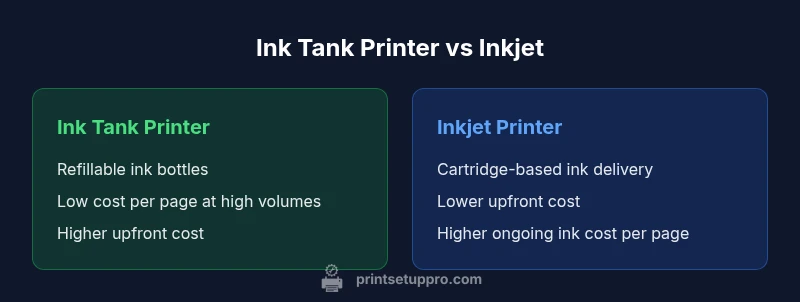
Ink tank printers generally offer lower ongoing costs and fewer cartridge replacements than traditional inkjet models, especially for high-volume printing. However, upfront prices can be higher, and ink bottle refills may require more hands-on maintenance. For most home offices and small businesses with regular print needs, ink tank printers provide better long-term value.
What is an ink tank printer?
An ink tank printer uses a system of refillable ink reservoirs instead of disposable cartridges. Bottles of ink are poured into the tanks, typically through a simple fill port, allowing for large ink capacities and significantly lower running costs when you print in bulk. This design reduces plastic waste since you’re replacing bottles rather than entire cartridges. There are variations in tank design, capillary systems, and bottle compatibility, so when shopping, check tank size, refill availability in your region, and whether the printer supports easy bottle refilling without spills. According to Print Setup Pro, ink tank systems tend to be more cost-efficient at higher volumes, though the initial price premium can be a barrier for very light users. This matters most for users who print hundreds or thousands of pages each month.
How ink tank printers work
Ink tank printers employ a refillable reservoir connected to the print head via micro-pump channels. When you print, ink is drawn from the reservoir and sprayed through nozzles with precise drop sizes. The system uses dye or pigment inks, or a mix, depending on the model and intended use (text vs. photos). Modern units incorporate auto-resetting sensors to monitor ink levels and alert you when a tank is low. The advantage is clear: fewer cartridge replacements and lower per-page costs, provided you consistently use compatible inks from reliable suppliers. Refilling is typically straightforward, though you should use the manufacturer’s recommended inks to preserve print quality and warranty coverage.
What is an inkjet printer?
Inkjet printers rely on cartridges to deliver ink to paper. They are widely available, with a broad range of models from basic monochrome to high-end photo printers. Cartridges are often sealed in color groups (cyan, magenta, yellow, black), with some models supporting individual-color cartridge replacement. The advantage is convenience and lower upfront cost, especially for light users or students who print sporadically. However, ongoing costs can be higher because ink cartridges must be replaced more frequently than refilled tanks, and some compatible third-party inks can affect warranties. Inkjet technology excels at vibrant color and photo realism, particularly when paired with high-quality photo paper and appropriate inks.
Cost considerations: upfront vs ongoing costs
One of the biggest differentiators between ink tank and inkjet printers is total cost of ownership. Ink tank printers typically carry a higher upfront price due to the larger reservoirs and integrated refill systems. Over time, the cost per page tends to be much lower with ink tank models, especially for households or small businesses that print in high volumes. This is where “value” emerges: if your monthly page count is in the hundreds or thousands, the savings from fewer ink replacements can offset the initial premium. For lighter users, the upfront cost gap may not be justified. Print Setup Pro analysis indicates that the break-even point depends heavily on monthly print volume and whether you source ink from the manufacturer or third parties. Consider your typical print mix — text-heavy documents vs. color photos — when weighing these costs.
Print quality and color handling
Inkjet printers can deliver superb color reproduction, particularly for photos and graphics, when used with the right ink sets and photo paper. The color gamut is often broader with dye-based inks or high-quality pigment inks, providing rich, saturated photos and smooth gradients. Ink tank printers can also produce excellent results, especially for text documents and color graphics, but achieving top-tier photo quality depends on using compatible inks and media. Some users notice slight variances in color accuracy if the ink refills aren’t matched to the original color profile. Overall, ink tank systems are capable of high-quality output for most office tasks, but photographers and color-critical workflows may prefer premium inkjet configurations.
Maintenance, reliability, and refills
Maintenance for ink tank printers centers on keeping tanks clean and ensuring bottles are sealed properly after filling. Most units require less frequent part replacement than cartridge-based printers, which can reduce downtime. However, refilling bottles introduces a different maintenance task: you must handle inks carefully to avoid spills or air bubbles, which can affect print quality. Reliability tends to be strong across modern models, but you’ll want to stay with official inks or reputable third-party brands to protect print quality and warranty. Some readers report occasional clogging if the printer sits idle for long periods; running a print job every few days helps mitigate this.
Use-case scenarios: home office, student, small business
For home offices and students who print frequently and value cost efficiency, ink tank printers often outperform cartridge-based rivals in long-term cost. They are particularly suitable for high-volume document printing, school reports, and colorful presentation handouts. Small businesses with regular color printing may also benefit, provided the business can manage regular ink refills and has a stable ink supply chain. If your primary needs include occasional printouts, occasional photos, or you require the absolute lowest upfront cost, a traditional inkjet may be more convenient. Always factor in media costs and warranty terms when evaluating long-term viability.
Environmental and recycling considerations
Refillable ink tank systems reduce plastic cartridge waste and the frequency of ink cartridge disposal. This is a meaningful environmental benefit for eco-conscious buyers. Still, the bottles themselves constitute waste, so it’s worth choosing inks from manufacturers that support refill programs or recycled packaging. Recycling programs for ink cartridges are widespread, but the best environmental outcome often comes from choosing a model with a long warranty and reliable, refill-friendly ink bottles. If sustainability is a priority, ink tank printers with refill-friendly designs typically help minimize waste over the printer’s lifetime.
Setup, maintenance tips and best practices
Begin with a clean workspace and protective gloves to prevent ink staining. Follow the manufacturer’s instructions for priming the tanks and aligning the print head after initial setup. Use only the recommended inks to ensure color accuracy and avoid damage to the print head. Keep an eye on the warranty terms: some printers may restrict warranty coverage if non-authorized inks are used. Schedule periodic nozzle checks and perform cleaning routines when you notice faint lines or color gaps. Maintain a regular printing schedule to keep ink flowing and reduce the risk of nozzle clogs, especially in drier environments.
Common myths and misconceptions
A common myth is that ink tank printers always offer perfect color accuracy for photos; in reality, achieving optimal image quality depends on ink type, media choice, and calibration. Another misconception is that refill tanks are mess-free; spills can occur if you rush the refill process, so take your time and use the manufacturer’s recommended technique. Finally, some buyers worry that ink tank printers are not compatible with third-party inks; while compatibility varies, most modern ink tank models support a wide range of fill inks when used correctly.
Comparison
| Feature | Ink Tank Printer | Inkjet Printer |
|---|---|---|
| Upfront cost | Typically higher due to refillable tanks | Generally lower upfront price for cartridge-based models |
| Cost per page | Low, with steady volumes and proper inks | Moderate to high depending on cartridge price and usage |
| Refill frequency | Infrequent, bottle refills per volume | More frequent cartridge replacements or refills |
| Print speed | Comparable to entry-level inkjets for text; color may vary | Good to fast for basic tasks; photo speed varies by model |
| Color quality | Excellent with proper inks for graphics; strong text | Excellent photo and color reproduction with the right inks |
| Waste and sustainability | Less plastic waste due to refill bottles | Higher cartridge waste unless recycled |
| Best for | High-volume printing and cost-conscious users | Occasional or color-rich printing with fast upfront affordability |
Benefits
- Lower ongoing operating costs with high-volume printing
- Fewer cartridge replacements and less packaging waste
- Large ink reservoirs reduce downtime between refills
- Better value for price-per-page when used heavily
Downsides
- Higher upfront cost for ink tank systems
- Refilling bottles can be messy if rushed
- Color photo quality can depend on ink/media choices
- Some models have limited third-party ink availability in certain regions
Ink tank printers win on long-term value for high-volume printing
Choose ink tank if you print frequently and want lower ongoing costs. Opt for inkjet if upfront price and ultra-wide color photos are priorities, or your volume is moderate.
People Also Ask
What is the main difference between an ink tank printer and an inkjet printer?
An ink tank printer uses refillable reservoirs with ink bottles, offering lower long-term costs for high-volume printing. An inkjet printer primarily uses disposable cartridges, typically cheaper upfront but with higher ongoing ink costs. The choice depends on your volume and need for color quality.
Ink tanks use refill bottles, saving money if you print a lot, while standard inkjets use cartridges and are cheaper upfront.
Are ink tank printers cheaper to operate over time?
Generally yes for high-volume users, because per-page ink cost is lower with refilled tanks. Break-even depends on monthly page counts and ink pricing. For light users, the upfront premium may not be worth it.
Yes, for heavy printing you usually save on ink costs over time; for light use, the upfront price matters more.
Can I use third-party inks with ink tank printers?
Many ink tank printers support third-party inks, but compatibility varies by model. Using non-original inks can affect print quality and may impact warranty terms. Always check the manufacturer’s guidance before purchasing third-party ink.
Some models allow third-party inks, but check your warranty and print quality before switching.
Which is better for photos: ink tank or inkjet?
Inkjets typically excel at photo quality due to broader color ranges and pigment or dye inks. Ink tank printers can produce good photos when paired with suitable inks and media but may not match high-end photo printers. Choose based on your photo needs and budget.
Inkjets usually give you the best photos; ink tanks can do decent photos with the right inks and media.
Do ink tank printers require special maintenance?
Maintenance mainly involves careful refilling and periodic nozzle checks. Avoid letting tanks dry out and run test pages to keep ink flowing. Regular use helps prevent clogs and keeps print quality stable.
Refill carefully and run regular nozzle checks to keep things smooth.
How do I decide between ink tank and inkjet for a small business?
Consider expected monthly page volume, color needs, and tolerance for upfront costs. If you print many pages with mixed color requirements, an ink tank printer could offer long-term savings. For light or infrequent use, an entry-level inkjet may be sufficient.
Look at your monthly pages and color needs, then choose based on long-term costs and upfront price.
Quick Summary
- Assess monthly page volume to determine value
- Prefer ink tanks for high-volume document printing
- Consider media and ink availability when aiming for photo quality
- Factor upfront cost against long-term savings
- Use manufacturer inks to protect warranty and results