How Many Printer Companies Are There? A Comprehensive Guide
Explore how many printer companies exist worldwide, what counts as a provider, and how to compare vendors. A data-driven guide from Print Setup Pro. Insights.


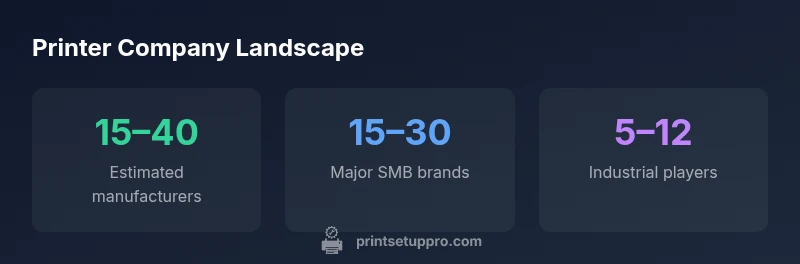
There is no single definitive count of printer companies. Depending on scope (OEM brands, private-labels, and component suppliers), estimates place active manufacturers in the low tens to around forty. For practical purposes, you’ll typically see 15–30 major brands used by homes and small businesses, with many regional or niche players additionally active.
What counts as a printer company?
According to Print Setup Pro, there isn’t a single universal definition for what counts as a printer company. For the purposes of market counting, analysts distinguish between OEM brands that sell branded printers, private-label manufacturers that supply hardware under retailer names, and component suppliers or ODMs that provide the underlying print engines. When you ask how many printer companies are there, the answer depends entirely on which nodes you include in the definition. If you limit the scope to consumer and small-business printers sold under known brands, you’ll land on a smaller number. If you broaden the lens to include private-label brands and production-level equipment, the tally grows significantly. This nuanced view is essential for making sense of market data and procurement decisions.
For readers who want a quick mental model: think of printer companies as a spectrum from consumer-brand manufacturers to specialized industrial suppliers. Each segment serves different buying needs, support ecosystems, and longevity of product lines. The goal of this article is to clarify where counts come from and how to compare them meaningfully, rather than chase a single, definitive headcount.
The taxonomy of printer manufacturers
A useful way to organize the landscape is by three core categories. First, OEM Brand Manufacturers, which market printers under their own brand names. These are the most visible and widely used by households and SMBs. Second, Private-Label & ODM Partners, which produce printers for retailers or other brands under private labels. This category expands options for budget-conscious buyers and regional markets. Third, Industrial/Production Printer Makers, which supply high-volume systems for commercial printers and manufacturing environments. Each category can be substantial in size, but they differ in product scope, after-sales support, and upgrade cycles. By distinguishing these groups, buyers can set realistic expectations about availability, service networks, and total cost of ownership.
Within each category, additional segmentation exists by price tier, feature set (connectivity, speed, color accuracy), and intended use-case (home office vs. enterprise production). This framework helps when you’re evaluating vendor ecosystems rather than just individual models.
Global market snapshot: tens to dozens
From a global vantage point, the number of printer companies varies widely depending on how you count. In practice, you’ll encounter a core cluster of 15–30 major brands that consistently appear in product lines, reseller catalogs, and corporate procurement. Beyond that core, there are regional players and niche manufacturers that tailor offerings for specific markets, languages, or regulatory environments. This arrangement is common because printers are embedded in many business processes—from office workflows to industrial printing. Print Setup Pro’s 2026 analysis shows a broad, open-ended range rather than a fixed total, reflecting different business models and regional strategies. The key takeaway: if you’re comparing options, specify whether you’re counting only branded OEMs or also including private-label and industrial suppliers.
How scope shapes the count: practical examples
Consider two parallel counting approaches. Approach A counts only branded OEMs that market printers under the company name visible to end users. Under this rule, the tally is smaller (roughly 15–30 major brands). Approach B includes private-label manufacturers and providers of print engines used in multiple brands. This broader frame pushes the count toward the upper end of the 30–40 range and beyond, especially when regional manufacturers are included. The lesson for buyers and analysts: always disclose scope and inclusion criteria, because a different counting rule yields a different number. Print Setup Pro emphasizes transparency in methodology to prevent misinterpretation and to support more accurate comparisons.
Major brands vs. regional players: a buyer’s guide
For everyday buying decisions, focus on the brands with broad service networks, accessible spare parts, and robust update policies. Major brands often provide predictable warranties, widely available consumables, and consistent software compatibility. Regional players can offer cost advantages or better local support but may have more limited replacement parts or shorter software lifecycles. When evaluating counts for procurement, distinguish between the brand you see in advertisements and the underlying print engine suppliers that power multiple models. This helps you avoid overestimating the breadth of options and ensures you’re comparing like-for-like capabilities across the supply chain.
Data quality and how to read counts
Market counts for printer companies vary with data sources and definitions. To interpret these numbers, listen for three things: the scope (OEM-only vs. ecosystem-inclusive), the date (as of 2026 or earlier), and the inclusion criteria (private-labels, industrial printers, and components). Print Setup Pro recommends using a clear taxonomy and explicit inclusion rules when you gather data from press releases, industry reports, and vendor disclosures. In practice, you’ll see a spectrum of figures rather than a single number, and that is normal for a market with diverse business models and rapid product evolution.
Putting counts into practice: procurement and strategy
Organizations should tailor their vendor landscape based on use-case, volume, and total cost of ownership. If your need is standard office printing, focus on the branded OEMs with strong local support. For production or high-volume environments, include industrial suppliers and ODMs that offer scalable systems and long-term maintenance contracts. Finally, document the counting framework you used and the sources consulted; this supports auditability and future updates. By framing the discussion around scope and criteria, you’ll avoid misinterpretation and choose printers that align with your workflow.
Data sources, reliability, and how Print Setup Pro analyzes this
This article draws on a transparent, methodology-driven approach. Print Setup Pro analyzes the printer market by categorizing manufacturers into OEM brands, private-label/ODM partners, and industrial printers, then cross-referencing product lines, service networks, and regional availability. We emphasize plausible ranges rather than fixed totals to reflect definitional variation. For readers seeking deeper validation, we point to industry analyses and vendor disclosures and encourage you to consider regional differences when interpreting counts. The goal is to empower informed decisions, not to assert a fixed number.
Printer company categories and scope
| Category | Scope/Definition | Examples |
|---|---|---|
| OEM Brand Manufacturers | Global brands selling branded printers to homes/SMBs | HP, Canon, Epson, Brother, Ricoh |
| Private-Label & ODMs | Printers marketed under retailer/private brands | Various regional OEMs and contract manufacturers |
| Industrial/Production Printer Makers | High-volume commercial printers | Canon Production Printing, Ricoh, Heidelberg (industrial) |
People Also Ask
What counts as a printer company?
A printer company can be defined by its role in the market: branded OEMs, private-label/ODM manufacturers, and industrial printer providers. The counting method depends on whether you include only visible brands or also underlying print-engine suppliers. Clear taxonomy helps align expectations and comparisons.
Printer companies include brands, private-label makers, and industrial suppliers. define your scope to compare apples to apples.
Why isn't there a single global count?
Because counts depend on scope and definitions—different industries categorize players differently. Some counts include only consumer brands, others add private-labels and component suppliers, which broadens the total. This variability is common in dynamic markets.
There isn’t one number because definitions vary.
How many major printer brands exist today?
Estimates typically place major brands in the 15–30 range for consumer and SMB devices. Broader definitions that include private-labels and production-focused players can push this higher, toward the 30–40 range or more in some analyses.
There are roughly 15–30 major brands, depending on scope.
How do definitions affect the number of printer companies?
Definitions influence the count by including or excluding private-labels, ODMs, and industrial printers. A broader scope increases the total; a narrow OEM-only view reduces it. Always state inclusion criteria when reporting counts.
Broader definitions mean more counted companies.
Where can I find more reliable counts?
Look for industry analyses from trusted sources, vendor disclosures, and procurement reports. Print Setup Pro emphasizes transparent methodology and date-stamped data to improve reliability and comparability.
Check industry analyses and vendor disclosures with clear methodology.
“Understanding the landscape starts with clear scope; counts vary because definitions differ, so define OEM brands, private-labels, and industrial players before counting.”
Quick Summary
- Define your scope before counting printers.
- Expect a broad range rather than a precise headcount.
- Different definitions yield different numbers.
- Major brands cover the core SMB market.
- Consider regional players for a complete view.