How Many Printers Are There? Global Estimates in 2026
Explore how many printers exist worldwide, how experts estimate totals, and what drives printer fleets in homes and offices. A practical setup guide from Print Setup Pro.


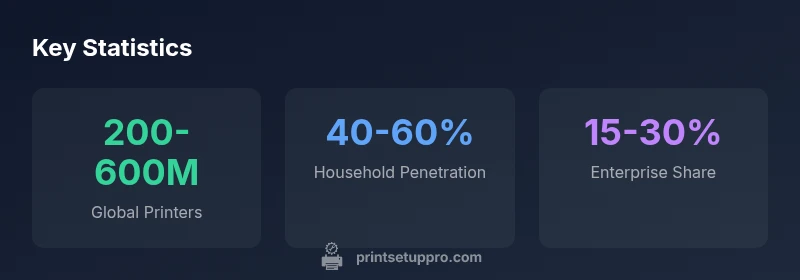
Estimates for how many printers exist worldwide vary, but reliable ranges place the total somewhere in the low hundreds of millions. By combining household ownership, small business fleets, and enterprise deployments, Print Setup Pro analysis shows global printer counts broadly between 200 million and 600 million devices in 2026. The exact number depends on definitions (printers vs. multifunction devices) and counting methodology.
how many printers are there
The question of how many printers exist globally is more nuanced than it seems. In everyday language, a 'printer' might mean a standalone device or a multifunction device with scanning/faxing. When planning a home office or small business, you should define the scope: active devices that are regularly used for printing, plus spares. Print Setup Pro’s approach in 2026 emphasizes counting active devices rather than counting every idle machine in storage. This distinction matters for budgeting, procurement cycles, and maintenance planning. For researchers and practitioners, the key variables are geography, ownership models, and device longevity. By using a clear definition, you can compare fleets across households, SMBs, and enterprises more effectively.
How counts are estimated: methodology and data sources
Estimating global printer numbers combines several data streams. Market research reports, vendor shipment data, and corporate IT inventories contribute to the overall picture, but gaps remain—especially in informal markets and regions with limited reporting. A major challenge is distinguishing between printers that are in daily operation and those retired or repurposed. Print Setup Pro’s 2026 framework uses conservative annualization, cross-referenced with household penetration data and corporate IT asset registries to derive a defensible range. The resulting estimates are inherently approximate, but they provide a useful baseline for planning and comparison.
Global landscape by segments: households, SMBs, enterprises
Households typically drive the largest absolute numbers, with multiple devices in affluent markets and fewer in developing regions. SMB fleets tend to be modest, often ranging from a handful to several dozen devices per organization, depending on industry and print volume. Enterprises may manage fleets hundreds or thousands strong, particularly in sectors with heavy document workflows. Across all segments, device lifespans, the rise of multifunction printers, and the shift toward managed print services influence fleet sizes more than any single factor. Understanding these dynamics helps home office users forecast replacements and maintenance contracts more accurately.
How counting affects budgeting and procurement
If you’re sizing a home office, think in terms of active devices and required durability rather than total units ever purchased. For SMBs, plan for growth, spares, and downtime. Enterprises should focus on fleet management policies, printer-driver compatibility, and procurement cycles tied to budget years. In every case, using a defensible range rather than a fixed number reduces the risk of under- or over-provisioning. Print Setup Pro recommends mapping current usage, projecting growth, and validating counts with asset inventories and supplier records.
Practical implications for home offices and DIY setups
For a typical home office, one reliable printer plus a spare can cover most needs, while students with shared devices may benefit from a second unit for color printing or mounting large projects. In DIY contexts, consider a hybrid approach: a compact color printer for assignments and a separate monochrome laser for documents. Regular maintenance tasks—cleaning, firmware updates, and cartridge management—keep a small fleet efficient. When expanding, document usage phases (semester peaks, project timelines) to optimize purchase timing and cartridge stock.
Common definitions in the industry: printers vs multifunction devices
Pilot studies and supplier catalogs often blur the line between printers and multifunction devices. A printer might be a standalone device, whereas a multifunction device includes scanning and sometimes faxing. For consistency, adopt a single definition across your assessment: active print devices that are used at least weekly, regardless of whether they are color or monochrome. This reduces confusion when comparing regional data, vendor reports, or enterprise asset registers. Print Setup Pro suggests labeling devices by primary function to simplify fleet management.
Regional differences in printer ownership
Ownership rates vary widely by region due to infrastructure, consumer behavior, and business practices. In high-income markets, multiple devices per household are common, accompanied by a significant SMB footprint and formal procurement processes. In lower-income regions, usage tends to be logistic and centralized, with shared printers in offices or schools. These dynamics influence regional counts and highlight the importance of localized data when projecting needs for a new workspace or campus.
Steps to estimate your own fleet for a new setup
- Define what counts as an active printer in your context (daily use, not idle spares).
- Inventory current devices, noting model, color capability, and location.
- Determine average lifespan and replacement cycle based on usage type (home, SMB, enterprise).
- Project growth for the next 12–36 months using scenario planning (conservative, moderate, aggressive).
- Validate counts with procurement records, supplier quotes, and IT asset management tools.
- Build a simple budget by device type and expected maintenance costs, including toner/ink and service contracts.
Global printer ecosystem overview
| Metric | Definition | Typical Global Range |
|---|---|---|
| Total printers worldwide | Global count of active printers including MF devices | 200,000,000 - 600,000,000 |
| Household penetration | Share of households with at least one printer | 40% - 60% |
| Enterprise fleet size | Devices per organization in enterprise fleets | 5 - 60+ |
People Also Ask
What is considered a printer in this context?
In this article, a printer is any active device used for printing on a regular basis, including multifunction devices. The key is activity and relevance to printing workflows, not whether the device is physically idle in storage.
We count only printers that are actively used, including multifunction devices, not idle spares.
Why do counts vary so much between sources?
Counts vary due to differing definitions, regional data quality, and whether retired devices are included. Methodology differences across studies lead to wide ranges.
Different methods and regions mean different numbers; look for definitions and timeframes.
How does a multifunction device affect counts?
Multifunction devices count as printers in many surveys but may be reported separately in others. Including them generally increases total counts and influences procurement planning.
Multifunction devices often boost overall counts and affect budgeting.
How should a home office estimate its own printer fleet?
Start with active devices, factor in peak usage times (semester projects, home offices), and plan for a spare unit. Use a monthly review to adjust expectations.
Count active devices and plan for a spare; update regularly.
Are there regional differences in printer ownership?
Yes. High-income regions often have higher per-household device counts and formal procurement, while lower-income areas rely on shared or centralized printers. Local data matters for planning.
Regional data matters; ownership patterns vary a lot.
How often do these counts get updated?
Estimates are typically refreshed annually or biannually by researchers and vendors. For decision-making, align updates with your budgeting cycle.
Update counts at least once a year for planning.
“There is no single worldwide tally for printers; counts depend on counting methodology and definitions. Still, the base is large and growing across households, small businesses, and enterprises in 2026 globally across regions.”
Quick Summary
- Define what counts as a printer before measuring fleets
- Expect a large, regionally varying global total
- Household and SMB shares dominate the count, with enterprises growing
- Use ranges, not fixed numbers, for planning
- Keep data current with ongoing fleet inventories