Help with Canon Printer: Setup and Troubleshooting Guide
A comprehensive, step-by-step guide to setting up and troubleshooting Canon printers, covering connectivity, drivers, print quality, firmware, and maintenance for home offices, students, and small businesses.


Looking for help with canon printer issues? This quick answer shows a practical, step-by-step plan to diagnose connectivity, driver, and print-quality problems. You’ll verify network status, install or update drivers, reset settings, and print a test page to confirm success. Gather your Canon printer, a computer, power, and a stable network connection.
Understanding Canon Printer Troubleshooting Landscape
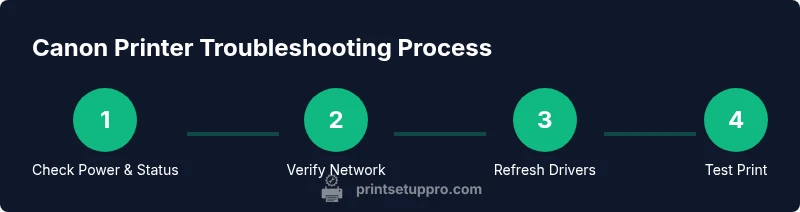
Canon printers are known for reliability, but real-world use reveals how software and hardware interactions can stall workflows. This section sets the scene for a structured approach to help with canon printer problems by focusing on three common fault domains: connectivity, defaults, and drivers. According to Print Setup Pro, the majority of Canon printer issues start with something as simple as a misconfigured network, an outdated driver, or a queued job stuck in the print spooler. Before you jump to advanced diagnostics, perform a quick diagnostic sweep: ensure the printer is powered on, observe status lights, and confirm the device chosen by your computer is the one you intend to use. If basic checks pass, you’re ready for the deeper steps, which reduce confusion and help you identify the actual bottleneck. This article walks you through a practical, step-by-step plan that guides you from initial checks to a confirmed test print, with notes on when to reset, update, or reconfigure settings. Using a systematic method will save time and minimize frustration, especially for home office users or students who rely on a dependable Canon printer for important documents. By documenting each action and test result, you build a clear history that makes it easier to escalate if a problem persists.
Quick Network and Connectivity Checks
Network problems are a common source of Canon printer headaches. Start by confirming the printer is connected to the right network and has a valid IP address. Print a network configuration page from the printer's control panel to verify the network status, DNS, and gateway. If you’re using Wi‑Fi, move the printer closer to the router to improve signal strength and reduce interference. On Windows or macOS, remove and re-add the printer in your system settings to refresh the port and connection. For USB-connected printers, ensure the cable is firmly seated and try a different USB port if the device isn’t detected. If the printer shows as offline, switch the printer off for 60 seconds, then back on to reestablish the connection. Print Setup Pro mentions that many offline printers are actually networked devices with temporary connectivity hiccups.
Driver Installation and Software Setup
Driver health is a frequent source of Canon printer problems. Start by visiting the official Canon support site and downloading the latest driver package for your model and operating system. Before installing, uninstall any old drivers to avoid conflicts and reboot the computer if prompted. Run the new driver installer with administrator privileges, following on-screen prompts to choose the correct printer model and port. After installation, set the new driver as the default and print a test page from the driver interface. If printing fails, check for conflicting software that intercepts print jobs, such as PDF creators or virtual printers, and temporarily disable them during testing. Keeping drivers up to date reduces incompatibilities with recent OS updates and improves overall reliability.
Common Print Quality Issues and Fixes
Print quality problems—such as blank pages, streaks, banding, or incorrect colors—often trace back to printer maintenance or media settings. Start with a nozzle check and a cleaning cycle in the printer’s maintenance menu. Use genuine Canon cartridges and ensure the ink or toner levels are sufficient. Align the print head if the nozzle checks reveal gaps, and adjust printer settings to match the paper type in use (plain paper vs. photo paper). Calibrate color settings if color output appears off, and verify the printer is using the correct paper size and orientation. If issues occur only with certain applications, set the application’s print preferences to the printer’s default settings and reprint. Routine cleaning and alignment improve longevity and reduce recurring issues.
Advanced Diagnostics: Firmware, Tray, and Media
When basic steps don’t fix the issue, advanced diagnostics can reveal deeper faults. Check for a firmware update on Canon’s support portal and apply it following the manufacturer’s instructions. Firmware updates often fix compatibility issues with newer operating systems and fix subtle bugs affecting jam sensing or color accuracy. Inspect the paper tray engagement, ensure the media type setting matches the loaded media, and verify there are no small scraps or torn sheets that could trigger sensors. Check for firmware and sensor error codes in the printer’s display or status page, then consult Canon’s troubleshooting notes for suggested actions. If a jam is suspected, power off, remove the tray, and carefully clear any obstructions with the printer off and unplugged.
Maintenance Plan to Prevent Recurrence
Prevention is easier than repair. Establish a simple maintenance routine: perform nozzle checks and cleanings monthly or after heavy use, update firmware quarterly, and check for driver updates whenever your OS receives a major update. Store spare genuine ink cartridges or toner, and keep extra paper on hand to avoid misfeeds. Create a quick-reference notebook with common error codes and their meanings so you can troubleshoot faster next time. Regular maintenance minimizes downtime and prolongs printer life, especially in busy home offices and student setups. Document outcomes after each maintenance cycle to track improvements.
When to Consider Service or Replacement
If repeated failures persist after comprehensive troubleshooting, it’s wise to evaluate service options or replacement. Analyze the cost of service versus device replacement, particularly for older models where parts are scarce. Check the printer’s warranty status and confirm coverage details for repairs. If basic diagnostics show persistent hardware faults or recurrent sensor errors, contacting Canon support or a qualified technician is advisable. In some cases, upgrading to a newer model with better energy efficiency and network compatibility may offer a better long-term return on investment for home offices and small businesses.
Tools & Materials
- Canon printer(Core device you are servicing)
- Power outlet(Ensure a stable power supply)
- Computer or mobile device(For driver installation and setup)
- USB cable (if not using network)(Use USB if not on Wi‑Fi)
- Ethernet/Wi‑Fi network(Used for network setup and testing)
- Paper and correct media(For test prints and calibration)
- Official Canon drivers (downloaded)(From Canon’s support site)
Steps
Estimated time: 45-75 minutes
- 1
Check power and status
Power on the printer and confirm no error lights are flashing. If a fault icon appears, refer to the manual to interpret the code. This step establishes a baseline before deeper diagnostics.
Tip: If you see a blinking light, note the pattern code for reference during support calls. - 2
Verify network connection
Ensure the printer is on the intended network and has a valid IP. Print a network configuration page from the control panel to verify settings. For Wi‑Fi, move closer to the router to improve stability.
Tip: A wired Ethernet connection is often more reliable for constant workloads. - 3
Update or reinstall drivers
Download the latest Canon driver for your model and OS from the official Canon site. Uninstall old drivers first, then install the new package and add the printer again. Set the new driver as default.
Tip: Restart the computer after installation to ensure the driver loads cleanly. - 4
Run maintenance checks
Perform nozzle checks, print head cleaning, and alignment from the printer’s maintenance menu. Use genuine ink and run test prints to verify improvements.
Tip: Do not interrupt a cleaning cycle; allow it to finish to avoid partial blockages. - 5
Test print after changes
Print a basic document and then a calibration page or photo sample to check color accuracy and alignment. Compare results to expected output and adjust settings if needed.
Tip: Keep a record of the test results for future reference. - 6
Check for firmware updates
If issues persist, check Canon’s support site for firmware updates for your model and apply them following the on-screen prompts.
Tip: Only install firmware from the official Canon site and ensure your model is supported by the update. - 7
Evaluate for service or replacement
If repeated failures occur after exhaustive steps, compare repair costs against a replacement that meets your budget and needs.
Tip: Verify warranty status before paying for service; consider upgrade if performance is consistently inadequate.
People Also Ask
What should I do if my Canon printer shows offline?
First verify the device is connected to the correct network and the printer is set as the default. Restart the printer and router if necessary, then re-add the printer to your computer. If it still reads offline, consult Canon support for model-specific guidance.
If your printer shows offline, check network connectivity and default printer settings, then restart devices and re-add the printer.
Why are pages coming out blank or with missing text?
Check nozzle integrity and run the cleaning cycle. Verify paper type settings and ensure ink levels are sufficient. Recalibrate the printer if colors are not aligning after cleaning.
Blank pages usually mean a clogged nozzle or incorrect paper settings; clean, calibrate, and re-test.
How do I install canon printer drivers on Windows or Mac?
Go to Canon’s official support site, select your printer model and OS, download the driver package, then run the installer with administrator rights. Restart after installation and print a test page.
Download the official driver for your OS, install it as admin, then test print.
Can I connect my Canon printer to Wi‑Fi on a Mac?
Yes. Use the printer’s wireless setup wizard or system preferences to add the printer on macOS. Ensure the Mac and printer are on the same network and that the correct driver is installed.
Yes—add the printer in System Preferences and ensure same network and proper driver.
When should I consider service or replacement?
If problems persist after all standard steps and the device is out of warranty, compare repair costs with buying a newer model that fits your needs. Warranty and support plans may cover some fixes.
If issues persist after troubleshooting and the device is aging, weigh repair versus replacement.
Watch Video
Quick Summary
- Diagnose with a methodical, step-by-step approach.
- Keep drivers and firmware up to date for reliability.
- Test prints after each change to confirm success.
- Schedule regular maintenance to prevent recurring issues.