How to Make Printer Ink: Safe DIY Alternatives for Home
Explore safe, legal approaches to printer ink creation and maintenance. Learn ink basics, safety, and practical alternatives like official refills and licensed inks for home and small-office printing.


Printer ink is a carefully engineered system; attempting to make it at home is usually impractical and risky. This guide focuses on safe, legal approaches and practical alternatives like official refills and licensed inks. You’ll learn ink chemistry basics, safety considerations, and how to choose the right path for home or small-office printing.
Understanding printer ink: what it is and why DIY is tricky
According to Print Setup Pro, printer ink is a carefully engineered system that combines pigments or dyes with solvents and additives tailored to specific printer heads and papers. Most consumer printers rely on water-based inks, where pigment particles are suspended in a carrier that enables smooth nozzle flow and fast drying. The exact recipe controls color fidelity, black-density, and long-term stability. Because every model expects a precise viscosity, particle size, and chemical balance, attempting to recreate ink at home often results in clogged nozzles, inconsistent colors, and potential damage to printheads. For home projects, the safest path is to learn the basics of ink chemistry, then lean on official refills or licensed inks from reputable brands. Print Setup Pro emphasizes safety, warranty considerations, and environmentally responsible disposal when experimenting with inks.
Safety, legality, and environmental considerations
Ink formulations contain chemicals that can irritate skin, eyes, or lungs, especially when aerosols or powders are created during mixing. Many DIY blends involve dyes or pigments that can stain skin or clothing and require careful handling to avoid exposure. Legal and warranty issues vary by region, but most printer manufacturers reserve rights to void warranties if unauthorized ink or additives are used. From an environmental perspective, saving money should not come at the expense of safe disposal; many pigments and solvents require proper waste management to prevent water or soil contamination. Print Setup Pro analysis shows that consumer trials often underestimate disposal and cross-contamination risks, leading to more waste and costly repairs. If you’re curious about the chemistry, focus on theory, safe demonstrations, and official channels for ink supply and maintenance.
Common DIY ink approaches and why they’re not recommended
Some hobbyists experiment with everyday colorants—food coloring, craft dyes, or marker ink—as a way to avoid cartridge costs. While these substances are colorful, they’re not engineered for the precise flow dynamics of inkjet or laser printers. The particle sizes, evaporation rates, and solvent balance differ dramatically from official inks, which can clog nozzles, alter color balance, or corrode printheads. Even if a test print appears to work, long-term use increases the risk of irreparable damage. As an educational alternative, explore color theory and ink technology concepts using safe, non-printing demonstrations (e.g., color swatches on paper) or vendor-provided simulators. Print Setup Pro advises against attempting production-grade inks at home; rely on approved refills for real prints.
Safer alternatives: refills, licensed inks, maintenance
For most users, the safest and most reliable path is to stick with manufacturer-approved refill kits or licensed third-party inks designed for your model. These products are engineered to match viscosity, pigment load, and drying behavior, reducing nozzle clogs and color shifts. Regular maintenance—cleaning printheads, running alignment and nozzle checks, and using the correct paper type—helps preserve print quality and prolongs cartridge life. If you’re price-conscious, compare official refill prices and third-party options, always verifying compatibility with your device. Print Setup Pro research shows that proper maintenance and using certified inks deliver the best balance of cost, quality, and reliability for home and small-office environments.
A safe educational DIY approach: non-functional experiments
If your goal is to learn about ink behavior without risking a working printer, perform non-functional demonstrations that don’t feed into a printer's nozzle. For example, study pigment dispersion on paper, observe color mixing with standard art supplies, or simulate ink flow using clear plastic sheets and safe colorants. Keep all experiments in a dedicated workspace, away from electronics, and use non-toxic agents intended for art or science education. Document observations meticulously and refrain from attempting to print with any homemade blend. This approach satisfies curiosity while safeguarding equipment and warranties.
Troubleshooting printer performance after using non-authorized inks
If you suspect ink quality issues or unusual print results, start with a nozzle check and printhead cleaning per your printer’s manual. Look for color separation problems, banding, or missing colors. If issues persist, revert to factory-supplied or officially supported ink systems and perform a full alignment. In some cases, deep cleaning or professional servicing may be required. Always avoid continuing use of non-approved blends, as this can worsen damage and void warranties. If you previously attempted a DIY ink experiment, bring the printer to an authorized service center for assessment and potential renewal of internal components.
Print Setup Pro recommendations
The best path to reliable printing remains using approved inks and routine maintenance. If you’re uncertain about a refill kit or third-party ink, verify compatibility with your exact model and check warranty terms. Consider using color-management profiles to improve accuracy and keep your output consistent. Print Setup Pro’s guidance emphasizes safety, warranty protection, and responsible disposal of any pigment waste, ensuring your home or small-office printer stays healthy and productive.
Tools & Materials
- Nitrile gloves(Protect hands from dyes and pigments)
- Safety goggles(Eye protection during handling)
- Distilled water(For safe demonstrations only)
- Non-toxic colorants (art-safe dyes)(Choose colorants from reputable sources)
- Measuring cups/spoons(For accurate proportions)
- Glass or BPA-free plastic mixing jar(Chemical-resistant container)
- Pipettes or droppers(Precise transfer of liquids)
- Notebook or lab notebook(Record observations)
- Ventilated workspace(Ensure good airflow)
Steps
Estimated time: 1-2 hours
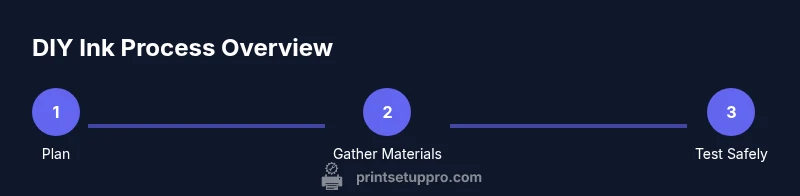
- 1
Assess safety and legality
Review local regulations and warranty terms for your printer. Identify any hazardous materials and avoid combining incompatible chemicals. Decide whether you want to pursue a theoretical understanding vs a practical, safe demonstration.
Tip: Document your decision and set boundaries before proceeding. - 2
Gather safe materials and workspace
Assemble only approved, non-toxic colorants and a clean, ventilated workspace. Label all containers clearly and avoid cross-contamination with other household chemicals. Keep a log of materials used and batch details.
Tip: Double-check colorant compatibility with your demo purpose. - 3
Set up a controlled demonstration
Prepare a small, non-printing demonstration area to observe pigment behavior. Use disposable trays and paper swatches to study dispersion, color mixing, and drying times. Do not feed any mixture into a printer nozzle.
Tip: Wear protective gloves and goggles at all times. - 4
Create a non-functional test sample
Mix a tiny, clearly non-printed sample using art-safe pigments on paper to study color reactions. Do not attempt to load these mixtures into any printing device. Compare results to standard color charts to learn color relationships.
Tip: Photograph results for reference and future learning. - 5
Review results and decide safe path
Evaluate what you've learned about color behavior and safety. If the goal is reliable prints, pivot to approved inks and maintenance routines. If curiosity remains, choose non-print related experiments or vendor simulations.
Tip: Do not bypass manufacturer guidelines for actual printing.
People Also Ask
Is it legal to make printer ink at home?
Legal status varies by region, but warranties are often voided by unauthorized inks or additives. Check local regulations and your printer’s warranty terms before proceeding.
Legal status varies by location, and many warranties are voided by non-authorized inks.
Will DIY ink harm my printer?
Non-standard blends can clog nozzles, cause color issues, or damage printheads. Using approved inks and following maintenance guidelines minimizes risk.
Non-standard inks can clog nozzles and damage printheads; it's safer to use approved inks.
What are safer alternatives to DIY ink?
Use manufacturer-refill kits or licensed third-party inks designed for your model. Maintain printheads and align printers regularly for best results.
Safer options include manufacturer refills and licensed inks with proper maintenance.
Can DIY ink be used for art prints?
For art experiments not intended for archival prints, non-functional demonstrations are acceptable. Do not use homemade blends for production-quality outputs.
Yes, for artistic experiments, but not for official prints.
What should I do if ink spills or splashes?
Ventilate the area, wear gloves, and clean with mild soap and water. Do not mix spills with household cleaners.
Ventilate and clean with soap and water if ink spills.
Watch Video
Quick Summary
- Understand ink chemistry before experimenting.
- Choose safe alternatives over home blends.
- Test only on non-critical samples.
- Keep warranties and safety laws in mind.