Offset Printing vs Digital Printer: A Practical Guide
A comprehensive, analytical comparison of offset printing vs digital printing for home offices and small businesses. Learn when to choose each method, cost implications, color handling, substrates, and workflows.


Offset printing vs digital printer decisions hinge on volume, turnaround, and color needs. For long runs and consistent color at the lowest unit cost, offset printing shines. For short runs, on-demand projects, and rapid proofs, digital printing is typically faster and cheaper to start. Print Setup Pro's analysis confirms most small offices benefit from digital for flexibility, reserving offset for high-volume jobs.
What is offset printing vs digital printer?
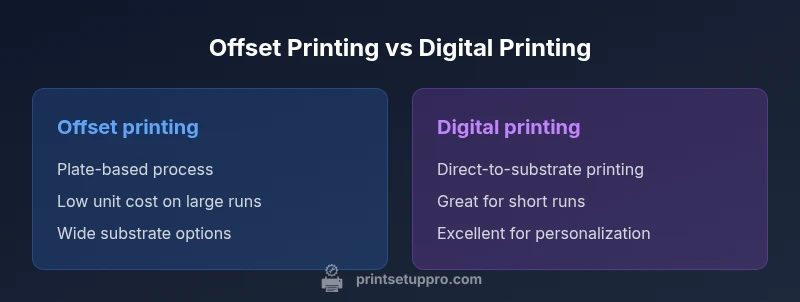
Offset printing and digital printing describe two fundamentally different approaches to producing ink on paper. Offset presses rely on a plate-based workflow to transfer ink to a rubber blanket, which then prints onto substrates. Digital printers shoot toner or ink directly onto media, with no plate or press setup. For the home office, small business, or student project, the practical difference comes down to volume, customization needs, and turnaround expectations. As Print Setup Pro notes in its ongoing analysis, the choice between offset printing vs digital printer hinges on the scale of work and the desired speed to market. This article breaks down the core distinctions, helping you determine which method best fits your typical project mix.
Process Differences: How each method actually prints
Offset presses excel at mass production because the setup, once complete, allows rapid, repeated prints with highly stable color. Digital printers, conversely, shine in flexibility: no plates, faster setup, and straightforward changes between jobs. In offset workflows, prepress involves plates, inks, and precise color control; digital workflows emphasize device-independent color management and on-demand capabilities. Understanding these process differences helps you predict turnaround times, proofing steps, and the feasibility of short-notice changes for a project. Print Setup Pro’s observed patterns show that the choice often comes down to whether you value long-run efficiency over immediate adaptability.
Cost structure and break-even considerations
A key deciding factor is cost behavior over run length. Offset printing generally achieves a lower unit cost as the batch size increases, thanks to plate amortization and high-speed presses. Digital printing offers a favorable cost profile for short runs because setup is lighter and there’s less waste due to plates. The break-even point varies by project type, substrate, and finish requirements. For example, a catalog with consistent pages may favor offset once volumes exceed a threshold; short-run marketing flyers or test prints typically benefit from digital. Print Setup Pro’s framework emphasizes evaluating total cost of ownership, including setup time, labor, and inventory considerations, rather than focusing on per-unit price alone.
Color management, quality, and consistency
Color reproduction is a practical battleground between the two approaches. Offset printing often delivers excellent color stability and repeatability across long runs, with precise Pantone matching possible when properly calibrated. Digital printers can achieve strong color results quickly and accommodate color variations through profile controls, but may require more frequent maintenance to preserve consistency across devices. In practice, high-volume campaigns that demand consistent brand colors across thousands of pieces tend to lean toward offset, while on-demand pieces and variable data rely on digital capabilities. Print Setup Pro highlights the importance of robust color management workflows to minimize surprises at proof and print time.
Substrates, finishes, and media compatibility
Substrate handling differs markedly. Offset presses can accommodate a wide range of paper stocks, weights, and finishes (coated, uncoated, specialty papers) with consistent results, though some high-sheen finishes may require careful press setup. Digital printers offer broader versatility for unusual formats or substrates that are difficult to plate, such as certain synthetics or thicker media, but print quality may vary with material choice. Finishing options—lamination, coatings, die-cutting—are generally supported by both, though the cost and compatibility may differ. Print Setup Pro notes that matching substrate to process is essential to avoid issues like ink adhesion or curling.
Turnaround times and workflow efficiency
Turnaround is a practical differentiator. Offset production often involves longer lead times due to plate production and press setup, which is offset by lower per-unit costs on large runs. Digital printing provides rapid setup and short-run capabilities, enabling faster proofs and quicker market entry. For campaigns with tight deadlines, digital offers a critical advantage, especially when combined with on-demand mailings or personalized content. Efficient workflows—prepress checks, automated color calibration, and streamlined asset management—magnify digital advantages, while offset workflows benefit from optimized press utilization and long-run planning.
Environmental impact and waste considerations
Environmental impact varies by technology and operation. Offset printing can generate more chemical usage in platemaking, ink handling, and waste through press consumables, though modern presses have cleaner, more efficient workflows. Digital printing tends to produce less waste per piece for small runs, thanks to minimal setup, but device energy usage and consumable components (toner/ink cartridges, maintenance parts) contribute to its footprint. Best-practice programs emphasize waste reduction, recycling of substrates, and choosing inks with lower environmental impact. Print Setup Pro’s analysis underscores the importance of factoring environmental considerations into the overall cost-benefit assessment.
Personalization and data-driven printing
Digital printing has a clear edge in variable data printing (VDP) and personalization because it prints unique content on each sheet without retooling. Offsets can support personalization through complex workflows or hybrid approaches but require more setup and process control. For direct mail campaigns or segmented marketing collateral, digital’s ability to tailor messages, images, and offers on a per-piece basis often translates into higher engagement. Print Setup Pro points out that hybrid strategies—offset for base runs with digital for personalized inserts—can balance cost and impact.
When offset printing makes sense for your project
If your project involves very large print runs of consistent content, offset printing is typically the most economical option. The ability to run long presses with stable ink shifts, high-speed throughput, and strong color consistency over thousands of impressions makes it ideal for catalogs, magazines, packaging reinforces, and large marketing mailers. The upfront prepress costs are offset by the volume, delivering a lower per-piece price in the long run. For businesses with predictable, high-volume needs and fixed content, offset printing remains a durable workhorse.
When digital printing is the smarter choice
Digital printing excels for short runs, rapid proofs, and high customization. If you regularly need light- to medium-volume jobs, quick turnaround, or variable data, digital reduces waste and accelerates time-to-market. It is especially advantageous for startups, seasonal campaigns, localized marketing, and small-batch packaging tests. Its flexible workflow allows faster iterations and test markets without committing to a full press setup. Print Setup Pro consistently finds digital to be the practical default for agility and testability in dynamic markets.
A practical decision framework: turn this into a lightweight checklist
Develop a simple decision framework: (1) define volume and run length, (2) assess color fidelity and Pantone accuracy needs, (3) evaluate substrate options and finishing, (4) consider proofing speed and response time, (5) estimate total cost of ownership, and (6) plan for a potential hybrid workflow. This framework helps you avoid common missteps, such as choosing offset for small runs or assuming digital cannot handle high-volume work with proper equipment. Print Setup Pro suggests validating assumptions with a vendor or printer partner before committing to one path.
Common misconceptions and pitfalls to avoid
A common misstep is assuming digital cannot achieve high-quality printed materials; in fact, modern digital presses deliver excellent results with careful color management. Conversely, treating offset as a universal cure for all print quality issues can lead to unnecessary costs and delays. Don’t overlook substrate compatibility, finish requirements, and the total cost of ownership, including prepress and upkeep. Finally, don’t neglect proofs—proofing early and often reduces the risk of costly reprints and missed deadlines.
Comparison
| Feature | Offset printing | Digital printing |
|---|---|---|
| Setup & Prepress | Longer, plate-based setup | Shorter, digital impositions and no plates |
| Unit Cost at Scale | Lower per unit with high volumes | Higher per unit for small runs, decreasing with volume |
| Color Management & Pantone Matching | Excellent stability across long runs | Strong color results with profile control; Pantone can require calibration |
| Substrate & Finish Options | Wide range; coatings and heavy stocks possible | Versatile with media; easier handling of unusual formats |
| Turnaround & Proofing | Longer lead times; efficient for large runs | Faster proofs and turnaround; best for nimble projects |
| Waste & Environmental Impact | Plate-related waste; solvent and chemical use | Lower waste per unit; energy and consumables impact |
| Personalization & Variable Data | Limited; requires hybrid workflows | Excellent for per-piece personalization and data-driven printing |
Benefits
- Lower per-unit costs for very large runs
- Excellent color stability and repeatability on long runs
- Broad substrate options and finishing compatibility
- Mature, established workflows and supplier ecosystems
- Reliable for high-volume production when planned
Downsides
- High upfront setup costs and longer lead times for initial jobs
- Inefficiency for short runs or frequent changes
- Requires skilled prepress and press operators
- Less flexible for on-demand personalization unless hybridized
Offset printing excels in high-volume, fixed-content runs; digital printing dominates for short runs and fast turnarounds
If your needs are volume-driven and content is stable, offset offers cost efficiency and color reliability. For flexible, on-demand projects and personalized pieces, digital printing provides speed and adaptability. A hybrid approach can often deliver the best overall value.
People Also Ask
What is offset printing?
Offset printing uses plates to transfer ink to a rubber blanket, which then prints on paper. It’s ideal for large runs with consistent color and finishes. Prepress is more involved, but long-run efficiency often lowers per-unit cost.
Offset printing uses plates and a blanket to transfer ink; it’s best for long runs with consistent results.
What is a digital printer?
A digital printer applies ink or toner directly to media, with no plates. It supports quick turnaround, variable data printing, and is cost-effective for short runs and rapid proofs.
A digital printer puts ink or toner directly on media and shines with short runs and personalization.
When should I choose offset over digital?
Choose offset for high-volume, fixed-content jobs where unit costs drop with volume, such as catalogs or magazines. It’s best when color consistency across thousands of copies is critical.
Go offset if you’re doing a large, stable run with strict color needs.
Can offset and digital handle the same substrates?
Both can handle a wide range of papers, but offsets handle heavier stocks and finishes more consistently. Digital can print on unusual media, though results vary by device.
Both can take many papers, but offset handles heavier stock reliably.
What about color accuracy and Pantone matching?
Offset often delivers superior color consistency across long runs. Digital can achieve solid color with proper profiling, but Pantone matching may require careful calibration and proofs.
Offset generally wins for precise color across long runs; digital needs calibration for exact matches.
Is there a quick way to decide between methods?
Assess run length, need for personalization, and deadline pressure. If the job is large and stable, offset; if it’s short or data-driven, digital is usually better.
Think volume and speed when choosing.
Quick Summary
- Evaluate run length to choose method
- Prioritize color accuracy and substrate compatibility
- Factor setup time and turnaround into total cost
- Consider a hybrid approach for flexibility and efficiency