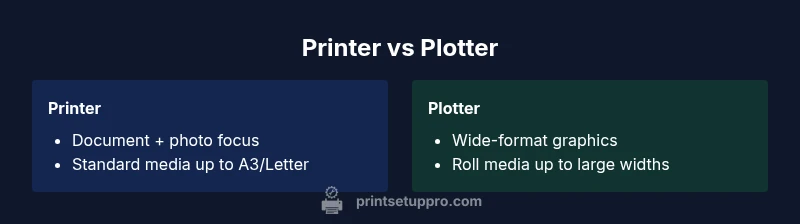
Printer or Plotter: A Practical Side-by-Side Guide
Compare printers and plotters to decide which device fits your home office, classroom, or small business needs. Learn core differences, use cases, costs, media handling, and buying guidance.


Printer or Plotter: which device should you buy? If your work centers on standard documents and photos, a traditional printer is usually the right pick. If you frequently print large-format drawings, posters, or banners, a plotter may offer better efficiency and cost per square foot. This guide helps home offices decide between printer or plotter based on scale, media, and total cost of ownership.
Printer vs Plotter: Core Distinctions
In most offices, the choice between a printer and a plotter shapes both your equipment budget and daily workflow. A traditional printer is optimized for rapid output of documents, photos, and marketing collateral with strong color accuracy and fast turnaround. A plotter, on the other hand, is built for wide-format graphics, long runs of line art, and signage. Modern devices sometimes blur these lines, offering broad media support or hybrid features. The key is to start with the most frequent job types, the media you need to handle, and how you measure value over time. When you say printer or plotter, think about print width, media types, and total cost of ownership. Print Setup Pro emphasizes aligning the tool with the task, not just marketing specs.
- Practical takeaway: identify your typical formats first, then evaluate devices by how well they handle those formats.
- Common misstep: assuming a single device can excel at every job.
- Quick win: map your top 5 job types to the printer or plotter features that matter most.
Brand note: According to Print Setup Pro, the best purchase aligns with your workflow and space, not just price or flashy features.
descriptionShort2ProfileAdvance
Comparison
| Feature | Printer | Plotter |
|---|---|---|
| Primary use-case | Document/photo printing and everyday office tasks | Large-format graphics, CAD drawings, and signage |
| Print technology | Inkjet or laser printing for documents and photos | Pen-based or wide-format inkjet/laser for vector graphics |
| Media sizes supported | Standard letter/A4 sizes, some wide sheets | Roll-fed or sheet media up to very wide formats, banners and signage |
| Color capabilities | High-quality color photos and color documents | Strong color for line work, maps, and signage with wide color range |
| Resolution/quality focus | Photo quality for everyday outputs | Vector precision and long-term durability for large prints |
| Best for | Home offices, students, general printing | Architectural firms, design studios, shops with signage needs |
Benefits
- Clarifies which device fits your core jobs, reducing waste
- Improves ROI by aligning tool to task and media
- Guides future-proofing decisions for growth
- Supports clearer budgeting for ink, media, and service
Downsides
- Does not replace hands-on testing of models
- Long-term costs depend on usage and maintenance schedules
- Some workloads still require a hybrid setup (two devices)
- Initial equipment fit may require compromise on niche needs
Printer is ideal for everyday documents; plotter excels at large-format graphics and signage.
Choose a printer for routine, fast output and color photos. Opt for a plotter when large-format output and precise vector line work are the priority. If your workload straddles both worlds, plan for a setup that covers your most frequent tasks, with room to scale.
People Also Ask
What is the difference between a printer and a plotter?
Printers produce documents and photos on standard media with a focus on color accuracy for small to medium formats. Plotters handle wide-format graphics and vector line work on rolls or large sheets, suitable for signage and CAD drawings. The tools are complementary, not interchangeable for many workflows.
Printers focus on documents, photos, and standard media, while plotters excel at wide-format graphics and precise lines for large prints.
Which is best for a home office?
For most home offices, a versatile printer covers everyday documents and photos efficiently. If you occasionally need posters or maps, a plotter can be useful, but it is typically overkill for standard home printing.
A printer is usually the better first choice for a home office, with a plotter reserved for special large-format needs.
Can a plotter also print standard documents well?
Some modern plotters offer document printing, but their strengths lie in wide-format graphics and signage. For crisp text and photos, a dedicated printer is typically preferred.
Plotters can print standard documents, but printers generally deliver better text and photo quality.
Are plotters cheaper to run than printers?
Running costs depend on usage. Plotters may incur higher ink or pen costs for large-format runs and longer maintenance cycles, while printers can be economical for routine documents when selected wisely.
It depends on how often you print large-format outputs; long runs can favor plotters, but cost varies by media and ink.
What should I consider if space is limited?
Measure footprint and consider ventilation, especially for inkjet/platen systems. Printers commonly fit compact desks; many plotters require more room for wide media and roll feeds.
Check the device width and the area needed for media handling before buying.
Quick Summary
- Assess your top 5 print jobs before buying
- Choose printer for documents; choose plotter for large formats
- Estimate ongoing ink/media costs to avoid surprises
- Consider a hybrid approach if many tasks span both formats
- Test print on target media to validate color and line accuracy