Printer Keeps Going Offline: Quick Troubleshooting Guide
Printer keeps going offline? This Print Setup Pro guide helps you quickly diagnose network, IP, and firmware issues and restore reliable printing on any device.


Most often, the printer keeps going offline due to a network or driver issue that makes the device appear disconnected. Start with quick checks: ensure power is on, verify the printer is connected to the correct network, and reboot the printer and router. If it persists, follow the diagnostic flow to pinpoint DHCP, IP conflicts, or outdated firmware.
Why a printer keeps going offline
According to Print Setup Pro, a printer that keeps going offline is almost always related to connectivity, driver, or firmware issues rather than a mysterious hardware fault. When a device cannot reach the network or the print queue, it will switch to an offline state to protect print jobs. Common culprits include misconfigured Wi‑Fi or Ethernet connections, IP address conflicts on small networks, stale printer firmware, or outdated driver software on your computer. Environmental factors—like crowded Wi‑Fi channels, new network equipment, or even a changed SSID—can also trigger intermittent offline behavior. By understanding these patterns, you can quickly narrow down the root cause and restore reliable printing without replacing hardware.
Throughout this guide you’ll see practical steps tailored for home offices, students, and small businesses. Print Setup Pro emphasizes methodical testing and minimal disruption, so you don’t waste time chasing phantom issues. The goal is to get your printer back online fast, with a durable setup that prevents future offline events. The keyword you’ll notice is printer keeps going offline, which signals the need for a consistent, repeatable troubleshooting process rather than ad hoc fixes.
Quick checks you can do in 5 minutes
Before diving into deeper diagnostics, perform a few fast checks to rule out obvious causes. First, confirm the printer’s power is on and the status light indicates normal operation. Next, verify the printer is connected to the correct network; if you have both 2.4GHz and 5GHz networks or multiple routers, the device may have joined the wrong one. A simple reboot of the printer and your router can clear stale connections and renew DHCP leases. Check the USB or Ethernet cable connections if you’re using a wired setup, and ensure the printer shows as online in the computer’s devices list. If you’re using USB, try a different port or cable. Finally, check whether the printer is configured to stay online on the device itself or if a power saving mode could be triggering offlining behavior.
If you’re seeing “printer keeps going offline” frequently, note when it happens (time of day, after a network change, or after a firmware update). This information becomes invaluable during deeper troubleshooting and helps you avoid repeating steps that don’t affect your setup.
Print Setup Pro recommends keeping a short log of changes you make during these quick checks. This log will help you identify any single action that resolves the issue across multiple work sessions, ensuring a faster resolution if the problem recurs.
Understand the diagnostic flow for offline printers
A systematic diagnostic flow helps you move from symptom to resolution without guesswork. Start by validating the symptom: does printing fail only from one computer or from all devices? If the issue is device-specific, focus on the driver, software, or local firewall settings. If the problem appears across devices, the fault is likely network-related or a printer’s internal state. Next, test the network path: can you ping the printer’s IP? Is the printer assigned a valid IP address, or is there an IP conflict with another device? If the IP is invalid or duplicates another device, you’ll need to adjust DHCP settings or assign a static IP with a reserved lease. Finally, consider firmware and driver health: outdated firmware can drop connections; outdated drivers can misreport offline status. Each step narrows the possibilities and reduces risk of changing unrelated settings.
Print Setup Pro also highlights the importance of consistent configurations: ensure your printer’s networking mode (Wi‑Fi or Ethernet) matches the path used by your workstations. A mismatch between the printer’s network and the computer’s network segment can manifest as intermittent offline states. Documenting network topology and printer settings helps you avoid repeating fixes in the future.
Step-by-step fix for the most common cause
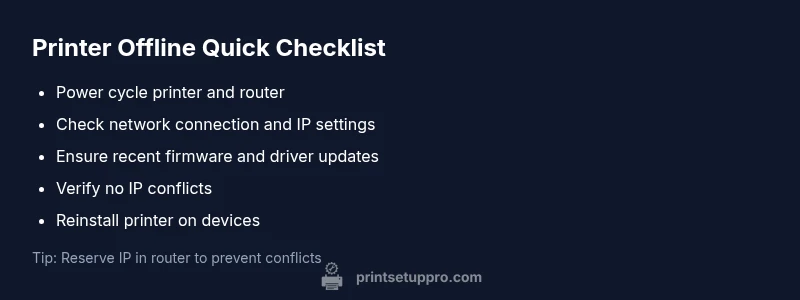
The most common cause of a printer appearing offline is a misconfigured network or an IP conflict. This section provides a concrete fix sequence you can perform in about 20–40 minutes. Start by power-cycling the printer, router, and computer to clear any stuck states. Then verify the network path by printing a configuration page from the printer to confirm it has a valid IP address and network gateway. If you notice an IP that clashes with another device, log into your router and reserve a unique IP for the printer (DHCP reservation) or assign a static IP outside the DHCP range. Check for firmware updates on the printer and drivers on your computer; install any available updates and reboot. Finally, re-add the printer to your devices, ensuring the correct port/protocol is selected (WSD/Bonjour for macOS, standard TCP/IP for Windows).
If the printer still reports offline after these steps, test with a different connection type (switch from Wi‑Fi to wired Ethernet or vice versa) to isolate the issue. Use a different computer to verify whether the problem is isolated to a single device or systemic across the network. When all else fails, consult the manufacturer’s support resources for a known issue or consider resetting the printer’s network settings to factory defaults as a last resort.
Safety tips and common mistakes
Safety matters matter when handling printers and network equipment. Always unplug power from the printer before disconnecting or reconnecting cables to avoid electrical shock or damage to USB ports. Do not restart the router and printer in quick succession if you notice overheating or unusual device behavior. Common mistakes include changing multiple settings at once, which makes it hard to identify the root cause, and assuming a problem is resolved after a single reboot without confirming stability over several print jobs. If the printer is part of a shared office network, inform others before applying changes to avoid interrupted print jobs. Finally, avoid firmware updates on critical production printers during peak hours; schedule updates during maintenance windows to prevent downtime.
Prevention and maintenance to stop offline issues
Preventing offline occurrences starts with a robust, repeatable setup. Reserve the printer’s IP address to prevent DHCP conflicts, and keep firmware and drivers up to date with a predictable update cadence. Document the printer’s network configuration and ensure that the wireless channel you rely on remains stable by minimizing interference (move the router, change channel, or reduce neighboring devices on the same frequency). Regularly check cables and ports for wear and secure connections to avoid intermittent disconnects. Create a simple maintenance routine that includes a quarterly firmware check, a monthly network health check, and a quick print test to verify the device remains online. If you deploy multiple printers, establish a standardized naming and configuration convention to streamline troubleshooting across devices.
Steps
Estimated time: 30-45 minutes
- 1
Power-cycle all devices
Turn off the printer, router, and computer. Unplug for 30 seconds to discharge residual power, then plug back in and allow devices to fully start. This clears temporary network state that can trigger offline status.
Tip: A clean power cycle often resolves stubborn offline states. - 2
Check physical connections
If using a wired connection, inspect Ethernet cables for damage and reseat them. For wireless setups, ensure the printer is connected to the intended network and displays a valid IP on its network config page.
Tip: Replace frayed cables and try another Ethernet port if available. - 3
Assess network type and range
Decide whether to use Wi‑Fi or Ethernet. If wireless, ensure signal strength is sufficient and consider temporarily moving the printer closer to the router to test stability.
Tip: Avoid congested channels by selecting a cleaner frequency band. - 4
Configure IP settings
Check if the printer has a dynamic IP or a conflicting static IP. Set a DHCP reservation or assign a unique static IP outside the router’s DHCP range, then reprint a test page.
Tip: Document the new IP for future troubleshooting. - 5
Update firmware and drivers
Check for and install available firmware on the printer and corresponding drivers on your computer. Reboot after updates and test print again.
Tip: Only perform updates from the manufacturer’s official site. - 6
Re-add printer on devices
Remove the printer from your devices list, then re-add using the new IP and correct protocol (TCP/IP). Test from multiple programs to ensure consistent online status.
Tip: If you use multiple OSes, repeat the process on each platform.
Diagnosis: Printer keeps going offline
Possible Causes
- highNetwork connectivity or DHCP lease issues
- mediumIP address conflict or DHCP reservation missing
- lowOutdated firmware or driver causing reporting drift
Fixes
- easyPower-cycle printer and router to refresh network state
- mediumVerify IP address is valid; set DHCP reservation or static IP
- easyUpdate printer firmware and PC/mac printer drivers
People Also Ask
Why does my printer show offline on Windows after a recent update?
Updates can change printer ports or disable services. Recheck the driver, reset the printer port, and re-add the device. If needed, rollback the update or reinstall the driver to restore online status.
Windows updates can alter printer settings. Reinstall the driver and re-add the printer to restore online status.
Is a USB connection more reliable than Wi‑Fi for avoiding offline status?
USB provides a direct, typically stable connection but isn’t practical for shared printing. For most home offices, wired Ethernet or a well-configured Wi‑Fi setup reduces offline occurrences better than USB alone.
USB is stable, but not always practical for multiple devices; wired or good Wi‑Fi generally reduces offline issues.
How do I set a static IP for a network printer?
Access the printer’s network settings or web interface and assign a fixed IP outside the DHCP range. Alternatively, create a DHCP reservation in your router so the printer always receives the same IP.
Set a fixed IP in the printer or reserve one in your router to keep the IP consistent.
What should I do if the printer reports offline but shows online in the device list?
This usually indicates a queue or driver issue. Remove and re-add the printer, verify the correct port, and ensure the driver matches the OS version.
If it shows offline but online in the device list, re-add the printer and verify the port and driver.
Can antivirus or firewall software cause a printer to appear offline?
Yes, some security software can block printer traffic. Temporarily disable protection for testing, or create an exception for the printer’s IP/port during troubleshooting.
Security software can block printer traffic; test with protection paused or add an exception for the printer.
How often should I update printer firmware?
Check for updates when you notice connectivity issues or when the manufacturer releases a stable firmware version. Do not update during critical printing tasks.
Check for updates when you notice issues or when a new stable firmware is released; avoid updating during important print jobs.
Watch Video
Quick Summary
- Follow a deliberate diagnostic flow, not guesses.
- Reserve or fix the printer’s IP to prevent conflicts.
- Keep firmware and drivers up to date for stability.
- Document printer settings to simplify future fixes.
- Power cycles are often the fastest first fix.