Supertank Printer vs Laser: A Clear Comparison Guide
A thorough, objective comparison of supertank ink-tank printers versus laser printers for home offices and small businesses. Explore cost of ownership, speed, color quality, and maintenance to decide which fits your printing needs.


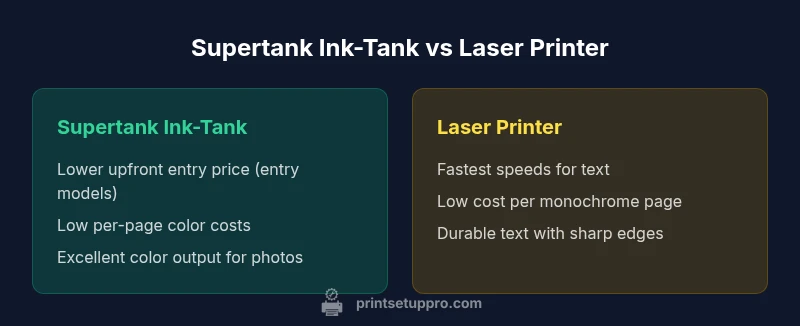
Supertank printer vs laser: The best pick depends on your typical workload. If you print lots of color photos or graphics, a supertank ink-tank model usually delivers lower running costs and richer color. If you mostly print text-heavy documents, a laser printer provides faster speeds and sharper text with strong long-term cost efficiency.
What defines a supertank printer
In the ongoing debate of the printer landscape, the term supertank printer is tied to ink-tank design. These models replace small cartridges with large, refillable ink tanks and bottles, enabling significantly higher ink capacity and lower per-page color costs. The distinction matters when you print frequently in color or run big printing projects. According to Print Setup Pro, the choice between a supertank printer vs laser hinges largely on color needs, volume, and total cost of ownership. This section explains how ink-tank systems work, where they shine, and where they may fall short for office workflows. Expect vibrant color output for photos and graphics, with the peace of mind that refills are typically inexpensive and straightforward.
What is a laser printer
Laser printers use dry toner and a fusing process to create images on paper. They are renowned for fast speeds, especially for text-heavy documents, and for consistently sharp black-and-white output. Color laser printers exist, but their per-page color costs and maintenance cycles can differ from ink-tank rivals. When weighing supertank printer vs laser, consider the balance between speed, precision of text, and total cost of ownership. Laser technology excels in high-velocity environments and standardized workflows, where multi-page reports and sharp typography matter most.
How ink-tank (supertank) systems work
Ink-tank printers rely on large, refillable reservoirs connected to print heads. The bottles used to refill these tanks are often more economical per milliliter than traditional cartridges, which reduces running costs for color-heavy jobs. In practice, maintenance centers on keeping tanks topped up and avoiding air gaps; clogging is less common when printers are used regularly. The durability of color output depends on pigment quality and print head design. For users who value color fidelity in photos and marketing materials, the supertank approach can be a practical, long-term investment.
How laser toner systems work
Laser printers deploy a photoconductor drum, toner powder, and a fuser to fuse toner onto paper. This process tends to yield very crisp text and high-speed output, especially for monochrome tasks. Color lasers can handle color documents, but the color gamut may be narrower than some inkjet options. From a total cost perspective, toners last longer than typical ink cartridges, and modern laser printers offer reliability and predictability for daily office use. When comparing to supe rtank printer vs laser, think about print volume and the need for fast monochrome output.
Key performance metrics to compare
When evaluating these two paradigms, focus on: color output quality vs text clarity, print speed for your typical documents, duty cycle (how many pages you print monthly), maintenance frequency, and energy consumption. Ink-tank systems often excel at color, posters, and photos, while lasers tend to win on speed and sharp text. Consider the media you print on (plain paper vs photo stock), your workspace constraints, and whether you print irregularly or regularly. A clear metric set helps avoid common misperceptions about “which is better.”
Cost of ownership: upfront and running costs
Initial price is only part of the equation. Supertank printers generally offer lower per-page color costs thanks to refillable ink tanks, while laser printers rely on toner cartridges that can last longer per unit but may incur higher upfront costs for color models. The true question is annual cost of printing for your typical workload. If you print many color pages, the long-run savings with ink tanks can be substantial; for heavy black-and-white text output, a reliable laser often proves more economical over time.
Print quality considerations: text, color, photos
Text sharpness is a strong suit for lasers, delivering crisp characters at high speeds. Color accuracy and photo realism can reach excellent levels with ink-tank systems, especially for images with gradients and vibrant hues. However, some laser printers deliver more durable text on plain paper, while inkjet prints may be sensitive to moisture unless coated or engineered for longevity. If your project requires precise typography or formal reports, weigh text quality against color fidelity to pick the best fit.
Speed and efficiency in real-world office use
In practical terms, laser printers typically outperform ink-tank devices on single-task scans of dense documents. For color-heavy, graphic-rich materials, ink-tank printers may show slower speeds but compensate with lower ongoing costs and better color reproduction. If your office runs back-to-back reports and standard forms, consider a laser; if your work emphasizes brochures, marketing color sheets, or student projects with vivid color, a supertank printer can be advantageous.
Practical setup tips for both types
- Position printers on a sturdy, vibration-free surface with proper ventilation.
- Use the recommended paper weight and finish to maximize output quality.
- Establish a consistent maintenance schedule: top up ink or check toner levels every few weeks; run a cleaning cycle if you notice color gaps.
- Keep replacement parts, maintenance kits, and paper stock within easy reach to avoid workflow interruptions.
- Calibrate color profiles for printers supporting ICC profiles to achieve predictable results for color-critical material.
Space, reliability, and maintenance planning
Space considerations matter: ink-tank printers are often bulkier due to reservoirs, while laser printers can be compact but may require more robust ventilation for high-speed drum operations. Reliability hinges on print volume and usage consistency; idle printers risk nozzle drying for inkjets, whereas laser printers require toner replacement and drum maintenance. Plan a maintenance budget and a spare device if your weekly output is mission-critical.
Use-case scenarios: best for home office, students, small business
For color-focused tasks like photo editing, marketing collateral, and creative projects, a supertank printer shines in cost per page and color range. Students may benefit from affordable color output for presentations and diagrams, plus the ability to print large color handouts. Small businesses with high-volume monochrome documents may prefer a laser printer for speed and straightforward reliability. The right choice is a function of your typical print mix and budget.
Final decision framework and a step-by-step selection guide
- List your typical print volume and color needs. 2) Estimate the proportion of color vs monochrome pages. 3) Compare upfront cost versus running costs per page. 4) Consider print speed requirements and space constraints. 5) Verify maintenance costs and availability of supply chains. 6) Run a pilot with a budget-friendly model if possible to verify color fidelity, text sharpness, and reliability.
Common myths debunked and pitfalls to avoid
- Myth: Ink-tank printers are always cheaper to run. Reality: It depends on color usage, model efficiency, and refill costs.
- Myth: Laser printers cannot print vivid photos. Reality: Color lasers exist, but color inks often deliver richer color for photos.
- Pitfall: Failing to account for maintenance and supply shipments when budgeting.
- Pitfall: Chasing the fastest speed without considering print quality and total cost of ownership.
Comparison
| Feature | Supertank Ink-Tank Printer | Laser Printer |
|---|---|---|
| Initial price | Lower upfront | Higher upfront |
| Color printing capability | Excellent color and photo quality | Good color support with crisp text |
| Print speed (text) | Moderate speed, good for color work | Fast for text-heavy documents |
| Cost per page | Low running costs for color pages | Typically lower cost per monochrome page |
| Maintenance frequency | Refill ink tanks regularly; occasional head cleaning | Toner cartridge replacements, drum maintenance |
| Best for | Color-heavy printing, photos, and graphics | Fast, business-grade text and forms |
Benefits
- Lower ongoing costs for color printing with ink-tank systems
- Excellent color reproduction for photos and graphics
- Refills are often inexpensive and straightforward
- Low-maintenance operation with large ink reservoirs
Downsides
- Slower speeds for color-heavy tasks compared with laser
- Color text can be less sharp than laser for dense documents
- Ink can dry out if printer sits idle too long
Laser is best for fast, sharp text; supertank shines for color-heavy workloads and lower running costs when color output is frequent.
Choose laser printers if your daily workload is text-dominant and speed matters. Opt for a supertank printer if color output and price per color page are your priorities, especially for photos and marketing materials.
People Also Ask
What is a supertank printer?
A supertank printer is an inkjet model that uses large refillable ink tanks instead of traditional cartridges. This design generally lowers running costs for color printing and makes color ink more affordable for frequent color work.
A supertank printer is an inkjet with big refillable ink tanks, which usually lowers color printing costs and is great for color-heavy jobs.
Is a laser printer faster than a supertank printer?
Yes, lasers commonly outperform ink-tank printers on text-heavy documents due to higher print speeds and crisper typography. Color laser printers exist, but color printing speeds and costs can vary by model.
Yes. Laser printers are typically faster for text and forms, with very sharp black-and-white output.
Which is cheaper to run for color printing?
For color-heavy printing, ink-tank systems often offer lower per-page color costs, especially when continuous color output is needed. However, the total cost depends on model efficiency, refill prices, and usage volume.
Color ink tanks usually cost less per page if you print a lot of color, but it depends on the model and usage.
Are ink-tank printers good for photos?
Yes, ink-tank printers can produce vibrant color photos with careful ink selection and color calibration. Some users may prefer dedicated photo printers for the highest fidelity, but many ink-tank models are capable for home photo printing.
Ink-tank printers are often great for photos, offering rich color, though elite photo printers might still edge them out in fine detail.
Can a supertank printer handle office-scale workloads?
Yes, for mixed office tasks involving color documents and occasional photo color output, a supertank printer can handle significant workloads, provided you manage ink refills and print volume.
They can handle office tasks if color output and volume are within typical ranges; plan for ink refills.
Do color lasers exist and are they cost-effective?
Color lasers exist and are reliable for business environments, but color inkjets often offer better color vibrancy and lower color-page running costs for high-volume color printing. Consider your color needs and print volume.
Color lasers exist and are reliable; for color-heavy work, inkjets may be more cost-effective depending on volume.
Quick Summary
- Define your print mix: color vs monochrome
- Assess total cost of ownership, not just upfront price
- Prioritize color fidelity for photos with ink-tank; prioritize speed and text sharpness with laser
- Account for maintenance and supply logistics in budgeting
- Test in real workflows before buying when possible